Thank you for visiting SNEWPapers!
Sign up free
Imperial Valley Press
El Centro, Imperial County, California
What is this article about?
Henry Armstrong, former triple boxing champion, retires after a loss to Ray Robinson due to blurred vision from scar tissue in his left eye, fearing blindness. Background covers his 1941 forced retirement by manager Eddie Mead after fights with Fritzie Zivic, Mead's death in 1942, and Armstrong's comeback earning $100,000.
Clipping
OCR Quality
Full Text
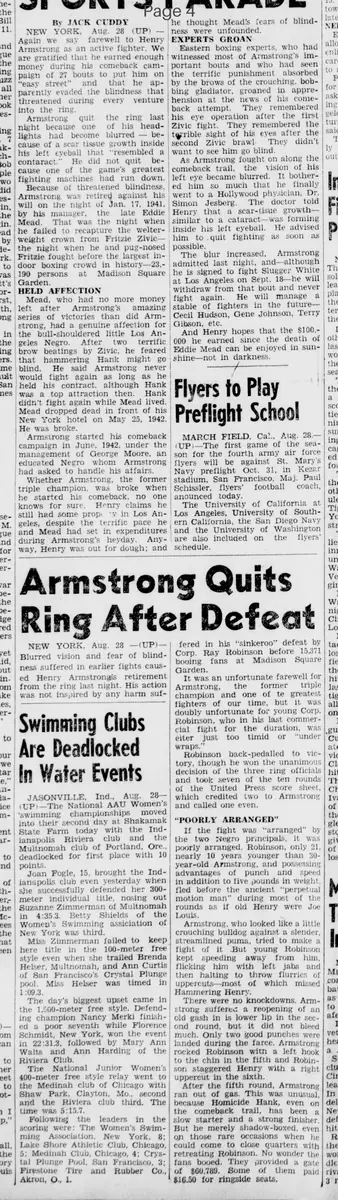
By JACK CUDDY
NEW YORK, Aug. 28 (UP) -
Again we say farewell to Henry Armstrong as an active fighter. We are gratified that he earned enough money during his comeback campaign of 27 bouts to put him on "easy street" and that he apparently evaded the blindness that threatened during every venture into the ring.
Armstrong quit the ring last night because one of his headlights had become blurred - because of a scar tissue growth inside his left eyeball that "resembled a cataract." He did not quit because one of the game's greatest fighting machines had run down. Because of threatened blindness.
Armstrong was retired against his will on the night of Jan. 17. 1941, by his manager, the late Eddie Mead. That was the night when he failed to recapture the welter-weight crown from Fritzie Zivic- the night when he and pug-nosed Fritzie fought before the largest indoor boxing crowd in history-23,190 persons at Madison Square Garden.
HELD AFFECTION
Mead. who had no more money left after; Armstrong's amazing series of victories than did Armstrong. had a genuine affection for the bull-shouldered little Los Angeles Negro.
After two terrific brow beatings by Zivic, he feared that hammering Hank might go blind.
He said Armstrong never would fight again as long as he held his contract. although Hank was a top attraction then. Hank didn't fight again while Mead lived. Mead dropped dead in front of his New York hotel on May 25, 1942. He was broke.
Armstrong started his comeback campaign in June. 1942. under the management of George Moore, an educated Negro whom Armstrong had asked to handle his affairs.
Whether Armstrong. the former triple champion. was broke when he started his comeback. no one knows for sure. Henry claims he still had some property in Los Angeles, despite the terrific pace he and Mead had set in expenditures during Armstrong's heyday. Anyway, Henry was out for dough; and he thought Mead's fears of blindness were unfounded.
EXPERTS GROAN
Eastern boxing experts. who had witnessed most of Armstrong's important bouts and who had seen the terrific punishment absorbed by the brows of the crouching, bobbing gladiator. groaned in apprehension at the news of his comeback attempt. They remembered his eye operation after the first Zivic fight. They remembered the terrible sight of his eyes after the second Zivic brawl. They didn't want to see him go blind.
As Armstrong fought on along the comeback trail, the vision of his left eye became blurred. It bothered him so much that he finally went to a Hollywood physician, Dr. Simon Jesberg. The doctor told Henry that a scar-tissue growth- similar to a cataract-was forming inside his left eyeball. He advised him to quit fighting as soon as possible.
The blur increased, Armstrong admitted last night, and-although he is signed to fight Slugger White at Los Angeles on Sept. 18he will withdraw from that bout and never fight again. He will manage a stable of fighters in the future- Cecil Hudson, Gene Johnson, Terry Gibson, etc.
And Henry hopes that the $100,000 he earned since the death of Eddie Mead can be enjoyed in sunshine-not in darkness.
Armstrong
Quits
Ring After Defeat
NEW YORK, Aug. 28 -(UP)-
Blurred vision and fear of blindness suffered in earlier fights caused Henry Armstrong's retirement from the ring last night. His action was not inspired by any harm suffered in his "sinkeroo" defeat by Corp. Ray Robinson before 15,371 booing fans at Madison Square Garden.
It was an unfortunate farewell for Armstrong, the former triple champion and one of the greatest fighters of our time, but it was doubly unfortunate for young Corp. Robinson. who in his last commercial fight for the duration, was either just too timid or "under wraps."
Robinson back-pedalled to victory, though he won the unanimous decision of the three ring officials and took seven of the ten rounds of the United Press score sheet, which credited two to Armstrong and called one even.
"POORLY ARRANGED"
If the fight was "arranged" by the two Negro principals, it was poorly arranged. Robinson, only 21. nearly 10 years younger than 30- year-old Armstrong, and possessing advantages of punch and speed in addition to five pounds in weight fled before the ancient "perpetual motion man" during most of the rounds as if old Henry were Joe Louis.
Armstrong. who looked like a little crouching bulldog against a slender. streamlined puma, tried to make a fight of it .But young Robinson kept speeding away from him, flicking him with left jabs and then halting to throw flurries of uppercuts-most of which missed Hammering Henry.
There were no knockdowns. Armstrong suffered a reopening of an old gash in his lower lip in the second round, but it did not bleed much. Only two good punches were landed during the farce. Armstrong rocked Robinson with a left hook to the chin in the fifth and Robinson staggered Henry with a right uppercut in the sixth.
After the fifth round, Armstrong ran out of gas. This was unusual, because Homicide Hank, even on the comeback trail, has been a slow starter and a strong finisher. But he merely shadow-boxed, even on those rare occasions when he could come to close quarters with retreating Robinson. No wonder the fans booed. They provided a gate of $60,789. Some of them paid $16.50 for ringside seats.
What sub-type of article is it?
What themes does it cover?
What keywords are associated?
What entities or persons were involved?
Where did it happen?
Story Details
Key Persons
Location
Madison Square Garden, New York; Los Angeles
Event Date
Aug. 28; Jan. 17, 1941; May 25, 1942; June 1942; Sept. 18
Story Details
Henry Armstrong retires from boxing due to blurred vision from scar tissue in his eye after a lackluster loss to Ray Robinson. Background includes his 1941 forced retirement by manager Eddie Mead fearing blindness after fights with Zivic, Mead's 1942 death, and Armstrong's comeback under George Moore, earning $100,000 before quitting on doctor's advice.