Thank you for visiting SNEWPapers!
Sign up free
National Gazette
Philadelphia, Philadelphia County, Pennsylvania
What is this article about?
Proceedings in the US House of Representatives on the Militia Bill, including debates and amendments restricting militia to white males, exemptions for poor militiamen, arm requirements, and criticisms of the bill's effectiveness.
Merged-components note: Continuation of the debate on the Militia Bill across pages 1 and 2.
Clippings
1 of 2
OCR Quality
Full Text
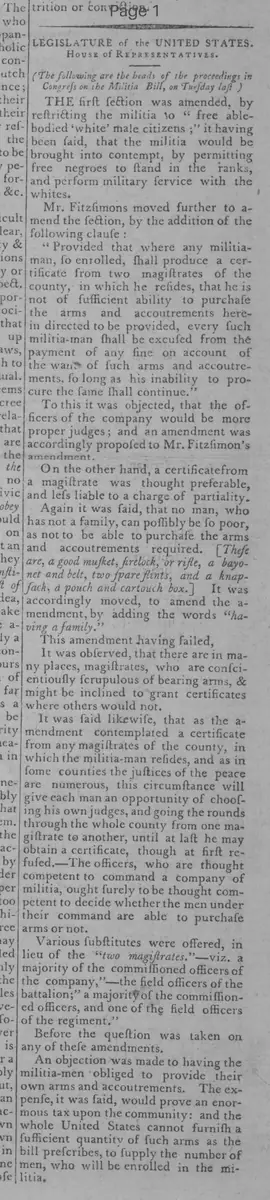
HOUSE OF REPRESENTATIVES.
(The following are the heads of the proceedings in Congress on the Militia Bill, on Tuesday last)
THE first section was amended, by restricting the militia to "free able-bodied 'white' male citizens;" it having been said, that the militia would be brought into contempt, by permitting free negroes to stand in the ranks, and perform military service with the whites.
Mr. Fitzsimons moved further to amend the section, by the addition of the following clause:
"Provided that where any militia-man, so enrolled, shall produce a certificate from two magistrates of the county, in which he resides, that he is not of sufficient ability to purchase the arms and accoutrements here-in directed to be provided, every such militia-man shall be excused from the payment of any fine on account of the want of such arms and accoutrements, so long as his inability to pro-cure the same shall continue."
To this it was objected, that the officers of the company would be more proper judges; and an amendment was accordingly proposed to Mr. Fitzsimons's amendment.
On the other hand, a certificate from a magistrate was thought preferable, and less liable to a charge of partiality.
Again it was said, that no man, who has not a family, can possibly be so poor, as not to be able to purchase the arms and accoutrements required. These are, a good musket, firelock, or rifle, a bayo-net and belt, two spare flints, and a knap-sack, a pouch and cartouch box.] It was accordingly moved, to amend the a-mendment, by adding the words "ha-ving a family."
This amendment having failed,
It was observed, that there are in ma-ny places, magistrates, who are conci-entiouly scrupulous of bearing arms, & might be inclined to grant certificates where others would not.
It was said likewise, that as the a-mendment contemplated a certificate from any magistrates of the county, in which the militia-man resides, and as in some counties the justices of the peace are numerous, this circumstance will give each man an opportunity of choof-ing his own judges, and going the rounds through the whole county from one ma-gistrate to another, until at last he may obtain a certificate, though at first re-fused. The officers, who are thought competent to command a company of militia, ought surely to be thought com-petent to decide whether the men under their command are able to purchase arms or not.
Various substitutes were offered, in lieu of the "two magistrates." viz. a majority of the commissioned officers of the company,"—the field officers of the battalion;" a majority of the commissioned officers, and one of the field officers of the regiment."
Before the question was taken on any of these amendments.
An objection was made to having the militia-men obliged to provide their own arms and accoutrements. The ex-pense, it was said, would prove an enor-mous tax upon the community: and the whole United States cannot furnish a sufficient quantity of such arms as the bill prescribes, to supply the number of men, who will be enrolled in the mi-litia.
A motion was now made, to strike out all that part of the section, which relates to the armament of the militia-men.
The expense of equipping themselves was looked upon as a kind of capitation or poll-tax—but a poll tax unequally laid, as it is to be borne by a certain description of men only, who, besides expending their money, will also contribute their personal services, for the common defence, whilst other descriptions of citizens will be exempt. Suppose 500,000 men to be enrolled in the militia, and the armament of each man to cost him only four dollars: here would, in the first instance, be a tax of two millions of dollars: Suppose again, each day, which is devoted to militia duty, to be valued at half a dollar, there being four days in every year allotted for that purpose, there would again be an annual tax of another million of dollars borne by less than one fifth part of the community, for the defence of the whole.
The question was taken on the motion for striking out, and passed in the negative.
The question being taken on the proviso, passed in the affirmative, with an amendment, making the field officers the judges of each man's ability to equip himself—and exempting him from fine or forfeiture for the want of arms, only so long as his inability to purchase them shall continue, or "until they can be procured for him."
A motion, made by Mr. Kitchell, to strike out the description of the bore of the fire-arms, gave rise to a short debate in which it was observed, that if the object in view was to have the arms uniform and all of the same caliber, that object would not be attained by the clause under consideration; as it still leaves a latitude, saying only "of a bore not smaller than —— balls to the pound."
—If it was meant to have the muskets all of the same bore, it would be difficult to procure them for a long time to come, and the expense would be enormous; it would be extravagance in the extreme to throw away as useless all the arms in the United States, and incur at once an expense of perhaps ten millions of dollars.
After further remarks on the inconveniences that must result from too strict an attention to uniformity of bore,
An honorable Gentleman arose, and expressed his disapprobation of the bill in general.—It had been said (he observed) that the only safe and substantial defence of the United States was a good militia:—when the new government was formed, a militia system had been broached:—A bill had been framed, and taken into consideration: but it was soon found, that nothing like the militia at first contemplated, could be obtained: section after section, the proposed militia law had been discussed, debated, altered, amended, till at length it was pared down to its present form: and it would be difficult to find such a milk and water thing, as it now is. If the United States are to have no better militia than what will be raised under this law, recourse must be had to what is called a standing army.'—A militia, armed with fowling pieces and squirrel guns, would never answer any good purpose: during the late war, this had been proved by experience, when more men of this description had been buried, than would, if properly armed, have been sufficient to have carried on the whole war.—
If the militia are to be no better armed, than is now proposed, it is best to say a short prayer over the bill, and let it die in peace.
To these remarks, an honorable gentleman replied, that many had perished during the late war for want of comfortable cloathing and other necessaries: but he had not heard of any dying for want of heavy muskets on their shoulders.—He wished to see a democratic militia, not an aristocratic one:—the militia to his mind, is a militia of freemen, possessed of their own arms, and capable of making good use of them.
The question being taken on striking out the description of the bore, and having passed in the negative,
It was proposed to fill the blank, for the number of balls to the pound, with 18, 20, 22, and 32.
After some remarks on the different sizes, &c. the blank was left to be filled up, after the rest of the bill is gone through.
A motion was then made to strike out the whole of the second section, which enumerates the different descriptions of persons, who are to be exempted from militia duty.
A short debate ensued, after which, without taking the question, the committee rose and reported progress.
The remainder of the proceedings of Congress, for the last week are unavoidably postponed till our next.
What sub-type of article is it?
What keywords are associated?
What entities or persons were involved?
Where did it happen?
Domestic News Details
Primary Location
United States
Event Date
Tuesday Last
Key Persons
Outcome
amendments restricting militia to white males passed; motion to exempt poor militiamen via field officers' judgment passed; motion to strike arm requirements failed; debate on firearm bore description continued without resolution; committee reported progress on exemptions section.
Event Details
Debate in the House of Representatives on the Militia Bill included amendments to restrict enrollment to free able-bodied white male citizens, provisions for excusing poor militiamen from arm purchases based on field officers' assessment, objections to self-armament costs, discussions on firearm uniformity, and general criticism of the bill's adequacy for national defense.