Thank you for visiting SNEWPapers!
Sign up free
The Watchman And Southron
Sumter, Sumter County, South Carolina
What is this article about?
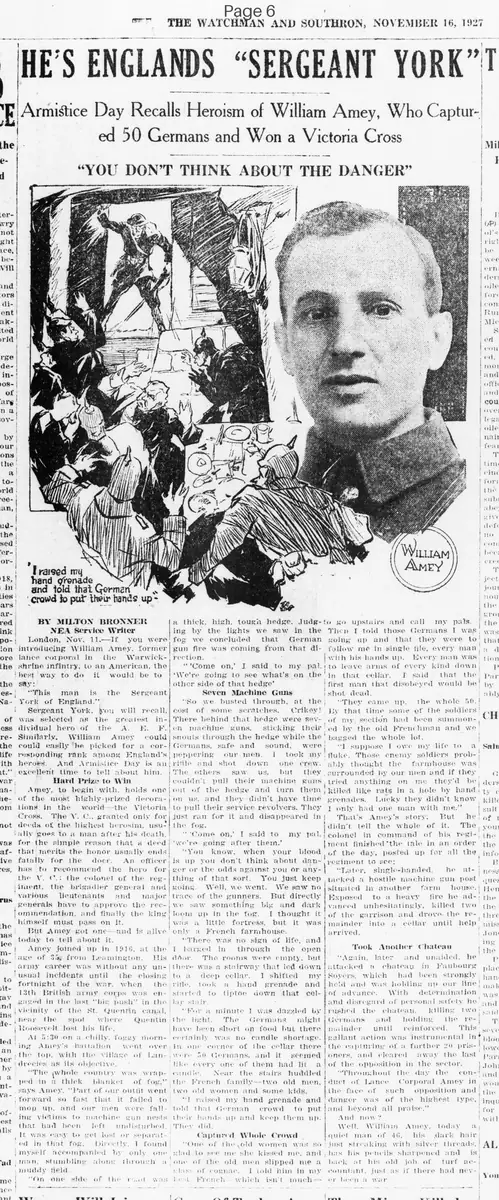
William Amey, a British lance corporal, earned the Victoria Cross for single-handedly capturing 50 German soldiers and neutralizing machine gun posts during the final push of World War I near St. Quentin Canal in 1918, hailed as England's Sergeant York.
Clipping
OCR Quality
Full Text
"SERGEANT
YORK"
Armistice Day Recalls Heroism of William Amey, Who Captured 50 Germans and Won a Victoria Cross
BY MILTON BRONNER
NEA Service Writer
London, Nov. 11.--If you were introducing William Amey, former lance corporal in the Warwickshire infantry, to an American, the best way to do it would be to say:
"This man is the Sergeant York of England."
Sergeant York, you will recall, was selected as the greatest individual hero of the A. E. F. Similarly, William Amey could easily be picked for a corresponding rank among England's heroes. And Armistice Day is an excellent time to tell about him.
Hard Prize to Win
Amey, to begin with, holds one of the most highly-prized decorations in the world--the Victoria Cross. The V. C., granted only for deeds of the highest heroism, usually goes to a man after his death, for the simple reason that a deed that merits the honor usually ends fatally for the doer. An officer has to recommend the hero for the V. C.; the colonel of the regiment, the brigadier general and various lieutenants and major generals have to approve the recommendation, and finally the king himself must pass on it.
But Amey got one--and is alive today to tell about it.
Amey joined up in 1916, at the age of 35, from Leamington. His army career was without any unusual incidents until the closing fortnight of the war, when the 13th British army corps was engaged in the last "big push" in the vicinity of the St. Quentin canal, near the spot where Quentin Roosevelt lost his life.
At 5:30 on a chilly, foggy morning Amey's battalion went over the top, with the village of Landrecies as its objective.
"The whole country was wrapped in a thick blanket of fog," says Amey. "Part of our outfit went forward so fast that it failed to mop up, and our men were falling victims to machine gun nests that had been left undisturbed. It was easy to get lost or separated in that fog. Directly, I found myself accompanied by only one man, stumbling along through a muddy field.
"On one side of the rut was a thick, high, tough hedge. Judging by the lights we saw in the fog we concluded that German gun fire was coming from that direction.
"'Come on,' I said to my pal, 'we're going to see what's on the other side of that hedge.'
Seven Machine Guns
"So we busted through, at the cost of some scratches. Crikey! There behind that hedge were seven machine guns, sticking their snouts through the hedge while the Germans, safe and sound, were peppering our men. I took my rifle and shot down one crew. The others saw us, but they couldn't pull their machine guns out of the hedge and turn them on us, and they didn't have time to pull their service revolvers. They just ran for it and disappeared in the fog.
"'Come on,' I said to my pal, 'we're going after them.'
"You know, when your blood is up you don't think about danger or the odds against you or anything of that sort. You just keep going. Well, we went. We saw no trace of the gunners. But directly we saw something big and dark loom up in the fog. I thought it was a little fortress, but it was only a French farmhouse.
"There was no sign of life, and I barged in through the open door. The rooms were empty, but there was a stairway that led down to a deep cellar. I shifted my rifle, took a hand grenade and started to tiptoe down that cellar stair.
For a minute I was dazzled by the light. The Germans might have been short on food but there certainly was no candle shortage. In one corner of the cellar there were 50 Germans, and it seemed like every one of them had lit a candle. Near the stairs huddled the French family--two old men, two old women and some kids.
I raised my hand grenade and told that German crowd to put their hands up and keep them up. They did.
Captured Whole Crowd
"One of the old women was so glad to see me she kissed me, and one of the old men slipped me a glass of cognac. I told him in my best French, which isn't much--to go upstairs and call my pals.
Then I told those Germans I was going up and that they were to follow me in single file, every man with his hands up. Every man was to leave arms of every kind down in that cellar. I said that the first man that disobeyed would be shot dead.
"They came up, the whole 50. By that time some of the soldiers of my section had been summoned by the old Frenchman and we bagged the whole lot.
"I suppose I owe my life to a fluke. Those enemy soldiers probably thought the farmhouse was surrounded by our men and if they tried anything on me they'd be killed like rats in a hole by hand grenades. Lucky they didn't know I only had one man with me."
That's Amey's story. But he didn't tell the whole of it. The colonel in command of his regiment finished the tale in an order of the day, posted up for all the regiment to see:
"Later, single-handed, he attacked a hostile machine gun post situated in another farm house. Exposed to a heavy fire he advanced unhesitatingly, killed two of the garrison and drove the remainder into a cellar until help arrived.
Took Another Chateau
"Again, later and unaided, he attacked a chateau in Faubourg Soyers, which had been strongly held and was holding up our line of advance. With determination and disregard of personal safety he rushed the chateau, killing two Germans and holding the remainder until reinforced. This gallant action was instrumental in the capturing of a further 50 prisoners, and cleared away the last of the opposition in the sector.
"Throughout the day the conduct of Lance Corporal Amey in the face of such opposition and danger was of the highest type, and beyond all praise."
And now?
Well, William Amey, today a quiet man of 46, his dark hair just streaking with silver threads, has his pencils sharpened and is back at his old job of turf accountant, just as if there had never been a war.
What sub-type of article is it?
What themes does it cover?
What keywords are associated?
What entities or persons were involved?
Where did it happen?
Story Details
Key Persons
Location
Vicinity Of The St. Quentin Canal, Near Landrecies And Faubourg Soyers
Event Date
Closing Fortnight Of The War, 1918
Story Details
During the final offensive of WWI, Lance Corporal William Amey, separated in fog, single-handedly neutralized seven German machine guns, captured 50 prisoners in a farmhouse cellar, and later attacked another machine gun post and a chateau, killing several Germans and enabling further captures, earning the Victoria Cross.