Thank you for visiting SNEWPapers!
Sign up free
Editorial
September 19, 1789
The Kentucky Gazette
Lexington, Fayette County, Kentucky
What is this article about?
Editorial in Pennsylvania Mercury by T.C.D. praises Congress's monetary divisions but critiques the 1786 dollar's silver fineness as inferior to commercial standards, proposes alternative 'fleece dollar' and coin designs symbolizing national themes, and discusses coinage costs and mint practices.
Clipping
OCR Quality
95%
Excellent
Full Text
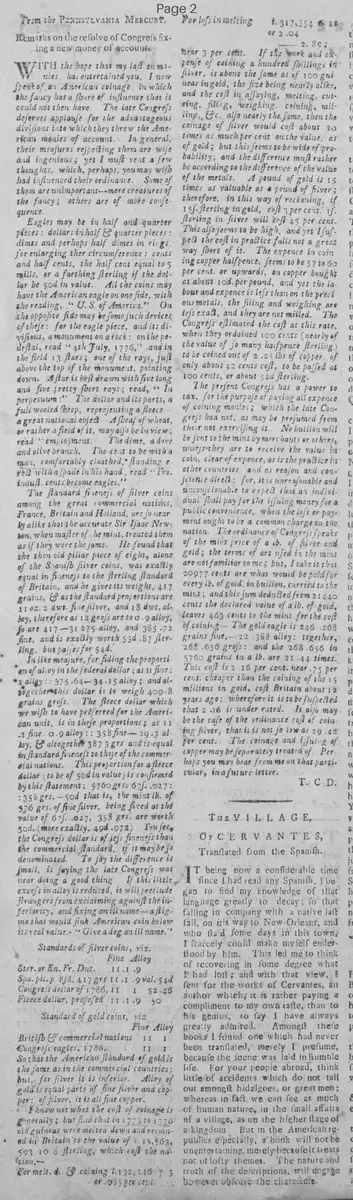
From the Pennsylvania Mercury.
Remarks on the resolve of Congress fixing a new money of account.
WITH the hope that my last animadversions has entertained you, I now speak of an American coinage, in which the fancy has a share of influence that it could not then have. The late Congress deserves applause for the advantageous divisions into which they threw the American monies of account. In general, their measures respecting them are wise and ingenious; yet I must vent a few thoughts, which, perhaps, you may wish had influenced their ordinance. Some of them are unimportant—mere creatures of the fancy; others are of more consequence.
Eagles may be in half and quarter pieces: dollars in half & quarter pieces: dimes and perhaps half dimes in rings, for enlarging their circumference: cents and half cents, the half cent equal to 5 mills, or a farthing sterling if the dollar be 5s in value. All the coins may have the American eagle on one side, with the reading, "U.S. of America." On the opposite side may be some such devices of these: for the eagle piece, and its divisions, a monument on a rock: on the pedestal, read "4th July, 1776," and in the field 13 stars; one of the rays, just above the top of the monument, pointing down. A star is best drawn with five long and five pretty short rays; read, "In perpetuum:" The dollar and its parts, a full wooled sheep, representing a fleece—a great national object—A sheaf of wheat, or rather a field of it, may also be in view; read "employment." The dime, a dove and olive branch. The cent to be with a man, comfortably clothed, standing erect with a spade in his hand, read "Industria. Cents become eagles."
The standard fineness of silver coins among the great commercial nations, France, Britain and Holland, are so near by alike that the accurate Sir Isaac Newton, when master of the mint, treated them as if they were the same. He found that the then old pillar piece of eight, alone of the Spanish silver coins, was exactly equal in fineness to the sterling standard of Britain, and he gives its weight, 417 grains, & as the standard proportions are 11 oz. 2 dwt. fine silver, and 18 dwt. alloy, therefore as 12 gross are to 1 alloy, so are 417-31 = 386 alloy, and 385.72 fine, and is exactly worth 5s 3d. 8 farthings sterling, but passes for 5s 4d.
In like measure, for finding the proportion of alloy in the federal dollar; as 11 fine: 1 alloy :: 375.64 - 34.15 alloy; and altogether this dollar is to weigh 409.8 grains gross. The fleece dollar which we wish to have preferred for the American unit, is in these proportions; as 11:1 fine, 0.9 alloy :: 358 fine—32.3 al. loy, & altogether 387.3 grs and is equal in standard fineness to those of the commercial nations. This proportion for a fleece dollar (to be 5s in value) is confirmed by this statement; 5760 grs. = £1.0s 2.7d: :: 358 grs. = 5s 0d that is, the mint lb. of 5760 grs. of fine silver, being fixed at the value of £1 0s 2.7d, 358 grs. are worth 5s. (more exactly, 4s 11.972) you see the Congress dollar is of less fineness than the commercial standard, if it may be so denominated. To say the difference is small, is saying the late Congress was near doing a good thing. If this little excess in alloy is reduced, it will preclude strangers from exclaiming against the inferiority, and fixing an ill name—a stigma that would sink American coin below its real value.—"Give a dog an ill name."
Standards of silver coins, viz.
Fine Alloy
Eng. or Eng. Fr. Dut.
11 1
Spa. pil. p 8/8, 417 grs 11 1 .9 val. 5s 4d
Congress dollar of 1786, 11 1 52.45
Fleece dollar, proposed 11 1 .9 5s 0d
Standard of gold coins, viz
Fine Alloy
British & commercial nations 11 1
Congress eagles, 1786,
11 1
So that the American standard of gold is the same as in the commercial countries: but, for silver it is inferior. Alloy of gold is equal parts of fine silver and copper: of silver, it is all fine copper.
I know not what the cost of coinage is generally; but find that in 1773 to 1776 old guineas were melted down and recoined in Britain to the value of £1,563,593 10s 8 sterling, which cost the nation,
For melt. d: : E coining £1,132,246 7
.or 7.2s per cent.
Part of its melting
1,317,354 5 33
or 2.04
2.89;
Bear 3 per cent. If the work and expense of coining a hundred shillings in silver, is about the same as of 100 guineas in gold, the size being nearly alike. and the cost in assaying, melting, cutting, filing, weighing, coining, milling, &c. also nearly the same, then the coinage of silver would cost about 20 times as much per cent on the value, as of gold; but this seems to be wide of probability; and the difference must rather be according to the difference of the value of the metals. A pound of gold is 15 times as valuable as a pound of silver; therefore, in this way of reckoning, if 15s. sterling in gold, cost 3 per cent. 15s. sterling in silver will cost 4s per cent. This also seems to be high, and yet I suspect the cost in practice falls not a great way short of it. The expense in coining copper halfpence, seems to be 57 to 60 per cent. or upwards, on copper bought at about 10d. per pound, and yet the labour and expense is less than on the precious metals, the filing and weighing are less exact, and they are not milled. The Congress estimated the cost at this rate, when they ordained 100 cents (nearly of the value of so many halfpence sterling) to be coined out of 2.25 lbs of copper, of only about 42 cents cost, to be passed at 100 cents, or about 5s 2d sterling.
The present Congress has a power to tax, for the purpose of paying all expense of coining monies; which the late Congress had not, as may be presumed from their not exercising it. No bullion will be sent to the mint by merchants or others, unless they are to receive the value in coin, clear of expense, as is the practice in other countries and as reason and conscience direct: for, it is unreasonable and unconscionable to expect that an individual shall pay for the issuing money for a public convenience, when the loss or payment ought to be a common charge on the nation. The ordinance of Congress speaks of the mint price of a lb. of silver and gold; the terms of art used in the mint are not familiar to me; but, I take it that 2077 cents are what would be paid for every lb. of gold. in bullion, carried to the mint; and this sum deducted from 21440 cents the declared value of a lb. of gold, leaves 463 cents to the mint for the cost of coining— The gold eagle is 246.268 grains fine,—22.383 alloy: together, 268.656 gross: and the 268.656 in 5760 grains in a lb. are 21.44 times. This cost is 2.16 per cent. near .75 per cent. cheaper than the coining of the 15 millions in gold, cost Britain about 12 years ago: wherefore it is to be suspected that 2.16 is under rated. It also may be the case of the ordinance cost of coining silver, that it is not so low as 2.9.42 per cent. The coinage and issuing of copper may be separately treated of. Perhaps you may hear from me on that particular, in a future letter.
T. C. D.
Remarks on the resolve of Congress fixing a new money of account.
WITH the hope that my last animadversions has entertained you, I now speak of an American coinage, in which the fancy has a share of influence that it could not then have. The late Congress deserves applause for the advantageous divisions into which they threw the American monies of account. In general, their measures respecting them are wise and ingenious; yet I must vent a few thoughts, which, perhaps, you may wish had influenced their ordinance. Some of them are unimportant—mere creatures of the fancy; others are of more consequence.
Eagles may be in half and quarter pieces: dollars in half & quarter pieces: dimes and perhaps half dimes in rings, for enlarging their circumference: cents and half cents, the half cent equal to 5 mills, or a farthing sterling if the dollar be 5s in value. All the coins may have the American eagle on one side, with the reading, "U.S. of America." On the opposite side may be some such devices of these: for the eagle piece, and its divisions, a monument on a rock: on the pedestal, read "4th July, 1776," and in the field 13 stars; one of the rays, just above the top of the monument, pointing down. A star is best drawn with five long and five pretty short rays; read, "In perpetuum:" The dollar and its parts, a full wooled sheep, representing a fleece—a great national object—A sheaf of wheat, or rather a field of it, may also be in view; read "employment." The dime, a dove and olive branch. The cent to be with a man, comfortably clothed, standing erect with a spade in his hand, read "Industria. Cents become eagles."
The standard fineness of silver coins among the great commercial nations, France, Britain and Holland, are so near by alike that the accurate Sir Isaac Newton, when master of the mint, treated them as if they were the same. He found that the then old pillar piece of eight, alone of the Spanish silver coins, was exactly equal in fineness to the sterling standard of Britain, and he gives its weight, 417 grains, & as the standard proportions are 11 oz. 2 dwt. fine silver, and 18 dwt. alloy, therefore as 12 gross are to 1 alloy, so are 417-31 = 386 alloy, and 385.72 fine, and is exactly worth 5s 3d. 8 farthings sterling, but passes for 5s 4d.
In like measure, for finding the proportion of alloy in the federal dollar; as 11 fine: 1 alloy :: 375.64 - 34.15 alloy; and altogether this dollar is to weigh 409.8 grains gross. The fleece dollar which we wish to have preferred for the American unit, is in these proportions; as 11:1 fine, 0.9 alloy :: 358 fine—32.3 al. loy, & altogether 387.3 grs and is equal in standard fineness to those of the commercial nations. This proportion for a fleece dollar (to be 5s in value) is confirmed by this statement; 5760 grs. = £1.0s 2.7d: :: 358 grs. = 5s 0d that is, the mint lb. of 5760 grs. of fine silver, being fixed at the value of £1 0s 2.7d, 358 grs. are worth 5s. (more exactly, 4s 11.972) you see the Congress dollar is of less fineness than the commercial standard, if it may be so denominated. To say the difference is small, is saying the late Congress was near doing a good thing. If this little excess in alloy is reduced, it will preclude strangers from exclaiming against the inferiority, and fixing an ill name—a stigma that would sink American coin below its real value.—"Give a dog an ill name."
Standards of silver coins, viz.
Fine Alloy
Eng. or Eng. Fr. Dut.
11 1
Spa. pil. p 8/8, 417 grs 11 1 .9 val. 5s 4d
Congress dollar of 1786, 11 1 52.45
Fleece dollar, proposed 11 1 .9 5s 0d
Standard of gold coins, viz
Fine Alloy
British & commercial nations 11 1
Congress eagles, 1786,
11 1
So that the American standard of gold is the same as in the commercial countries: but, for silver it is inferior. Alloy of gold is equal parts of fine silver and copper: of silver, it is all fine copper.
I know not what the cost of coinage is generally; but find that in 1773 to 1776 old guineas were melted down and recoined in Britain to the value of £1,563,593 10s 8 sterling, which cost the nation,
For melt. d: : E coining £1,132,246 7
.or 7.2s per cent.
Part of its melting
1,317,354 5 33
or 2.04
2.89;
Bear 3 per cent. If the work and expense of coining a hundred shillings in silver, is about the same as of 100 guineas in gold, the size being nearly alike. and the cost in assaying, melting, cutting, filing, weighing, coining, milling, &c. also nearly the same, then the coinage of silver would cost about 20 times as much per cent on the value, as of gold; but this seems to be wide of probability; and the difference must rather be according to the difference of the value of the metals. A pound of gold is 15 times as valuable as a pound of silver; therefore, in this way of reckoning, if 15s. sterling in gold, cost 3 per cent. 15s. sterling in silver will cost 4s per cent. This also seems to be high, and yet I suspect the cost in practice falls not a great way short of it. The expense in coining copper halfpence, seems to be 57 to 60 per cent. or upwards, on copper bought at about 10d. per pound, and yet the labour and expense is less than on the precious metals, the filing and weighing are less exact, and they are not milled. The Congress estimated the cost at this rate, when they ordained 100 cents (nearly of the value of so many halfpence sterling) to be coined out of 2.25 lbs of copper, of only about 42 cents cost, to be passed at 100 cents, or about 5s 2d sterling.
The present Congress has a power to tax, for the purpose of paying all expense of coining monies; which the late Congress had not, as may be presumed from their not exercising it. No bullion will be sent to the mint by merchants or others, unless they are to receive the value in coin, clear of expense, as is the practice in other countries and as reason and conscience direct: for, it is unreasonable and unconscionable to expect that an individual shall pay for the issuing money for a public convenience, when the loss or payment ought to be a common charge on the nation. The ordinance of Congress speaks of the mint price of a lb. of silver and gold; the terms of art used in the mint are not familiar to me; but, I take it that 2077 cents are what would be paid for every lb. of gold. in bullion, carried to the mint; and this sum deducted from 21440 cents the declared value of a lb. of gold, leaves 463 cents to the mint for the cost of coining— The gold eagle is 246.268 grains fine,—22.383 alloy: together, 268.656 gross: and the 268.656 in 5760 grains in a lb. are 21.44 times. This cost is 2.16 per cent. near .75 per cent. cheaper than the coining of the 15 millions in gold, cost Britain about 12 years ago: wherefore it is to be suspected that 2.16 is under rated. It also may be the case of the ordinance cost of coining silver, that it is not so low as 2.9.42 per cent. The coinage and issuing of copper may be separately treated of. Perhaps you may hear from me on that particular, in a future letter.
T. C. D.
What sub-type of article is it?
Economic Policy
What keywords are associated?
American Coinage
Congress Ordinance
Silver Fineness
Coin Designs
Mint Costs
What entities or persons were involved?
Congress
Sir Isaac Newton
Editorial Details
Primary Topic
Proposals For American Coinage Standards And Designs
Stance / Tone
Constructive Criticism Of Congress's Monetary Ordinance
Key Figures
Congress
Sir Isaac Newton
Key Arguments
Congress's Divisions Of Monies Are Wise But Silver Fineness Is Inferior
Propose 'Fleece Dollar' Matching Commercial Standards
Suggest Symbolic Coin Designs Like Eagle, Monument, Sheep, Dove
Discuss Coinage Costs And Need For Public Funding