Thank you for visiting SNEWPapers!
Sign up free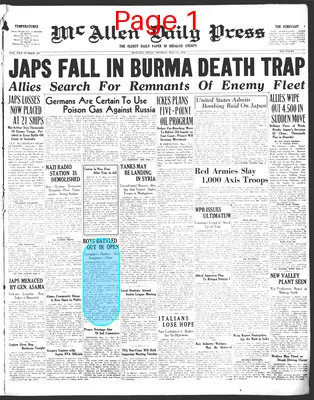
Mcallen Daily Press
Mcallen, Hidalgo County, Texas
What is this article about?
Lieut. Col. Walter J. Clear revealed that Corregidor's defenders fought Japanese in exposed positions, not underground shelters, with guns in the open. The USS Trout delivered ammunition through a blockade in February.
Clipping
OCR Quality
Full Text
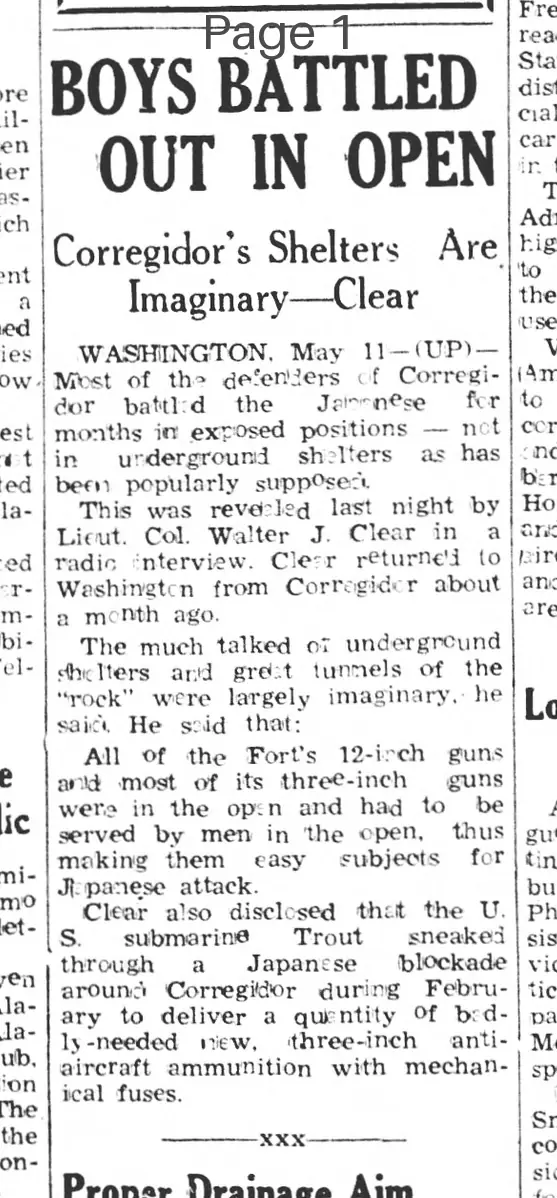
Corregidor's Shelters Are Imaginary—Clear
WASHINGTON, May 11-(UP)—Most of the defenders of Corregidor battled the Japanese for months in exposed positions—not in underground shelters as has been popularly supposed.
This was revealed last night by Lieut. Col. Walter J. Clear in a radio interview. Clear returned to Washington from Corregidor about a month ago.
The much talked of underground shelters and great tunnels of the "rock" were largely imaginary, he said. He said that:
All of the Fort's 12-inch guns and most of its three-inch anti-aircraft guns were in the open and had to be served by men in the open, thus making them easy subjects for Japanese attack.
Clear also disclosed that the U. S. submarine Trout sneaked through a Japanese blockade around Corregidor during February to deliver a quantity of badly-needed 3-inch anti-aircraft ammunition with mechanical fuses.
xxx
What sub-type of article is it?
What keywords are associated?
What entities or persons were involved?
Where did it happen?
Foreign News Details
Primary Location
Corregidor
Event Date
During February
Key Persons
Outcome
underground shelters largely imaginary; guns exposed to attack; submarine delivered ammunition through blockade
Event Details
Defenders battled Japanese in exposed positions for months, not in supposed underground shelters. Fort's 12-inch guns and most 3-inch anti-aircraft guns were in the open, served by men exposed to attack. USS Trout submarine delivered needed 3-inch anti-aircraft ammunition with mechanical fuses through Japanese blockade around Corregidor in February.