Thank you for visiting SNEWPapers!
Sign up free
The Independent
Oskaloosa, Jefferson County, Kansas
What is this article about?
In 1862, a Kentucky Unionist, surrounded by secessionists, secretly aided Union Generals Nelson and Rosecrans by posing as a spy for Confederate General Bragg, providing false intelligence to the rebels and accurate details to the Union, aiding the advance to the Battle of Stones River.
Clipping
OCR Quality
Full Text
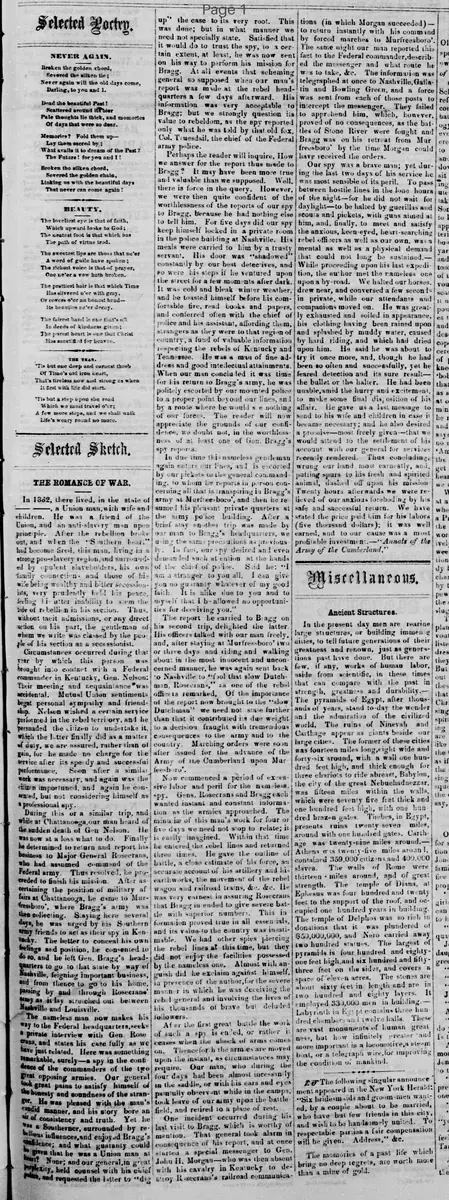
THE ROMANCE OF WAR.
In 1862, there lived, in the state of Kentucky, a Union man, with wife and children. He was a friend of the Union, and an anti-slavery man upon principle. After the rebellion broke out, and when the "Southern heart" had become fired, this man, living in a strong pro-slavery region, and surrounded by opulent slaveholders, his own family connections and those of his wife being wealthy and bitter secessionists, very prudently held his peace, feeling the utter inability to stem the tide of rebellion in his section. Thus, without tacit admissions, or any direct action on his part, the gentleman of whom we write was classed by the people of his section as a secessionist.
Circumstances occurred during that year by which this person was brought into contact with a Federal commander in Kentucky. Gen. Nelson. Their meeting and acquaintance was accidental. Mutual Union sentiments begat personal sympathy and friendship. Nelson wished a certain service performed in the rebel territory, and he persuaded the citizen to undertake it, which the latter finally did as a matter of duty, we are assured, rather than of gain, for he made no charge for the service after its speedy and successful performance.
Soon after a similar work was necessary, and again was the citizen importuned, and again he consented, but not considering himself as a professional spy.
During this or a similar trip, and while at Chattanooga, our man heard of the sudden death of Gen. Nelson. He was now at a loss what to do. Finally he determined to return and report his business to Major-General Rosecrans, who had assumed command of the Federal army. Thus resolved, he proceeded to finish his mission. After ascertaining the position of military affairs at Chattanooga, he came to Murfreesboro', where Bragg's army was then collecting. Staying here several days, he was urged by his Southern army friends to act as their spy in Kentucky. The better to conceal his own feelings and position, he consented to do so, and left Gen. Bragg's headquarters to go to that state by way of Nashville, feigning important business, and from thence to go to his home, passing by and through Rosecrans' army as it lay stretched out between Nashville and Louisville.
The nameless man now makes his way to the Federal headquarters, seeks a private interview with Gen. Rosecrans, and states his case fully as we have just related. Here was something remarkable, surely—a spy in the confidence of the commanders of the two great opposing armies.
Our general took great pains to satisfy himself of the honesty and soundness of the stranger. He was pleased with the man's candid manner, and his story bore an air of consistency and truth. He was a Southerner, surrounded by rebellious influences, and enjoyed Bragg's confidence; and what guaranty could be given that he was a Union man at heart! None; and our general, in great perplexity, held counsel with his chief of police, and requested the latter to "dig up" the case to its very root. This was done; but in what manner we need not specially state. Satisfied that it would do to trust the spy, to a certain extent, at least, he was now sent on his way to perform his mission for Bragg. At all events that scheming general so supposed when our man's report was made at the rebel headquarters a few days afterward. His information was very acceptable to Bragg; but we strongly question its value to rebeldom, as the spy reported only what he was told by that old fox, Col. Truesdail, the chief of the Federal army police.
Perhaps the reader will inquire, How do we answer for the report thus made to Bragg? It may have been more true and valuable than we supposed. Well, there is force in the query. However, we were then quite confident of the worthlessness of the reports of our spy to Bragg, because he had nothing else to tell him. For five days did our spy keep himself locked in a private room in the police building at Nashville. His meals were carried to him by a trusty servant. His door was "shadowed" constantly by our best detectives, and so were his steps if he ventured upon the street for a few moments after dark. It was cold and bleak winter weather, and he toasted himself before his comfortable fire, read books and papers, and conferred often with the chief of police and his assistant, affording them, strangers as they were to that region of country, a fund of valuable information respecting the rebels of Kentucky and Tennessee. He was a man of fine address and good intellectual attainments.
When our man concluded it was time for his return to Bragg's army, he was politely escorted by our mounted police to a proper point beyond our lines, and by a route where he would see nothing of our forces. The reader will now appreciate the grounds of our confidence, we doubt not, in the worthlessness of at least one of Gen. Bragg's spy reports.
In due time this nameless gentleman again enters our lines, and is escorted by our pickets to the general commanding, to whom he reports in person concerning all that is transpiring in Bragg's army at Murfreesboro', and then he resumes his pleasant private quarters at the army police building.
After a brief stay another trip was made by our man to Bragg's headquarters, using the same precautions as previously. In fact, our spy desired and even demanded such attention at the hands of the chief of police. Said he: "I am a stranger to you all. I can give you no guaranty whatever of my good faith. It is alike due to you and to myself that I be allowed no opportunities for deceiving you."
The report he carried to Bragg on his second trip, delighted the latter. His officers talked with our man freely, and, after staying at Murfreesboro' two or three days and riding and walking about in the most innocent and unconcerned manner, he was again sent back to Nashville to "fool that slow Dutchman, Rosecrans," as one of the rebel officers remarked. Of the importance of the report now brought to the "slow Dutchman" we need not state further than that it contributed its due weight to a decision fraught with tremendous consequences to the army and to the country. Marching orders were soon after issued for the advance of the Army of the Cumberland upon Murfreesboro'.
Now commenced a period of excessive labor and peril for the nameless spy. Gens. Rosecrans and Bragg each wanted instant and constant information as the armies approached. The minutiae of this man's work for four or five days we need not stop to relate; it is easily imagined. Within that time he entered the rebel lines and returned three times. He gave the outline of battle, a close estimate of his force, an accurate account of his artillery and his earthworks, the movement of the rebel wagon and railroad trains, &c. &c. He was very earnest in assuring Rosecrans that Bragg intended to give battle with superior numbers. This information proved true in all essentials, and its value to the country was inestimable. We had other spies piercing the rebel lines at this time, but they did not enjoy the facilities possessed by the nameless one. Almost with anguish did he exclaim against himself, in presence of the author, for the severe manner in which he was deceiving the rebel general and involving the lives of his thousands of brave but deluded followers.
After the first great battle the work of such a spy is ended, or rather it ceases when the shock of arms comes on. Thenceforth the armies are moved upon the instant, as circumstances may require. Our man, who during the four days had been almost incessantly in the saddle, or with his ears and eyes painfully observant while in the camps, took leave of our army upon the battle field, and retired to a place of rest.
One incident occurred during his last visit to Bragg, which is worthy of mention. That general took alarm in consequence of his report, and at once started a special messenger to Gen. John H. Morgan—who was then absent with his cavalry in Kentucky to destroy Rosecrans's railroad communication (in which Morgan succeeded)—to return instantly with his command by forced marches to Murfreesboro'.
The same night our man reported this fact to the Federal commander, described the messenger and what route he was to take, &c. The information was telegraphed at once to Nashville, Gallatin and Bowling Green, and a force was sent from each of those posts to intercept the messenger. They failed to apprehend him, which, however, proved of no consequences, as the battles of Stone River were fought and Bragg was on his retreat from Murfreesboro' by the time Morgan could have received the orders.
Our spy was a brave man; yet during the last two days of his service he was most sensible of its peril. To pass between hostile lines in the lone hours of the night—for he did not wait for daylight—to be halted by guerillas and scouts and pickets, with guns aimed at him, and, finally, to meet and satisfy the anxious, keen-eyed, heart-searching rebel officers as well as our own, was a mental as well as a physical demand that could not long be sustained.
While proceeding upon his last expedition, the author met the nameless one upon a by-road. We halted our horses, drew near, and conversed a few seconds in private, while our attendants and companions moved on. He was greatly exhausted and soiled in appearance, his clothing having been rained upon and splashed by muddy water, caused by hard riding, and which had dried upon him. He said he was about to try it once more, and, though he had been so often and successfully, yet he feared detection and its sure result—the bullet or the halter. He had been unable, amid the hurry and excitement, to make some final disposition of his affairs. He gave us a last message to send to his wife and children in case it became necessary; and he also desired a promise—most freely given—that we would attend to the settlement of his account with our general for services recently rendered. Thus concluding, wrung our hand most earnestly, and, putting spurs to his fresh and spirited animal, dashed off upon his mission. Twenty hours afterwards we were relieved of our anxious foreboding by his safe and successful return. We have stated the price paid him for his labors (five thousand dollars); it was well earned, and to our cause was a most profitable investment.—"Annals of the Army of the Cumberland."
What sub-type of article is it?
What themes does it cover?
What keywords are associated?
What entities or persons were involved?
Where did it happen?
Story Details
Key Persons
Location
Kentucky And Tennessee
Event Date
1862 1863
Story Details
A nameless Union sympathizer from Kentucky acts as a double agent, spying for Confederate General Bragg while secretly providing vital intelligence to Union Generals Nelson and Rosecrans, including details on rebel forces and movements, contributing to the Union strategy before the Battle of Stones River.