Thank you for visiting SNEWPapers!
Sign up free
Story
March 19, 1888
The Memphis Appeal
Memphis, Shelby County, Tennessee
What is this article about?
Reminiscences of the Beecher-Tilton adultery scandal, its origins in a Brooklyn newspaper dispute, key figures like Beecher, Tilton, Bowen, and Kinsella, Tilton's lifestyle, Moulton's role, Beecher's denial, and Mrs. Tilton's possible hysteria. (248 characters)
Clipping
OCR Quality
98%
Excellent
Full Text
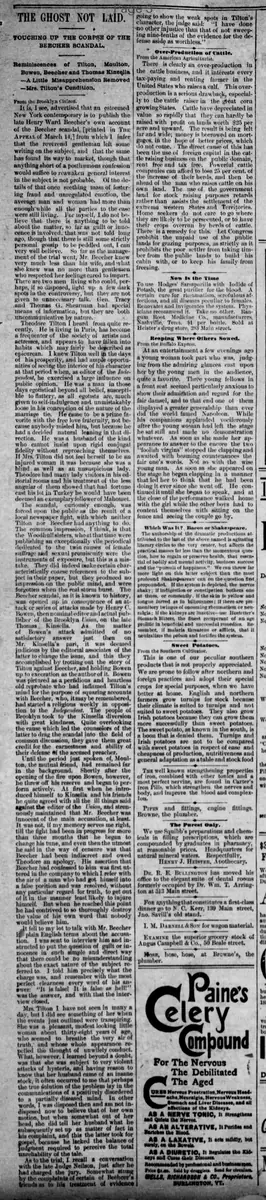
THE GHOST NOT LAID.
TOUCHING UP THE CORPSE OF THE BEECHER SCANDAL.
Reminiscences of Tilton, Moulton, Bowen, Beecher and Thomas Kinsella—A Little Misapprehension Removed—Mrs. Tilton's Condition.
From the Brooklyn Citizen.
It is, I see, advertised that an esteemed New York contemporary is to publish the late Henry Ward Beecher's own account of the Beecher scandal, [printed in The Appeal of March 14,] from which I infer that the reverend gentleman left some writing on the subject, and that the same has found its way to market, though that anything short of a posthumous confession would suffice to reawaken general interest in the subject is not probable. Of the details of that once seething mass of festering fraud and unregulated emotion, the average man and woman had more than enough while all the parties to the case were still living. For myself, I do not believe that there is anything to be told about the matter, so far as guilt or innocence is involved, that was not told long ago, though that there is still some strictly personal gossip to be peddled out, I can very well believe. So far as the management of the trial went, Mr. Beecher knew very much less than his wife, and what she knew was no more than gentlemen who respected her feelings cared to impart. There are two men living who could, perhaps, if so disposed, light up a few dark spots in the controversy, but they are not given to unnecessary talk. Gen. Tracy and Thomas G. Shearman had special means of information, but they are both uncommunicative by nature.
Theodore Tilton I heard from quite recently. He is living in Paris, has become a frequenter of the society of artists and actresses, and appears to have fallen into habits which may fairly be described as epicurean. I knew Tilton well in the days of his prosperity, and had ample opportunities of seeing the interior of his character at that period when, as editor of the Independent, he exercised a large influence on public opinion. He was a man in those days egotistical beyond all belief, susceptible to flattery, as all egotists are, much given to self-indulgence and unmistakably loose in his conception of the nature of the marriage tie. He came to be a prime favorite with the free love fraternity, not because anybody misled him, but because he had a decided natural leaning in that direction. He was a husband of the kind who cannot insist upon rigid conjugal fidelity without reproaching themselves. If Mrs. Tilton did not feel herself to be an injured woman it was because she was a blind as well as an unsuspicious lady. Theodore had many lady visitors in his editorial rooms and his treatment of the less angular of them showed that had fortune cast his lot in Turkey he would have been deemed an exemplary follower of Mahomet.
The scandal, curiously enough, was forced upon the public as the result of a local newspaper fight, with which neither Tilton nor Beecher had anything to do. The common impression, I think, is that the Woodhull sisters, who at that time were publishing an exceptionally vile periodical dedicated to the twin causes of female suffrage and sexual promiscuity were the instruments of exposure, but this is a mistake. They did indeed make certain characteristically coarse references to the subject in their paper, but they produced no impression on the public mind, and were forgotten when the real storm burst. The Beecher scandal, as it is known to history, was opened up in consequence of an attack or series of attacks made by Henry C. Bowen, then nominal editor and actual publisher of the Brooklyn Union, on the late Thomas Kinsella.
As the matter of Bowen's attack admitted of no satisfactory answer just then on Mr. Kinsella's part, it was deemed judicious by the editorial associates of the latter to change the issue, and this they accomplished by trotting out the story of Tilton against Beecher, and holding Bowen up to execration as the author of it. Bowen was pictured as a perfidious and heartless old reprobate who had inflamed Tilton's mind for the purpose of squaring accounts with Beecher, who, it may be remembered, had started a religious weekly in opposition to the Independent. The people of Brooklyn took to the Kinsella diversion with great kindness. Quite overlooking the cause which led the counselors of the latter to drag the scandal into the field of common discussion, they gave them great credit for the earnestness and ability of their defense of the accused preacher.
Up till the period just spoken of, Moulton, the mutual friend, had remained far in the background. Shortly after the opening of the fire upon Bowen, however, he threw off his reserve and began to perform actively. At first when he introduced himself to Kinsella and his friends he quite agreed with all the ill things said against the editor of the Union, and strenuously maintained that Mr. Beecher was innocent of the main accusation, at least. It was not, if my memory serves me right, till the fight had been in progress for more than three months that he began to change his tune, and even then the utmost he said in the way of censure was that Beecher had been indiscreet and owed Theodore an apology. His assertion that Beecher had confessed to him was first uttered in the company to which I refer with the air of a man who had got himself into a false position and was resolved, without any particular regard for truth, to get out of it in the manner least likely to injure himself. But when he reached this point he had contrived to so thoroughly destroy the value of his own word that nobody would believe him.
It fell to my lot to talk with Mr. Beecher in plain English terms about the accusation. I was sent to interview him and instructed to put the question of guilt or innocence in such simple and direct way that there could be no misunderstanding about the exact nature of the subject referred to. I told him precisely what the charge was, and remember with the most perfect clearness every word of his answer: "It is false! It is false as hell!" was the answer, and with that the interview closed.
Mrs. Tilton I have not seen in many a day, but I did see something of her when the events just outlined were transpiring. She was a pleasant, modest looking little woman about thirty-eight years of age, who seemed to breathe the very air of truth, and whose whole appearance repelled the thought of unwifely conduct. What, however, I learned beyond a doubt, was that she was subject to very violent attacks of hysteria, and having reason to know that her husband came of an insane stock, it often occurred to me that perhaps the true solution of the problem lay in the communications of a positively disordered to a partially diseased mind. In other words, I was disposed then and am not indisposed now to believe that of her own motion, but when somewhat out of her head, she did tell her husband what he subsequently set up as matter of fact in his complaint, and this the latter took for gospel, because he lacked the balance of judgment required to perceive the total unreliability of the tale.
As to the trial, I recall a conversation with the late Judge Neilson, just after he had charged the jury. Somewhat stung by the complaints of certain of Beecher's friends as to his treatment of evidence going to show the weak spots in Tilton's character, the judge said: "I have done no other injustice than that of not sweeping nine-tenths of the evidence for the defense aside as worthless."
TOUCHING UP THE CORPSE OF THE BEECHER SCANDAL.
Reminiscences of Tilton, Moulton, Bowen, Beecher and Thomas Kinsella—A Little Misapprehension Removed—Mrs. Tilton's Condition.
From the Brooklyn Citizen.
It is, I see, advertised that an esteemed New York contemporary is to publish the late Henry Ward Beecher's own account of the Beecher scandal, [printed in The Appeal of March 14,] from which I infer that the reverend gentleman left some writing on the subject, and that the same has found its way to market, though that anything short of a posthumous confession would suffice to reawaken general interest in the subject is not probable. Of the details of that once seething mass of festering fraud and unregulated emotion, the average man and woman had more than enough while all the parties to the case were still living. For myself, I do not believe that there is anything to be told about the matter, so far as guilt or innocence is involved, that was not told long ago, though that there is still some strictly personal gossip to be peddled out, I can very well believe. So far as the management of the trial went, Mr. Beecher knew very much less than his wife, and what she knew was no more than gentlemen who respected her feelings cared to impart. There are two men living who could, perhaps, if so disposed, light up a few dark spots in the controversy, but they are not given to unnecessary talk. Gen. Tracy and Thomas G. Shearman had special means of information, but they are both uncommunicative by nature.
Theodore Tilton I heard from quite recently. He is living in Paris, has become a frequenter of the society of artists and actresses, and appears to have fallen into habits which may fairly be described as epicurean. I knew Tilton well in the days of his prosperity, and had ample opportunities of seeing the interior of his character at that period when, as editor of the Independent, he exercised a large influence on public opinion. He was a man in those days egotistical beyond all belief, susceptible to flattery, as all egotists are, much given to self-indulgence and unmistakably loose in his conception of the nature of the marriage tie. He came to be a prime favorite with the free love fraternity, not because anybody misled him, but because he had a decided natural leaning in that direction. He was a husband of the kind who cannot insist upon rigid conjugal fidelity without reproaching themselves. If Mrs. Tilton did not feel herself to be an injured woman it was because she was a blind as well as an unsuspicious lady. Theodore had many lady visitors in his editorial rooms and his treatment of the less angular of them showed that had fortune cast his lot in Turkey he would have been deemed an exemplary follower of Mahomet.
The scandal, curiously enough, was forced upon the public as the result of a local newspaper fight, with which neither Tilton nor Beecher had anything to do. The common impression, I think, is that the Woodhull sisters, who at that time were publishing an exceptionally vile periodical dedicated to the twin causes of female suffrage and sexual promiscuity were the instruments of exposure, but this is a mistake. They did indeed make certain characteristically coarse references to the subject in their paper, but they produced no impression on the public mind, and were forgotten when the real storm burst. The Beecher scandal, as it is known to history, was opened up in consequence of an attack or series of attacks made by Henry C. Bowen, then nominal editor and actual publisher of the Brooklyn Union, on the late Thomas Kinsella.
As the matter of Bowen's attack admitted of no satisfactory answer just then on Mr. Kinsella's part, it was deemed judicious by the editorial associates of the latter to change the issue, and this they accomplished by trotting out the story of Tilton against Beecher, and holding Bowen up to execration as the author of it. Bowen was pictured as a perfidious and heartless old reprobate who had inflamed Tilton's mind for the purpose of squaring accounts with Beecher, who, it may be remembered, had started a religious weekly in opposition to the Independent. The people of Brooklyn took to the Kinsella diversion with great kindness. Quite overlooking the cause which led the counselors of the latter to drag the scandal into the field of common discussion, they gave them great credit for the earnestness and ability of their defense of the accused preacher.
Up till the period just spoken of, Moulton, the mutual friend, had remained far in the background. Shortly after the opening of the fire upon Bowen, however, he threw off his reserve and began to perform actively. At first when he introduced himself to Kinsella and his friends he quite agreed with all the ill things said against the editor of the Union, and strenuously maintained that Mr. Beecher was innocent of the main accusation, at least. It was not, if my memory serves me right, till the fight had been in progress for more than three months that he began to change his tune, and even then the utmost he said in the way of censure was that Beecher had been indiscreet and owed Theodore an apology. His assertion that Beecher had confessed to him was first uttered in the company to which I refer with the air of a man who had got himself into a false position and was resolved, without any particular regard for truth, to get out of it in the manner least likely to injure himself. But when he reached this point he had contrived to so thoroughly destroy the value of his own word that nobody would believe him.
It fell to my lot to talk with Mr. Beecher in plain English terms about the accusation. I was sent to interview him and instructed to put the question of guilt or innocence in such simple and direct way that there could be no misunderstanding about the exact nature of the subject referred to. I told him precisely what the charge was, and remember with the most perfect clearness every word of his answer: "It is false! It is false as hell!" was the answer, and with that the interview closed.
Mrs. Tilton I have not seen in many a day, but I did see something of her when the events just outlined were transpiring. She was a pleasant, modest looking little woman about thirty-eight years of age, who seemed to breathe the very air of truth, and whose whole appearance repelled the thought of unwifely conduct. What, however, I learned beyond a doubt, was that she was subject to very violent attacks of hysteria, and having reason to know that her husband came of an insane stock, it often occurred to me that perhaps the true solution of the problem lay in the communications of a positively disordered to a partially diseased mind. In other words, I was disposed then and am not indisposed now to believe that of her own motion, but when somewhat out of her head, she did tell her husband what he subsequently set up as matter of fact in his complaint, and this the latter took for gospel, because he lacked the balance of judgment required to perceive the total unreliability of the tale.
As to the trial, I recall a conversation with the late Judge Neilson, just after he had charged the jury. Somewhat stung by the complaints of certain of Beecher's friends as to his treatment of evidence going to show the weak spots in Tilton's character, the judge said: "I have done no other injustice than that of not sweeping nine-tenths of the evidence for the defense aside as worthless."
What sub-type of article is it?
Biography
Historical Event
Deception Fraud
What themes does it cover?
Deception
Justice
Misfortune
What keywords are associated?
Beecher Scandal
Tilton Beecher
Adultery Accusation
Newspaper Feud
Trial Reminiscences
Hysteria Influence
What entities or persons were involved?
Henry Ward Beecher
Theodore Tilton
Mrs. Tilton
Henry C. Bowen
Thomas Kinsella
Moulton
Gen. Tracy
Thomas G. Shearman
Judge Neilson
Where did it happen?
Brooklyn
Story Details
Key Persons
Henry Ward Beecher
Theodore Tilton
Mrs. Tilton
Henry C. Bowen
Thomas Kinsella
Moulton
Gen. Tracy
Thomas G. Shearman
Judge Neilson
Location
Brooklyn
Story Details
Retrospective on the Beecher-Tilton scandal, detailing origins from a newspaper feud, key figures' roles, Tilton's character, Moulton's shifting testimony, Beecher's denial, Mrs. Tilton's hysteria, and trial observations.