Thank you for visiting SNEWPapers!
Sign up free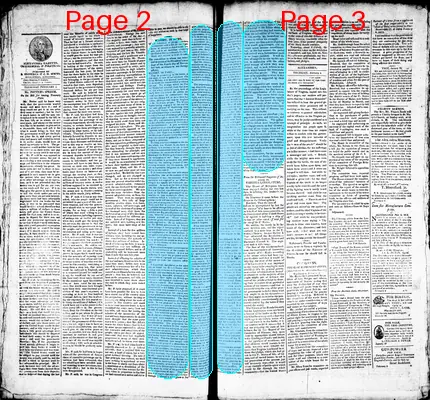
Alexandria Gazette, Commercial And Political
Alexandria, Virginia
What is this article about?
Congressional committee report dated January 20, 1813, reviewing US-British relations amid the War of 1812. It discusses failed armistice proposals over impressment of seamen and Orders in Council, approves executive actions, and recommends a bill regulating seamen in US vessels.
Merged-components note: The component on page 3 is a direct continuation of the foreign relations committee report from page 2, despite OCR garbling; relabel from editorial to foreign_news as it matches the content and topic.
Clippings

1 of 2
OCR Quality
Full Text
REPORT, IN PART
accompanied with a bill for the regulation of seamen on board public vessels, and in the merchant service of the United States.—January 20, 1813.
The committee to whom was referred so much of the President's message of the fourth day of November last, as relates to our foreign affairs,
REPORT, IN PART.
That in presenting to the house, at this time, a view of our relations with Great Britain, it is deemed unnecessary to recite the causes which produced the war. The wrongs which the United States had received from that power, for a long series of years, have already been laid before the public, and need not again be enumerated: they were too deeply felt to have been forgotten, although they may be forgiven by the American people. The United States having engaged in the war for the sole purpose of vindicating their rights and honor, that motive alone should animate them to its close. It behooves a free and virtuous people to give a useful example to the world. It is the duty of a representative government to render a faithful account of its conduct to its constituents. A just sensibility to great and unprovoked wrongs and indignities, will justify an appeal to arms: an honorable reparation should restore the blessings of peace: every step which they take should be guided by a sacred regard to principle.
To form a correct estimate of the duties which the United States have to perform, it is necessary to take a view of the communications which have passed between the executive of the United States and the British government since the declaration of war. Such a view, the committee is persuaded, will show distinctly the existing ground of controversy between the two nations, and the indispensable obligation on the United States to maintain it.
Your committee has seen with much satisfaction, that at the moment of the declaration of war, the attention of the executive was engaged in an effort to bring it to a speedy and honorable termination. As early as the 26th of June last, the charge des affaires of the United States at London, was instructed to propose to the British government an armistice, to take immediate effect, on conditions which it is believed the impartial world will consider safe, honorable, and advantageous to Great Britain. They were few in number and limited to positive wrongs daily practised. That the orders in council should be repealed, and that our flag should protect our seamen, were the only indispensable conditions insisted on. Other wrongs, however great, were postponed for amicable negotiation. As an inducement to the British government to forbear these wrongs, it was proposed to repeal the non-importation law, and to prohibit the employment of British seamen, in the public and private vessels of the United States: particular care was taken, that these propositions should be made in a form as conciliatory as they were amicable in substance.
Your committee cannot avoid expressing its astonishment at the manner in which they were received. It was not sufficient to reject the proposed armistice, terms of reproach and insult were adopted to make the rejection offensive.
It happened, that almost on the same day on which the United States, after having been worn out with accumulated wrongs, had resorted to the last and only remaining honorable alternative, in support of their rights, the British government had repealed conditionally its orders in council. That measure was unexpected, because every previous application for it had failed, although repeated to the very moment it was decided on. Conditional as the repeal was, it was admitted to have removed a great obstacle to accommodation. The other only remained, the practice of impressment. It was proposed to the British government to open an amicable negotiation to provide a substitute to it, which should be considered an ample equivalent. The substitute proposed was defined, and of a character so comprehensive as to have removed, as was presumed, every possible objection to an accommodation. The proposition before made to exclude British seamen from our service was enlarged, so as to comprehend all native British subjects not already naturalized or entitled to naturalization under the laws of the United States. This was likewise rejected.
Your committee have sought with anxiety some proof of a disposition in the British government to accommodate, on any fair condition, the important difference between the two nations, relative to impressment; but they have sought in vain: none is to be found either in the communications of the British minister to the American charge des affaires at London, or in those of the commander of the British naval forces at Halifax, made by order of his government to the department of state. They have seen with regret, that although lord Castlereagh professed a willingness in his government to receive amicably any proposition either to check abuse of impressment, or to provide a substitute to it, he not only declined a negotiation for the purpose, but discountenanced the expectation that any substitute could be provided which the British government would accept. Notice also, though it was the cause of surprise, that in the communication of Admiral Warren to the department of state, the subject of impressment was not even alluded to. Had the executive agreed to an armistice on the repeal of the orders in council, without a satisfactory pledge against impressment, or a distinct understanding with the British government to that effect, it would not have been entitled to confidence, and the committee would not have hesitated to declare it. The impressment of seamen is deservedly considered the most offensive and unjustifiable cause of the war, and must be prosecuted until that cause be removed. To appeal to arms in defence of a right, and to lay them down without securing it, or a satisfactory pledge for it, or good disposition in the enemy to secure it, would be considered in no other light than a retreat from the honor and interest of the country. To attempt to negotiate for the security of such important interests, with the expectation that any of the propositions which had been urged before the declaration of war had been rejected, would have more weight now they had been made in vain, would be an act of folly which would not only expose us to the scorn and derision of the British nation and of the world. On a full view, therefore, of the conduct of the executive in relation to the British government since the declaration of war, the committee consider it their duty to express their entire approbation of it. They see in it a firm resolution to support the rights and honor of their country, in a sincere and commendable desire to promote peace on such amicable conditions as they may, with safety, accept.
It remains, therefore, for the United States to take their final stand with Great Britain, and to prosecute the war with consistency, and with firmness and constancy which the friendly and liberal propositions of the executive, so unworthily rejected by the British government, has in a great measure destroyed the hope of amicable adjustment. It is, however, possible that the British government, after insisting on the repeal of the orders in council, may have declined the armistice proposed by Mr. Adams, under the expectation that their terms would have been satisfactory to this government. Be this as it may, your committee consider it the duty of this house to communicate to its constituents the actual state of the controversy, the principles on which it is founded, that cause, and the obligations which it imposes.
From what has been stated, your committee think that however great the other wrongs, the impressment of seamen was that alone which rendered an armistice, and in consequence an accommodation, impossible. Had that rest been arranged in any manner, the president availing himself of the intrinsic justice of his cause, and of the amicable spirit in which the negotiation would have been conducted, would have had a fair opportunity for satisfaction in the adjustment of other differences. Great Britain claims a right to take her own seamen and to ascertain who are such, wherever found, whether in American vessels. In the exercise of this pretension, British cruizers impress American seamen from the nature of the service, it is probable that that abuse shall be carried to a great extent. A British officer who is not to be the arbiter in such a case, of the liberty and lives of American citizens ought not to depend on such a party. The British government insists that every American shall carry with him the evidence of his citizenship, and that all those who have not such evidence, it might be impressed if not otherwise objected to, as the documents of citizenship may be destroyed or taken from them after it was granted, nor need they be entitled to respect from improper persons. Even certificates have been counterfeited, transferred, &c. On what principle then is it reasonable to other and much more important claims of the British government chimerical, so great and shameful as to warrant the unlimited exercise of the most odious and oppressive kind of belligerent power to carry them into effect. Ought the free citizens of the United States, traversing the main ocean, and in the enjoyment of the protection of their flag, to be considered by a foreign government as liable to impressment, and treated as the slaves of every petty commander who may think fit to seize them? Is it consistent with every principle of national honor and justice, that an American citizen, in a British vessel, taken from her by the enemy, should prove his American citizenship by a badge of slavery, or be considered a British subject, and treated accordingly? The conduct of Great Britain in similar circumstances, would prove his citizenship, whether it be to France or to any other power, disregarding the rights of the flag, to enter on board her vessels, take from them her own subjects, and impress them into her service, as the documents of citizenship may be destroyed or taken from them after it was granted, nor need they be entitled to respect from improper persons. Even certificates have been counterfeited, transferred, &c. On what principle then is it reasonable to other and much more important claims of the British government chimerical, so great and shameful as to warrant the unlimited exercise of the most odious and oppressive kind of belligerent power to carry them into effect. Ought the free citizens of the United States, traversing the main ocean, and in the enjoyment of the protection of their flag, to be considered by a foreign government as liable to impressment, and treated as the slaves of every petty commander who may think fit to seize them? Is it consistent with every principle of national honor and justice, that an American citizen, in a British vessel, taken from her by the enemy, should prove his American citizenship by a badge of slavery, or be considered a British subject, and treated accordingly?
Therefore, their vessels should suffer such appearance, Jamaica sugar, since that h claim to unpress re, provided it be in United States being s. That American any other than those a this cannot be they demand Ex exempted from it Take from American han by the rusgel in r, which ought to be he r:paciius grusp of cre is nothing to pro- in itself, so consistent of the United States; This then is the ex bn their rights as un nt that it should ever ), that it has been a Sh clul.n is, that B.i. questi n Te foun hoply.nent in the se - S:stey: this is re- 1affcoting essentially e British xangle.- i.d bare more weight of the British nation wit. G:eut Batain ceatrarv, that it is in n rec:ive i-sto jur scr- eif within tht limit inio it riut.rily...If nersr woull no: ex- :ne auject of even : povcrs hive been e tair unp huppi- l-t'y. uherever their ti The British gor . is seame.i that pi- ns torm. be s ground in Great Britui. Let :-rot md, thit in cuse suli be nud.: bet ween ynercby cach should hrrvice the citizans & her, ou the cosli:ions ne st.ted. that this pared -o far as dep:ndts Birt, and for that pur- with such regu:tions I1 be edequate. With nut p recived on what h go-erment can per- If B.itish vramen are wriceif the United e tff ciuslly done, the he claim noust cease In that uct ane British fourlon bon'd A.neri. ull be absurd to urge ve fur immessment. nillingness to give ef- sed artonguient, vour d-r it rqualiv the duty &. clare. in termns' the at shruld tize British te: live it, a' d prrse ceafinpr ssment from . the Uuited States will in tha! prartice. but .aingly with all their grexsa'y lw to i quire rauld tave bren with eut, in tie the nr ; bren repealed bef ro : s5, or how ]-ng tle ssncnt would lao c b.ipe that that rerta) Eloued by a siifc :t with rryp,ct to in heen declared. & the sment being neeess s ove of' the most i, . it is evident that t ed for in the padif":- Ssion ofit in a tre. ty d not leave it on its I: it would in efeet P relignishment: an the fectingy of every Areyalt, The seamen tes have a elaim on Bor aroteetion, & they rd. Ita single ship , aid the eronerty of dilizen vrested from it pooses the indignt- ooutry. -How mneh ken onghtye tobe ex- e bnold so many of d h.hly meritorious Haw ciizyns snatebed n of their famitirs and nry. and eaiviedin a iiing huinlage. It is ought wot, whieh can tolerytet. witbou ie sulferings of the vie- bat wide seere of dis- it spreads among their bogh the catlatry, the solf is. in the highest dingtothe t. seales it isincomnuble nith aty. Itis sutversive Hars of thcir indenend torbearance of the U nder it has been sista- kimily. pretensien was motur- a right. Hadresist nger delaved, it might ene. Every adinis- strated against it, in a espoke the growing in- the country. Their re produced no effeet. I heilastriegsleader of hen caiied by the voice Lof his country to the head of the go- veraincat, to, pause.. rather than to yecoindend to his fellow citizens.n wew wat beore they had recovered rom the ealamities of the late one. It was worthy his immediate sue. cessors to followhis example. In pence qur free system of govern ment would gain strength, and onr happy unionbecome consolidated : hut, at the last session, the perjod had arrived when forbearance oould be no longer justified. It was the duty ofeongress to take up this sub- ject in conneetion with the other great wrongs of which they com- plained. and to seek redress in the mode which beeame the representa- tives of a free people. They have done so by appealing to arms, & that appeal will be supported by their constitucnts. Your committce are aware that an inferesting erisis has arrived in the United States; butthey have no painful apprehension of its conse- quenoes. The course before them is direct. It is nointed out equally by a regard to the honor, the righis and the interests of the nation. If we pursue it with firmness and vigor. relyisig onthe aid of Heaven, our success is inevitable. Our resources are abundant ; the people are brave and virtuous, and their spirit unbroken. The gallan- trv ofoue infant navy bespeaks our growing greatness on that element : and that of our troops, when ledto action, inspires fuil confidence of what may bo expected from them, when their organization is complete. Our unionis alwaysmost strong when menaced by foreign dangers ; the people of America are never so much one fanily, as when their liber. ties are invadod. Your coinmittee, for the copside rations above set forth. recoinmend to the house the passing of the bill herewith reported," for the regula- tion of seamen on board the public vessels and in the merehantservice of the United States."
What sub-type of article is it?
What keywords are associated?
What entities or persons were involved?
Where did it happen?
Foreign News Details
Primary Location
Great Britain
Event Date
January 20, 1813
Key Persons
Outcome
failed armistice proposals; recommendation to pass bill regulating seamen to address impressment issues.
Event Details
The committee reports on US efforts since June 1812 to negotiate an armistice with Britain over Orders in Council and impressment of seamen, which were rejected. It approves the executive's conduct and urges continued prosecution of the war until impressment is resolved, emphasizing its role as the primary cause.