Thank you for visiting SNEWPapers!
Sign up free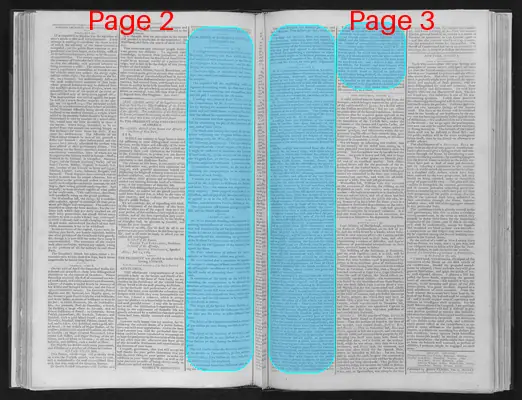
Gazette Of The United States
New York, New York County, New York
What is this article about?
Detailed proceedings of the U.S. House of Representatives from August 5-7, 1789, covering passage of bills on War Department, Western Territory, coasting trade, and member compensations; committee appointments; messages from the President and Senate; and debates on salaries.
Merged-components note: These two components are a direct continuation of the 'SKETCH OF PROCEEDINGS OF CONGRESS' article, with the text flowing seamlessly from one to the next.
Clippings
1 of 2
OCR Quality
Full Text
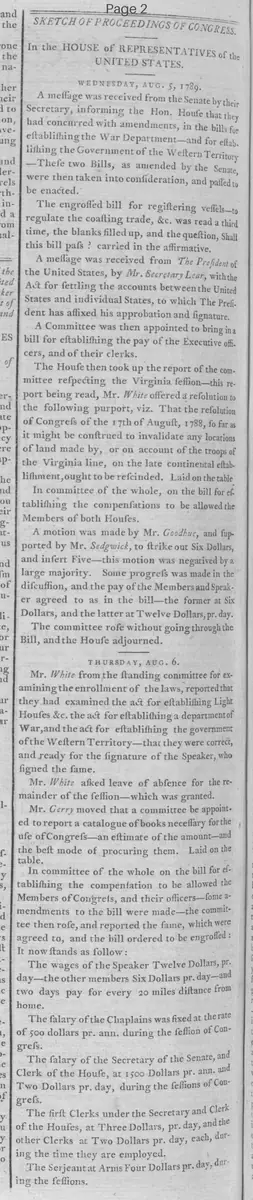
In the HOUSE of REPRESENTATIVES of the UNITED STATES.
WEDNESDAY, AUG. 5, 1789.
A message was received from the Senate by their Secretary, informing the Hon. House that they had concurred with amendments, in the bills for establishing the War Department—and for establishing the Government of the Western Territory—These two Bills, as amended by the Senate, were then taken into consideration, and passed to be enacted.
The engrossed bill for registering vessels—to regulate the coasting trade, &c. was read a third time, the blanks filled up, and the question, Shall this bill pass? carried in the affirmative.
A message was received from The President of the United States, by Mr. Secretary Lear, with the Act for settling the accounts between the United States and individual States, to which The President has affixed his approbation and signature.
A Committee was then appointed to bring in a bill for establishing the pay of the Executive officers, and of their clerks.
The House then took up the report of the committee respecting the Virginia session—this report being read, Mr. White offered a resolution to the following purport, viz. That the resolution of Congress of the 17th of August, 1788, so far as it might be construed to invalidate any locations of land made by, or on account of the troops of the Virginia line, on the late continental establishment, ought to be rescinded. Laid on the table.
In committee of the whole, on the bill for establishing the compensations to be allowed the Members of both Houses.
A motion was made by Mr. Goodhue, and supported by Mr. Sedgwick, to strike out Six Dollars, and insert Five—this motion was negatived by a large majority. Some progress was made in the discussion, and the pay of the Members and Speaker agreed to as in the bill—the former at Six Dollars, and the latter at Twelve Dollars, pr. day.
The committee rose without going through the Bill, and the House adjourned.
THURSDAY, AUG. 6.
Mr. White from the standing committee for examining the enrollment of the laws, reported that they had examined the act for establishing Light Houses &c. the act for establishing a department of War, and the act for establishing the government of the Western Territory—that they were correct, and ready for the signature of the Speaker, who signed the same.
Mr. White asked leave of absence for the remainder of the session—which was granted.
Mr. Gerry moved that a committee be appointed to report a catalogue of books necessary for the use of Congress an estimate of the amount—and the best mode of procuring them. Laid on the table.
In committee of the whole on the bill for establishing the compensation to be allowed the Members of Congress, and their officers—some amendments to the bill were made—the committee then rose, and reported the same, which were agreed to, and the bill ordered to be engrossed: It now stands as follows:
The wages of the Speaker Twelve Dollars, pr. day—the other members Six Dollars pr. day—and two days pay for every 20 miles distance from home.
The salary of the Chaplains was fixed at the rate of 500 dollars pr. ann. during the session of Congress.
The salary of the Secretary of the Senate, and Clerk of the House, at 1500 Dollars pr. ann. and Two Dollars pr. day, during the sessions of Congress.
The first Clerks under the Secretary and Clerk of the Houses, at Three Dollars, pr. day, and the other Clerks at Two Dollars pr. day, each, during the time they are employed.
The Sergeant at Arms Four Dollars pr. day, during the sessions,
The Door-keepers 730 dollars pr. ann. and their Assistants, Two dollars pr. day, during the sessions.
A message was received from the Senate, by their Secretary, informing, that they insisted on their amendment to the Treasury-Bill, respecting the removability of the Secretary by the President.
Also that they had agreed to the resolution of the House for appointing a committee to report what business ought to be finished previous to the adjournment, and appointed Mr. Strong, Mr. Elsworth, and Mr. Carroll, on their part. Adjourned.
FRIDAY, AUGUST 7.
Mr. Seney presented a memorial from John White, continental commissioner of accounts for the States of Pennsylvania, Delaware, and Maryland, appointed by the late Congress, praying that compensation may be allowed to him and his assistants for services performed, for special reasons, after the expiration of his commission: This memorial with accompanying papers were read, and on motion, referred to a committee, consisting of Mr. Seney, Mr. Vining, and Mr. Heister.
Mr. Gerry introduced a motion, that a committee be appointed to prepare and report a bill for the further encouragement of the navigation and commerce of the United States. This motion was adopted, and a committee, consisting of Mr. Gerry, Mr. Trumbull, and Mr. Burke appointed.
A message from the President of the United States, by the Hon. Gen. Knox, was received, respecting the present posture of Indian affairs, suggesting the propriety of appointing commissioners to investigate and report their actual situation. The message also noticed the subject of the militia throughout the United States—referred to a committee of the whole house upon the state of the Union.
Another message was received from the President, by Mr. Secretary Lear, with three acts of Congress, to which the President has affixed his approbation and signature, viz. The bill for establishing Light-Houses, Beacons, Buoys, and public Piers. the bill for establishing the government of the Western Territory, and the bill for establishing the War Department.
The engrossed bill for allowing compensations to the members and officers of the two Houses was read—a motion was then made by Mr. Sedgwick, that the same should be recommitted, this motion was seconded by several members, which brought on a debate.—In favor of the motion it was observed, that If the bill should become a law in its present form, there was danger of its having an inauspicious influence upon the reputation of the government, That the salaries of the most respectable officers in some of the States, and particularly in Massachusetts, where the Governor receives but 800l. a year, and the Judges of the Superior Courts but 300l. and where the public business is executed by men of the first abilities, and no difficulty exists in procuring the most competent talents for every department—would lead to enquiries upon these allowances, which it would be difficult to answer—that the compensations proposed to be given to some of the officers of Congress, will be considered as a profuse and thoughtless application of the public money, and as greatly overrating the services for which such compensations are allowed—that in particular the sum of 730 dollars to the door-keeper, was so out of proportion to other compensations as to render this bill inconsistent with itself—that it was contrary to the rule adopted by the House, with respect to other appointments, especially the clerks in several departments, to some of which it was with difficulty that the House consented to allow 600 dollars, where talents and great responsibility were expected.
On the other hand it was said that the bill had received repeated discussions, that it was now in the third stage of its progress, and if gentlemen had seriously thought of making so strenuous an opposition, they ought to have come forward at an earlier day—that it would but ill comport with the principles of economy which some gentlemen appeared to advocate, to spend any more time in a tedious discussion of a bill which has so long been before the house : That if the bill was not so perfectly accurate as some gentlemen wished, yet it would be more eligible to pass it, than to sacrifice the time of the House in going over the ground again, especially as every part of it had received the sanction of a respectable majority —That the motion was entirely out of order, and if the rules of the House were thus to be broken through, it was in the power of the disappointed, forever to impede the public business—that as to the small salaries given in particular States, the circumstances did not apply, as gentlemen were in such instances at home, and under no necessity of incurring any extra-expences, but that the members of Congress came from the extreme parts of the continent, and were supposed to make temporary sacrifices when they took their seats in the House—that with respect to the public opinion, however proper it may be to pay attention to it, if the House under that influence was afraid to decide upon such measures as the majority thought to be right, the constitution was but a name.
What sub-type of article is it?
What keywords are associated?
What entities or persons were involved?
Where did it happen?
Domestic News Details
Primary Location
United States
Event Date
August 5 7, 1789
Key Persons
Outcome
bills passed for war department, western territory government, coasting trade regulation, light-houses, and member/officer compensations; committees appointed on executive pay, books for congress, navigation encouragement, indian affairs, and militia; messages from president on indian affairs and signed acts; debate on recommitting compensation bill.
Event Details
The House received Senate messages on amended bills for War Department and Western Territory, passing them; approved bill regulating coasting trade; received presidential approval on accounts settlement act; appointed committee for executive pay; considered Virginia land resolution; debated and set member compensations at $6/day (Speaker $12), with additional details for officers; examined and signed acts; granted leave to Mr. White; proposed committee for congressional books; received Senate insistence on Treasury Bill amendment and joint committee on adjournment business; referred memorial from John White for compensation; appointed committee for navigation bill; received presidential messages on Indian affairs, militia, and signed acts; debated recommitting compensation bill with arguments on economy, reputation, and order.