Thank you for visiting SNEWPapers!
Sign up free
Twin City Review
Champaign, Champaign County, Illinois
What is this article about?
US Bureau of Labor Statistics reports that low rents in post-WWI Germany did not benefit workers, as employers adjusted wages accordingly. Real wages remained low, housing construction stalled, workers bore disproportionate taxes, and efforts to extend work hours beyond eight emerged by 1923.
Clipping
OCR Quality
Full Text
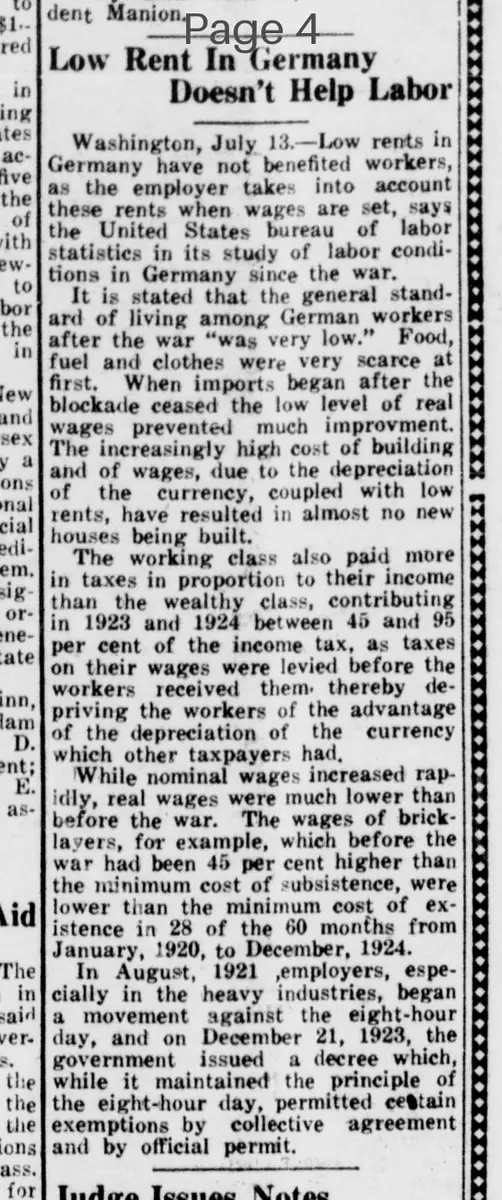
Doesn't Help Labor
Washington, July 13.—Low rents in Germany have not benefited workers, as the employer takes into account these rents when wages are set, says the United States bureau of labor statistics in its study of labor conditions in Germany since the war.
It is stated that the general standard of living among German workers after the war "was very low." Food, fuel and clothes were very scarce at first. When imports began after the blockade ceased the low level of real wages prevented much improvement.
The increasingly high cost of building and of wages, due to the depreciation of the currency, coupled with low rents, have resulted in almost no new houses being built.
The working class also paid more in taxes in proportion to their income than the wealthy class, contributing in 1923 and 1924 between 45 and 95 per cent of the income tax, as taxes on their wages were levied before the workers received them, thereby depriving the workers of the advantage of the depreciation of the currency which other taxpayers had.
While nominal wages increased rapidly, real wages were much lower than before the war. The wages of bricklayers, for example, which before the war had been 45 per cent higher than the minimum cost of subsistence, were lower than the minimum cost of existence in 28 of the 60 months from January, 1920, to December, 1924.
In August, 1921, employers, especially in the heavy industries, began a movement against the eight-hour day, and on December 21, 1923, the government issued a decree which while it maintained the principle of the eight-hour day, permitted certain exemptions by collective agreement and by official permit.
What sub-type of article is it?
What keywords are associated?
Where did it happen?
Foreign News Details
Primary Location
Germany
Event Date
Since The War, Up To December 1924
Outcome
real wages lower than pre-war levels; minimal new housing construction; workers contributed 45-95% of income tax in 1923-1924; government decree in 1923 allowed exemptions to eight-hour day.
Event Details
US Bureau of Labor Statistics study shows low rents did not aid German workers post-war due to wage adjustments by employers. Standard of living remained low with scarce essentials; imports did not improve conditions due to low real wages. High building costs and currency depreciation halted new housing. Workers faced higher proportional taxes, losing currency depreciation benefits. Nominal wages rose but real wages fell below subsistence for many periods. Employers pushed against eight-hour day from 1921, leading to 1923 government decree permitting exemptions.