Thank you for visiting SNEWPapers!
Sign up free
Story
August 30, 1896
The News & Observer
Raleigh, Wake County, North Carolina
What is this article about?
Special correspondence from New York on August 29 critiques the dominance of wealth, New York bankers' arrogant opposition to free silver influenced by English interests, the city's loss of commercial spirit, and the widening gulf between rich and poor amid corporate control.
Clipping
OCR Quality
95%
Excellent
Full Text
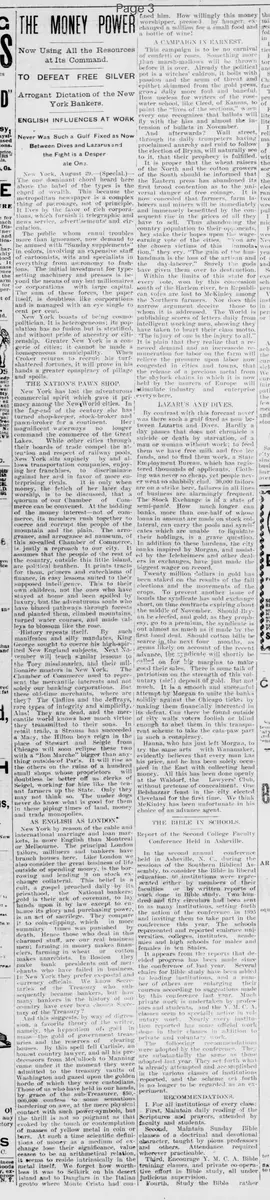
Now Using All the Resources at Its Command.
TO DEFEAT FREE SILVER
Arrogant Dictation of the New York Bankers.
ENGLISH INFLUENCES AT WORK
Never Was Such a Gulf Fixed as Now Between Dives and Lazarus and the Fight is a Desperate One.
New York, August 29.-(Special.)-
The one dominant chord heard here above the babel of the types is the chord of wealth. This because the metropolitan newspaper is a complex thing of patronage, not of principle. It lives by the favor of rich corporations, which furnish it telegraphic and news service, advertisements and circulation.
The public whom ennui troubles more than ignorance, now demand to be amused with "Sunday supplements" in colors, involving an expensive staff of cartoonists, wits and specialists in everything from astronomy to fashions. The initial investment for type-setting machinery and presses is beyond the means of any but millionaires or corporations with large capital.
The sum of these forces, the paper itself, is doubtless like corporations and is managed with an eye single to cent per cent.
New York boasts of being cosmopolitan. It is heterogeneous; its population has no fusion but is stratified, and without pride of ancestry or citizenship. Greater New York is a congerie of cities; it cannot be made a homogeneous municipality.
When Croker returns to recruit his turf-shattered fortunes, it will prove in his hands a greater conspiracy of pillage and spoils,
THE NATION'S PAWN SHOP
New York has lost the adventurous commercial spirit which gave it primacy among the New World cities. In the fag-end of the century she has turned shop-keeper, stock-broker and pawn-broker for a continent.
Her magnificent waterways no longer command the commerce of the Great Lakes. While other cities through their boards of trade compel the attention and respect of railway pools, New York sits supinely by and allows transportation companies, enjoying her franchises, to discriminate against her and in favor of more enterprising rivals. It is only when money, the fetich of her later day worship, is to be discussed, that a quorum of our Chamber of Commerce can be convened. At the bidding of the money interest-not of commerce, its members rush together to coerce and corrupt the people of the mountain and the plain. The arrogance, and arrogance ad nauseum, of this so-called Chamber of Commerce is justly a reproach to our city. It assumes that the people of the rest of the country, outside this little island, are political heathen. It prints tracts for them, primers and catechisms of finance, in easy lessons suited to their supposed intelligence. This to their own children, not the ones who have stayed at home and been spoiled by luxury, but the adventurous souls who have blazed pathways through forests and planted them, climbed mountains, turned water courses, and made valleys to blossom like the rose.
History repeats itself. By such manifestos and silly mandates, King George sought to coerce his high-spirited New England subjects. Next November will teach similar lessons to the Tory missionaries, and their millionaire masters in New York. The Chamber of Commerce used to represent the mercantile interests and not solely our banking corporations. But these old-time merchants, where are they? The Claflins and the Jeffrays, rare types of integrity and simplicity. Alas! They are dead. and the mercantile world knows how much virtue they transmitted to their sons. In retail trade, a Strauss has succeeded a Macy, the Hilton boys reign in the place of Stewart and Seigle from Chicago will soon eclipse these two with a "Bon Marche" bigger than anything outside of Paris. It will rise as the others on the ruins of a hundred small shops whose proprietors will doubtless be better off as clerks of Seigel, working for hire like the tenant farmers up the State. Only they may not think so. The under dogs never do know what is good for them in these piping times of land, money and trade monopolies.
AS ENGLISH AS LONDON.
New York by reason of the cable and international marriage and loan markets, is more English than Montreal or Melbourne. The principal London tailors, milliners and bankers have branch houses here. Like London we also consider the great business of life outside of spending money, is the borrowing and lending it on stock exchange collateral. This belief is a cult, a gospel preached daily by its priesthood, the National bankers; gold is their ark of covenant, to lay hands upon it by law except to enhance its glory and purchasing power, is an act of sacrilege. They compare it to coin-clipping, which in more summary times was punished by death. Hence those who deal in this charmed stuff, are our real business men; farming in money makes financiers, farming in wheat or cotton makes anarchists. In Boston they make bank presidents out of merchants who have failed in business. In New York they prefer ex-postal and currency officials. We know Secretaries who subsequently became bankers, but how many bankers in the history of our country have ever been chosen Secretary of the Treasury?
And this suggests, by way of digression, a favorite theory of the writer, namely, the hypnotism of gold in our treasuries and the reserves of clearing houses-the gold of government treasuries. By this spell fell Carlisle, an honest country lawyer, and all his predecessors from McCulloch to Manning came under it the moment they were admitted to the treasury vaults of Washington and gazed upon the golden horde of which they were custodians. Those of us who have held in our hands, by grace of the sub-Treasurer, $50,000,000 confess to some sensations bordering on awe, at the mere physical contact with such power-symbols, but the thrill is not so poignant as that evoked by the touch or contemplation of masses of yellow metal in coin or bars. At such a time scientific definitions of money as a medium of exchange lose their significance, value ceases to be an arithmetical relation, it seems to reside intrinsically in the metal itself. We forget how worthless it was to Selkirk on his desert island and to Danglars in the Italian grotto where Monte Cristo had confined him. How willingly this money worshipper, pressed by hunger, exchanged a million for a small food and a bottle of wine!
TO DEFEAT FREE SILVER
Arrogant Dictation of the New York Bankers.
ENGLISH INFLUENCES AT WORK
Never Was Such a Gulf Fixed as Now Between Dives and Lazarus and the Fight is a Desperate One.
New York, August 29.-(Special.)-
The one dominant chord heard here above the babel of the types is the chord of wealth. This because the metropolitan newspaper is a complex thing of patronage, not of principle. It lives by the favor of rich corporations, which furnish it telegraphic and news service, advertisements and circulation.
The public whom ennui troubles more than ignorance, now demand to be amused with "Sunday supplements" in colors, involving an expensive staff of cartoonists, wits and specialists in everything from astronomy to fashions. The initial investment for type-setting machinery and presses is beyond the means of any but millionaires or corporations with large capital.
The sum of these forces, the paper itself, is doubtless like corporations and is managed with an eye single to cent per cent.
New York boasts of being cosmopolitan. It is heterogeneous; its population has no fusion but is stratified, and without pride of ancestry or citizenship. Greater New York is a congerie of cities; it cannot be made a homogeneous municipality.
When Croker returns to recruit his turf-shattered fortunes, it will prove in his hands a greater conspiracy of pillage and spoils,
THE NATION'S PAWN SHOP
New York has lost the adventurous commercial spirit which gave it primacy among the New World cities. In the fag-end of the century she has turned shop-keeper, stock-broker and pawn-broker for a continent.
Her magnificent waterways no longer command the commerce of the Great Lakes. While other cities through their boards of trade compel the attention and respect of railway pools, New York sits supinely by and allows transportation companies, enjoying her franchises, to discriminate against her and in favor of more enterprising rivals. It is only when money, the fetich of her later day worship, is to be discussed, that a quorum of our Chamber of Commerce can be convened. At the bidding of the money interest-not of commerce, its members rush together to coerce and corrupt the people of the mountain and the plain. The arrogance, and arrogance ad nauseum, of this so-called Chamber of Commerce is justly a reproach to our city. It assumes that the people of the rest of the country, outside this little island, are political heathen. It prints tracts for them, primers and catechisms of finance, in easy lessons suited to their supposed intelligence. This to their own children, not the ones who have stayed at home and been spoiled by luxury, but the adventurous souls who have blazed pathways through forests and planted them, climbed mountains, turned water courses, and made valleys to blossom like the rose.
History repeats itself. By such manifestos and silly mandates, King George sought to coerce his high-spirited New England subjects. Next November will teach similar lessons to the Tory missionaries, and their millionaire masters in New York. The Chamber of Commerce used to represent the mercantile interests and not solely our banking corporations. But these old-time merchants, where are they? The Claflins and the Jeffrays, rare types of integrity and simplicity. Alas! They are dead. and the mercantile world knows how much virtue they transmitted to their sons. In retail trade, a Strauss has succeeded a Macy, the Hilton boys reign in the place of Stewart and Seigle from Chicago will soon eclipse these two with a "Bon Marche" bigger than anything outside of Paris. It will rise as the others on the ruins of a hundred small shops whose proprietors will doubtless be better off as clerks of Seigel, working for hire like the tenant farmers up the State. Only they may not think so. The under dogs never do know what is good for them in these piping times of land, money and trade monopolies.
AS ENGLISH AS LONDON.
New York by reason of the cable and international marriage and loan markets, is more English than Montreal or Melbourne. The principal London tailors, milliners and bankers have branch houses here. Like London we also consider the great business of life outside of spending money, is the borrowing and lending it on stock exchange collateral. This belief is a cult, a gospel preached daily by its priesthood, the National bankers; gold is their ark of covenant, to lay hands upon it by law except to enhance its glory and purchasing power, is an act of sacrilege. They compare it to coin-clipping, which in more summary times was punished by death. Hence those who deal in this charmed stuff, are our real business men; farming in money makes financiers, farming in wheat or cotton makes anarchists. In Boston they make bank presidents out of merchants who have failed in business. In New York they prefer ex-postal and currency officials. We know Secretaries who subsequently became bankers, but how many bankers in the history of our country have ever been chosen Secretary of the Treasury?
And this suggests, by way of digression, a favorite theory of the writer, namely, the hypnotism of gold in our treasuries and the reserves of clearing houses-the gold of government treasuries. By this spell fell Carlisle, an honest country lawyer, and all his predecessors from McCulloch to Manning came under it the moment they were admitted to the treasury vaults of Washington and gazed upon the golden horde of which they were custodians. Those of us who have held in our hands, by grace of the sub-Treasurer, $50,000,000 confess to some sensations bordering on awe, at the mere physical contact with such power-symbols, but the thrill is not so poignant as that evoked by the touch or contemplation of masses of yellow metal in coin or bars. At such a time scientific definitions of money as a medium of exchange lose their significance, value ceases to be an arithmetical relation, it seems to reside intrinsically in the metal itself. We forget how worthless it was to Selkirk on his desert island and to Danglars in the Italian grotto where Monte Cristo had confined him. How willingly this money worshipper, pressed by hunger, exchanged a million for a small food and a bottle of wine!
What sub-type of article is it?
Curiosity
Historical Event
What themes does it cover?
Social Manners
Moral Virtue
Misfortune
What keywords are associated?
Free Silver
New York Bankers
Chamber Of Commerce
English Influences
Money Worship
Social Stratification
Gold Standard
What entities or persons were involved?
Croker
Claflins
Jeffrays
Strauss
Macy
Hilton Boys
Stewart
Seigle
Carlisle
Mcculloch
Manning
Selkirk
Danglars
Monte Cristo
Where did it happen?
New York
Story Details
Key Persons
Croker
Claflins
Jeffrays
Strauss
Macy
Hilton Boys
Stewart
Seigle
Carlisle
Mcculloch
Manning
Selkirk
Danglars
Monte Cristo
Location
New York
Event Date
August 29
Story Details
Critique of New York bankers' and Chamber of Commerce's arrogant efforts to defeat free silver through coercion and propaganda, influenced by English interests, amid the city's shift to money worship and loss of commercial spirit, widening the gap between rich and poor.