Thank you for visiting SNEWPapers!
Sign up free
Literary
March 1, 1827
The Wilmingtonian, And Delaware Advertiser
Wilmington, New Castle County, Delaware
What is this article about?
This excerpt from White's Treatise on Veterinary Medicine explains the importance of monitoring a horse's pulse to assess disease severity and guide treatment, noting normal rates of 36-40 beats per minute and dangers above 80-90, with remedies like bleeding recommended early.
Clipping
OCR Quality
98%
Excellent
Full Text
PULSE OF A HORSE.
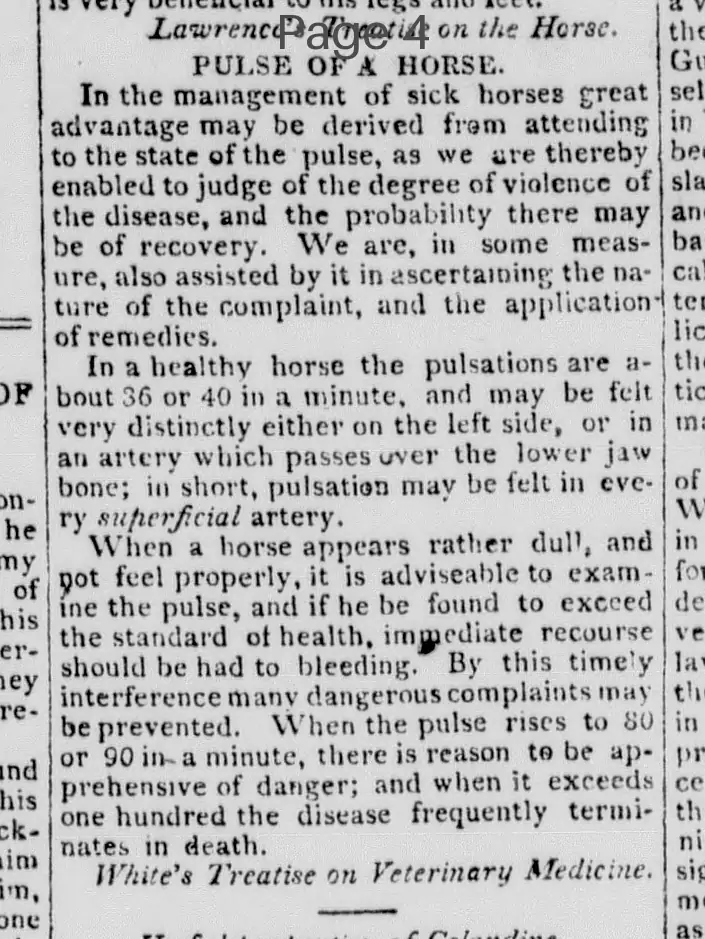
In the management of sick horses great advantage may be derived from attending to the state of the pulse, as we are thereby enabled to judge of the degree of violence of the disease, and the probability there may be of recovery. We are, in some measure, also assisted by it in ascertaining the nature of the complaint, and the application of remedies.
In a healthy horse the pulsations are about 36 or 40 in a minute, and may be felt very distinctly either on the left side, or in an artery which passes over the lower jaw bone; in short, pulsation may be felt in every superficial artery.
When a horse appears rather dull, and not feel properly, it is advisable to examine the pulse, and if he be found to exceed the standard of health, immediate recourse should be had to bleeding. By this timely interference many dangerous complaints may be prevented. When the pulse rises to 80 or 90 in a minute, there is reason to be apprehensive of danger: and when it exceeds one hundred the disease frequently terminates in death.
White's Treatise on Veterinary Medicine.
In the management of sick horses great advantage may be derived from attending to the state of the pulse, as we are thereby enabled to judge of the degree of violence of the disease, and the probability there may be of recovery. We are, in some measure, also assisted by it in ascertaining the nature of the complaint, and the application of remedies.
In a healthy horse the pulsations are about 36 or 40 in a minute, and may be felt very distinctly either on the left side, or in an artery which passes over the lower jaw bone; in short, pulsation may be felt in every superficial artery.
When a horse appears rather dull, and not feel properly, it is advisable to examine the pulse, and if he be found to exceed the standard of health, immediate recourse should be had to bleeding. By this timely interference many dangerous complaints may be prevented. When the pulse rises to 80 or 90 in a minute, there is reason to be apprehensive of danger: and when it exceeds one hundred the disease frequently terminates in death.
White's Treatise on Veterinary Medicine.
What sub-type of article is it?
Essay
What keywords are associated?
Horse Pulse
Veterinary Care
Bleeding Remedy
Pulse Examination
Sick Horses
What entities or persons were involved?
White's Treatise On Veterinary Medicine.
Literary Details
Title
Pulse Of A Horse.
Author
White's Treatise On Veterinary Medicine.
Form / Style
Prose Treatise On Horse Health
Key Lines
In A Healthy Horse The Pulsations Are About 36 Or 40 In A Minute, And May Be Felt Very Distinctly Either On The Left Side, Or In An Artery Which Passes Over The Lower Jaw Bone; In Short, Pulsation May Be Felt In Every Superficial Artery.
When The Pulse Rises To 80 Or 90 In A Minute, There Is Reason To Be Apprehensive Of Danger: And When It Exceeds One Hundred The Disease Frequently Terminates In Death.