Thank you for visiting SNEWPapers!
Sign up free
Editorial
April 14, 1843
Southern Christian Advocate
Charleston, Charleston County, South Carolina
What is this article about?
A reflective piece from the Western Christian Advocate discussing the boundaries of lawful amusements, recreations, and pleasures for pious men, stressing personal experience, caution against spiritual harm, and vigilance against temptation, signed J. H. L. from Newport, Ky., March 1843.
Clipping
OCR Quality
98%
Excellent
Full Text
From the Western Christian Advocate.
EVENING MEDITATIONS.
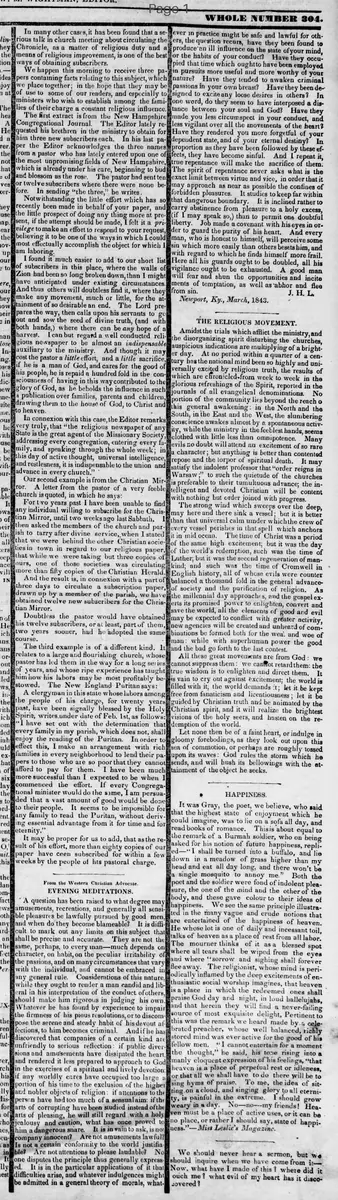
A question has been raised to what degree may amusements, recreations, and generally all sensible pleasures be lawfully pursued by good men. and when do they become blameable? It is difficult to mark out any limits on this subject that shall be precise and accurate. They are not the same, perhaps, to every man—much depends on character, on habit, on the peculiar irritability of the passions, and on many circumstances that vary with the individual, and cannot be embraced in any general rule. Considerations of this nature while they ought to render a man candid and liberal in his interpretation of the conduct of others. should make him rigorous in judging his own.
Whatever he has found by experience to impair the firmness of his pious resolutions, or to discompose the serene and steady habit of his devout affections, to him becomes criminal. And if he has discovered that companies of a certain kind are unfriendly to serious reflection: if public diversions and amusements have dissipated the heart and rendered it less prepared to approach to God in the exercises of a spiritual and lively devotion if any worldly cares have occupied too large a portion of his time to the exclusion of the higher and nobler objects of religion: if attentions to the person have had too much of a sensual aim: if the arts of corrupting have been studied instead of the arts of pleasing, he will still regard with a holy jealousy and caution, what has once proved to him a dangerous snare. It is in vain to ask, is not company innocent? Are not amusements lawful? Is not a certain conformity to the world justifiable? Are not attentions to please laudable? No one disputes the principle thus generally expressed. It is in the particular applications of it that difficulties arise, and whatever indulgences might ever in practice might be safe and lawful for others, the question recurs, have they been found to produce an ill influence on the state of your mind, or the habits of your conduct? Have they occupied that time which ought to have been employed in pursuits more useful and more worthy of your nature? Have they tended to awaken criminal passions in your own breast? Have they been designed to excite any loose desires in others? In one word, do they seem to have interposed a distance between your soul and God? Have they made you less circumspect in your conduct, and less vigilant over all the movements of the heart? Have they rendered you more forgetful of your dependent state, and of your eternal destiny?" In proportion as they have been followed by these effects, they have become sinful. And I repeat it, true repentance will make the sacrifice of them: The spirit of repentance never asks what is the exact limit between virtue and vice, in order that it may approach as near as possible the confines of forbidden pleasures. It studies to keep far within that dangerous boundary. It is inclined rather to carry abstinence from pleasure to a holy excess, (if I may speak so.) than to permit one doubtful liberty. Job made a covenant with his eyes in order to guard the purity of his heart. And every man, who is honest to himself, will perceive some sin which more easily than others besets him, and with regard to which he finds himself more frail. Here all his guards ought to be doubled, all his vigilance ought to be exhausted. A good man will fear and shun the opportunities and incitements of temptation, as well as 'abhor and flee from sin.'
J. H. L.
Newport, Ky., March, 1843
EVENING MEDITATIONS.
A question has been raised to what degree may amusements, recreations, and generally all sensible pleasures be lawfully pursued by good men. and when do they become blameable? It is difficult to mark out any limits on this subject that shall be precise and accurate. They are not the same, perhaps, to every man—much depends on character, on habit, on the peculiar irritability of the passions, and on many circumstances that vary with the individual, and cannot be embraced in any general rule. Considerations of this nature while they ought to render a man candid and liberal in his interpretation of the conduct of others. should make him rigorous in judging his own.
Whatever he has found by experience to impair the firmness of his pious resolutions, or to discompose the serene and steady habit of his devout affections, to him becomes criminal. And if he has discovered that companies of a certain kind are unfriendly to serious reflection: if public diversions and amusements have dissipated the heart and rendered it less prepared to approach to God in the exercises of a spiritual and lively devotion if any worldly cares have occupied too large a portion of his time to the exclusion of the higher and nobler objects of religion: if attentions to the person have had too much of a sensual aim: if the arts of corrupting have been studied instead of the arts of pleasing, he will still regard with a holy jealousy and caution, what has once proved to him a dangerous snare. It is in vain to ask, is not company innocent? Are not amusements lawful? Is not a certain conformity to the world justifiable? Are not attentions to please laudable? No one disputes the principle thus generally expressed. It is in the particular applications of it that difficulties arise, and whatever indulgences might ever in practice might be safe and lawful for others, the question recurs, have they been found to produce an ill influence on the state of your mind, or the habits of your conduct? Have they occupied that time which ought to have been employed in pursuits more useful and more worthy of your nature? Have they tended to awaken criminal passions in your own breast? Have they been designed to excite any loose desires in others? In one word, do they seem to have interposed a distance between your soul and God? Have they made you less circumspect in your conduct, and less vigilant over all the movements of the heart? Have they rendered you more forgetful of your dependent state, and of your eternal destiny?" In proportion as they have been followed by these effects, they have become sinful. And I repeat it, true repentance will make the sacrifice of them: The spirit of repentance never asks what is the exact limit between virtue and vice, in order that it may approach as near as possible the confines of forbidden pleasures. It studies to keep far within that dangerous boundary. It is inclined rather to carry abstinence from pleasure to a holy excess, (if I may speak so.) than to permit one doubtful liberty. Job made a covenant with his eyes in order to guard the purity of his heart. And every man, who is honest to himself, will perceive some sin which more easily than others besets him, and with regard to which he finds himself more frail. Here all his guards ought to be doubled, all his vigilance ought to be exhausted. A good man will fear and shun the opportunities and incitements of temptation, as well as 'abhor and flee from sin.'
J. H. L.
Newport, Ky., March, 1843
What sub-type of article is it?
Moral Or Religious
What keywords are associated?
Evening Meditations
Lawful Amusements
Pious Conduct
Moral Boundaries
Spiritual Vigilance
Repentance
Temptation
What entities or persons were involved?
Job
Editorial Details
Primary Topic
Boundaries Of Lawful Amusements And Pleasures For The Pious
Stance / Tone
Cautionary And Advisory On Spiritual Vigilance
Key Figures
Job
Key Arguments
Limits Of Amusements Vary By Individual Character And Experience
Pleasures Become Criminal If They Impair Pious Resolutions Or Devout Affections
Certain Companies And Diversions Can Hinder Serious Reflection And Devotion
True Repentance Requires Sacrificing Indulgences That Distance The Soul From God
Vigilance Should Be Doubled Against Personal Frailties And Temptations