Thank you for visiting SNEWPapers!
Sign up free
Editorial
September 8, 1790
Gazette Of The United States
New York, New York County, New York
What is this article about?
Satirical essay by J. Courtnay defending the Church of England and established institutions against Protestant dissenters, linking their conduct to historical upheavals and warning of dangers from the French Revolution. Critiques repeal of test and corporation acts, praises persecution, and alleges dissenters' disloyalty.
Clipping
OCR Quality
98%
Excellent
Full Text
PHILOSOPHICAL REFLECTIONS
ON THE LATE
REVOLUTION IN FRANCE,
AND THE CONDUCT
OF
THE DISSENTERS IN ENGLAND.
CONCLUDED.
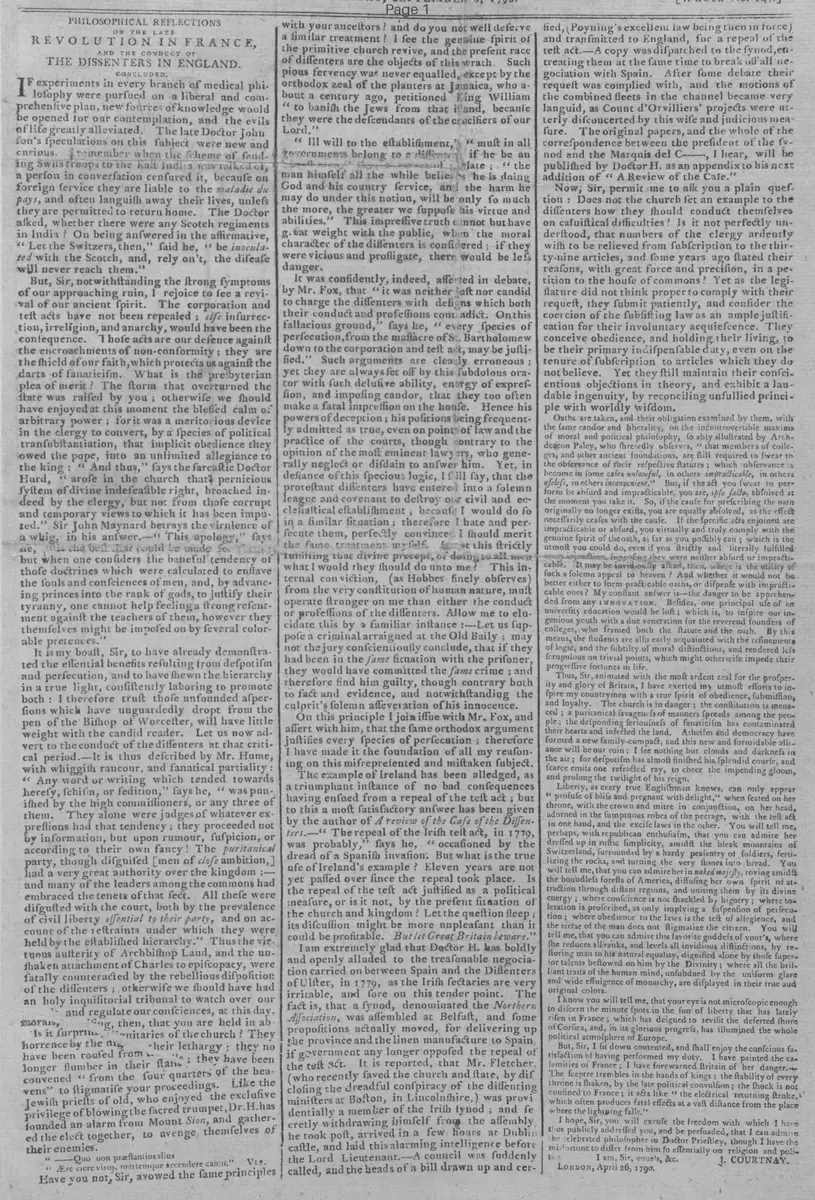
If experiments in every branch of medical philosophy were pursued on a liberal and comprehensive plan, new sources of knowledge would be opened for our contemplation, and the evils of life greatly alleviated. The late Doctor John's speculations on this subject were new and curious. I remember when the scheme of sending Swiss troops to the West Indies was talked of, a person in conversation censured it, because on foreign service they are liable to the maladie du pays, and often languish away their lives, unless they are permitted to return home. The Doctor asked, whether there were any Scotch regiments in India? On being answered in the affirmative, "Let the Switzers, then," said he, "be inoculated with the Scotch, and, rely on't, the disease will never reach them."
But, Sir, notwithstanding the strong symptoms of our approaching ruin, I rejoice to see a revival of our ancient spirit. The corporation and test acts have not been repealed; else insurrection, irreligion, and anarchy, would have been the consequence. Those acts are our defence against the encroachments of non-conformity; they are the shield of our faith, which protects us against the darts of fanaticism. What is the presbyterian plea of merit? The storm that overturned the state was raised by you; otherwise we should have enjoyed at this moment the blessed calm of arbitrary power; for it was a meritorious device in the clergy to convert, by a species of political transubstantiation, that implicit obedience they owed the pope, into an unlimited allegiance to the king: "And thus," says the sarcastic Doctor Hurd, "arose in the church that pernicious system of divine indefeasible right, broached indeed by the clergy, but not from those corrupt and temporary views to which it has been imputed." Sir John Maynard betrays the virulence of a whig, in his answer.—"This apology," says he, "is as bad as the fault could be."
But when one considers the baneful tendency of those doctrines which were calculated to enslave the souls and consciences of men, and, by advancing princes into the rank of gods, to justify their tyranny, one cannot help feeling a strong resentment against the teachers of them, however they themselves might be imposed on by several colorable pretences.
It is my boast, Sir, to have already demonstrated the essential benefits resulting from despotism and persecution, and to have shown the hierarchy in a true light, consistently laboring to promote both: I therefore trust those unfounded aspersions which have unguardedly dropped from the pen of the Bishop of Worcester, will have little weight with the candid reader. Let us now advert to the conduct of the dissenters at that critical period.—It is thus described by Mr. Hume, with whiggish rancour, and fanatical partiality:
"Any word or writing which tended towards heresy, schism, or sedition," says he, "was punished by the high commissioners, or any three of them. They alone were judges of whatever expressions had that tendency; they proceeded not by information, but upon rumour, suspicion, or according to their own fancy! The puritanical party, though disguised [men of close ambition,] had a very great authority over the kingdom;—and many of the leaders among the commons had embraced the tenets of that sect. All these were disgusted with the court, both by the prevalence of civil liberty essential to their party, and on account of the restraints under which they were held by the established hierarchy." Thus the virtuous austerity of Archbishop Laud, and the unshaken attachment of Charles to episcopacy, were fatally counteracted by the rebellious disposition of the dissenters; otherwise we should have had an holy inquisitional tribunal to watch over and regulate our consciences, at this day.
Morais, Going, then, that you are held in abhorrence by the dignitaries of the church? They horrify by their lethargy; they no longer slumber in their stands; they have been roused from the four quarters of the heavens to stigmatize your proceedings. Like the Jewish priests of old, who enjoyed the exclusive privilege of blowing the sacred trumpet, Dr. H. has sounded an alarm from Mount Sion, and gathered the elect together, to avenge themselves of their enemies.
Have you not, Sir, avowed the same principles
"Are clyere viros, martemque accendere cantu." Vir.
66
—Quo non præstantior alius
with your ancestors? and do you not well deserve a similar treatment? I see the genuine spirit of the primitive church revive, and the present race of dissenters are the objects of this wrath. Such pious fervency was never equalled, except by the orthodox zeal of the planters at Jamaica, who about a century ago, petitioned King William "to banish the Jews from that island, because they were the descendants of the crucifiers of our Lord."
"Ill will to the establishment." must in all governments belong to a dissenter if he be an honest man himself all the while believes he is doing God and his country service, and the harm he may do under this notion, will be only so much the more, the greater we suppose his virtue and abilities." This impressive truth cannot but have great weight with the public, when the moral character of the dissenters is considered; if they were vicious and profligate, there would be less danger.
It was confidently, indeed, affected in debate, by Mr. Fox, that "it was neither just nor candid to charge the dissenters with designs which both their conduct and professions contradict. On this fallacious ground," says he, "every species of persecution, from the massacre of St. Bartholomew down to the corporation and test act, may be justified." Such arguments are clearly erroneous; yet they are always set off by this subtle orator with such delusive ability, energy of expression, and imposing candor, that they too often make a fatal impression on the house. Hence his powers of deception; his positions being frequently admitted as true, even on points of law and the practice of the courts, though contrary to the opinion of the most eminent lawyers, who generally neglect or disdain to answer him. Yet, in defiance of this specious logic, I still say, that the protestant dissenters have entered into a solemn league and covenant to destroy our civil and ecclesiastical establishment; because I would do in a similar situation; therefore I hate and persecute them, perfectly convinced I should merit the same treatment myself. Is not this strictly ruminating that divine precept, or doing to all men what I would they should do unto me? This internal conviction, (as Hobbes finely observes) from the very constitution of human nature, must operate stronger on me than either the conduct or professions of the dissenters. Allow me to elucidate this by a familiar instance:—Let us suppose a criminal arraigned at the Old Bailey; may not the jury conscientiously conclude, that if they had been in the same situation with the prisoner, they would have committed the same crime; and therefore find him guilty, though contrary both to fact and evidence, and notwithstanding the culprit's solemn asseveration of his innocence.
On this principle I join issue with Mr. Fox, and assert with him, that the same orthodox argument justifies every species of persecution; therefore I have made it the foundation of all my reasoning on this misrepresented and mistaken subject.
The example of Ireland has been alleged, as a triumphant instance of no bad consequences having ensued from a repeal of the test act; but to this a most satisfactory answer has been given by the author of A review of the Case of the Dissenters.—"The repeal of the Irish test act, in 1779, was probably," says he, "occasioned by the dread of a Spanish invasion. But what is the true use of Ireland's example? Eleven years are not yet passed over since the repeal took place. Is the repeal of the test act justified as a political measure, or is it not, by the present situation of the church and kingdom? Let the question sleep; its discussion might be more unpleasant than it could be profitable. But let Great Britain beware."
I am extremely glad that Doctor H. has boldly and openly alluded to the treasonable negotiation carried on between Spain and the Dissenters of Ulster, in 1779, as the Irish sectaries are very irritable, and sore on this tender point. The fact is, that a synod, denominated the Northern Association, was assembled at Belfast, and some propositions actually moved, for delivering up the province and the linen manufacture to Spain, if government any longer opposed the repeal of the test act. It is reported, that Mr. Fletcher, (who recently saved the church and state, by disclosing the dreadful conspiracy of the dissenting ministers at Boston, in Lincolnshire,) was providentially a member of the Irish synod; and secretly withdrawing himself from the assembly he took post, arrived in a few hours at Dublin castle, and laid this alarming intelligence before the Lord Lieutenant.—A council was suddenly called, and the heads of a bill drawn up and certified, (Poyning's excellent law being then in force) and transmitted to England, for a repeal of the test act.—A copy was dispatched to the synod, entreating them at the same time to break off all negotiation with Spain. After some debate their request was complied with, and the motions of the combined fleets in the channel became very languid, as Count d'Orvilliers' projects were utterly disconcerted by this wise and judicious measure. The original papers, and the whole of the correspondence between the president of the synod and the Marquis del C—, I hear, will be published by Doctor H, as an appendix to his next edition of "A Review of the Case."
Now, Sir, permit me to ask you a plain question: Does not the church set an example to the dissenters how they should conduct themselves on casuistical difficulties? Is it not perfectly understood, that numbers of the clergy ardently wish to be relieved from subscription to the thirty-nine articles, and some years ago stated their reasons, with great force and precision, in a petition to the house of commons? Yet as the legislature did not think proper to comply with their request, they submit patiently, and consider the coercion of the subsisting law as an ample justification for their involuntary acquiescence. They conceive obedience, and holding their living, to be their primary indispensable duty, even on the tenure of subscription to articles which they do not believe. Yet they still maintain their conscientious objections in theory, and exhibit a laudable ingenuity, by reconciling unfullied principle with worldly wisdom.
Oaths are taken, and their obligation examined by them, with the same candor and liberality, on the incontrovertible maxims of moral and political philosophy, so ably illustrated by Archdeacon Paley, who shrewdly observes, "that members of colleges, and other ancient foundations, are still required to swear to the observance of their respective statutes; which observance is become in some cases unlawful, in others impracticable, in others useless, in others inconvenient." But, if the act you swear to perform be absurd and impracticable, you are, ipso facto, absolved at the moment you take it. So, if the cause for prescribing the oath originally no longer exists, you are equally absolved, as the effect necessarily ceases with the cause. If the specific acts enjoined are impracticable or absurd, you virtually and truly comply with the genuine spirit of the oath, as far as you possibly can; which is the utmost you could do, even if you strictly and literally fulfilled every injunction, supposing they were neither absurd or impracticable.
It may be invidiously asked, then, where is the utility of such a solemn appeal to heaven? And whether it would not be better either to form practicable oaths, or dispense with impracticable ones? My constant answer is—the danger to be apprehended from any innovation. Besides, one principal use of an university education would be lost; which is, to inspire our ingenious youth with a due veneration for the reverend founders of colleges, who framed both the statute and the oath. By this means, the students are also early acquainted with the refinement of logic, and the subtlety of moral distinctions, and rendered less scrupulous on trivial points, which might otherwise impede their progressive fortunes in life.
Thus, Sir, animated with the most ardent zeal for the prosperity and glory of Britain, I have exerted my utmost efforts to inspire my countrymen with a true spirit of obedience, submission, and loyalty. The church is in danger; the constitution is menaced; a puritanical savageness of manners spreads among the people; the desponding seriousness of fanaticism has contaminated their hearts and infected the land. Atheism and democracy have formed a new family-compact, and this new and formidable alliance will be our ruin: I see nothing but clouds and darkness in the air; for despotism has almost finished his splendid course, and scarce emits one refracted ray, to cheer the impending gloom, and prolong the twilight of his reign.
Liberty, as every true Englishman knows, can only appear "prolific of bliss and pregnant with delight," when seated on her throne, with the crown and mitre in conjunction, on her head, adorned in the sumptuous robes of the peerage, with the test act in one hand, and the excise laws in the other. You will tell me, perhaps, with republican enthusiasm, that you can admire her dressed up in rustic simplicity, amidst the bleak mountains of Switzerland, surrounded by a hardy peasantry of soldiers, fertilizing the rocks, and turning the very stones into bread. You will tell me, that you can admire her in naked majesty, roving amidst the boundless forests of America, diffusing her own spirit of attraction through distant regions, and uniting them by its divine energy; where conscience is not shackled by bigotry; where toleration is proscribed, as only implying a suspension of persecution: where obedience to the laws is the test of allegiance, and the virtue of the man does not stigmatize the citizen. You will tell me, that you can admire this favorite goddess of yours, where she reduces all ranks, and levels all invidious distinctions, by restoring man to his natural equality, dignified alone by those superior talents bestowed on him by the Divinity; where all the brilliant traits of the human mind, unsubdued by the uniform glare and wide effulgence of monarchy, are displayed in their true and original colors.
I know you will tell me, that your eye is not microscopic enough to discern the minute spots in the sun of liberty that has lately risen in France; which has deigned to revisit the deserted shore of Corsica, and, in its glorious progress, has illumined the whole political atmosphere of Europe.
But, Sir, I sit down contented, and shall enjoy the conscious satisfaction of having performed my duty. I have painted the calamities of France; I have forewarned Britain of her danger. The sceptre trembles in the hands of kings; the stability of every throne is shaken, by the late political convulsion; the shock is not confined to France; it acts like "the electrical returning stroke, which often produces fatal effects at a vast distance from the place where the lightning falls."
I hope, Sir, you will excuse the freedom with which I have thus publicly addressed you, and be persuaded, that I can admire the celebrated philosopher Doctor Priestley, though I have the misfortune to differ from him so essentially on religion and politics
I am, Sir, yours, &c.
J. COURTNAY.
London, April 26, 1790.
ON THE LATE
REVOLUTION IN FRANCE,
AND THE CONDUCT
OF
THE DISSENTERS IN ENGLAND.
CONCLUDED.
If experiments in every branch of medical philosophy were pursued on a liberal and comprehensive plan, new sources of knowledge would be opened for our contemplation, and the evils of life greatly alleviated. The late Doctor John's speculations on this subject were new and curious. I remember when the scheme of sending Swiss troops to the West Indies was talked of, a person in conversation censured it, because on foreign service they are liable to the maladie du pays, and often languish away their lives, unless they are permitted to return home. The Doctor asked, whether there were any Scotch regiments in India? On being answered in the affirmative, "Let the Switzers, then," said he, "be inoculated with the Scotch, and, rely on't, the disease will never reach them."
But, Sir, notwithstanding the strong symptoms of our approaching ruin, I rejoice to see a revival of our ancient spirit. The corporation and test acts have not been repealed; else insurrection, irreligion, and anarchy, would have been the consequence. Those acts are our defence against the encroachments of non-conformity; they are the shield of our faith, which protects us against the darts of fanaticism. What is the presbyterian plea of merit? The storm that overturned the state was raised by you; otherwise we should have enjoyed at this moment the blessed calm of arbitrary power; for it was a meritorious device in the clergy to convert, by a species of political transubstantiation, that implicit obedience they owed the pope, into an unlimited allegiance to the king: "And thus," says the sarcastic Doctor Hurd, "arose in the church that pernicious system of divine indefeasible right, broached indeed by the clergy, but not from those corrupt and temporary views to which it has been imputed." Sir John Maynard betrays the virulence of a whig, in his answer.—"This apology," says he, "is as bad as the fault could be."
But when one considers the baneful tendency of those doctrines which were calculated to enslave the souls and consciences of men, and, by advancing princes into the rank of gods, to justify their tyranny, one cannot help feeling a strong resentment against the teachers of them, however they themselves might be imposed on by several colorable pretences.
It is my boast, Sir, to have already demonstrated the essential benefits resulting from despotism and persecution, and to have shown the hierarchy in a true light, consistently laboring to promote both: I therefore trust those unfounded aspersions which have unguardedly dropped from the pen of the Bishop of Worcester, will have little weight with the candid reader. Let us now advert to the conduct of the dissenters at that critical period.—It is thus described by Mr. Hume, with whiggish rancour, and fanatical partiality:
"Any word or writing which tended towards heresy, schism, or sedition," says he, "was punished by the high commissioners, or any three of them. They alone were judges of whatever expressions had that tendency; they proceeded not by information, but upon rumour, suspicion, or according to their own fancy! The puritanical party, though disguised [men of close ambition,] had a very great authority over the kingdom;—and many of the leaders among the commons had embraced the tenets of that sect. All these were disgusted with the court, both by the prevalence of civil liberty essential to their party, and on account of the restraints under which they were held by the established hierarchy." Thus the virtuous austerity of Archbishop Laud, and the unshaken attachment of Charles to episcopacy, were fatally counteracted by the rebellious disposition of the dissenters; otherwise we should have had an holy inquisitional tribunal to watch over and regulate our consciences, at this day.
Morais, Going, then, that you are held in abhorrence by the dignitaries of the church? They horrify by their lethargy; they no longer slumber in their stands; they have been roused from the four quarters of the heavens to stigmatize your proceedings. Like the Jewish priests of old, who enjoyed the exclusive privilege of blowing the sacred trumpet, Dr. H. has sounded an alarm from Mount Sion, and gathered the elect together, to avenge themselves of their enemies.
Have you not, Sir, avowed the same principles
"Are clyere viros, martemque accendere cantu." Vir.
66
—Quo non præstantior alius
with your ancestors? and do you not well deserve a similar treatment? I see the genuine spirit of the primitive church revive, and the present race of dissenters are the objects of this wrath. Such pious fervency was never equalled, except by the orthodox zeal of the planters at Jamaica, who about a century ago, petitioned King William "to banish the Jews from that island, because they were the descendants of the crucifiers of our Lord."
"Ill will to the establishment." must in all governments belong to a dissenter if he be an honest man himself all the while believes he is doing God and his country service, and the harm he may do under this notion, will be only so much the more, the greater we suppose his virtue and abilities." This impressive truth cannot but have great weight with the public, when the moral character of the dissenters is considered; if they were vicious and profligate, there would be less danger.
It was confidently, indeed, affected in debate, by Mr. Fox, that "it was neither just nor candid to charge the dissenters with designs which both their conduct and professions contradict. On this fallacious ground," says he, "every species of persecution, from the massacre of St. Bartholomew down to the corporation and test act, may be justified." Such arguments are clearly erroneous; yet they are always set off by this subtle orator with such delusive ability, energy of expression, and imposing candor, that they too often make a fatal impression on the house. Hence his powers of deception; his positions being frequently admitted as true, even on points of law and the practice of the courts, though contrary to the opinion of the most eminent lawyers, who generally neglect or disdain to answer him. Yet, in defiance of this specious logic, I still say, that the protestant dissenters have entered into a solemn league and covenant to destroy our civil and ecclesiastical establishment; because I would do in a similar situation; therefore I hate and persecute them, perfectly convinced I should merit the same treatment myself. Is not this strictly ruminating that divine precept, or doing to all men what I would they should do unto me? This internal conviction, (as Hobbes finely observes) from the very constitution of human nature, must operate stronger on me than either the conduct or professions of the dissenters. Allow me to elucidate this by a familiar instance:—Let us suppose a criminal arraigned at the Old Bailey; may not the jury conscientiously conclude, that if they had been in the same situation with the prisoner, they would have committed the same crime; and therefore find him guilty, though contrary both to fact and evidence, and notwithstanding the culprit's solemn asseveration of his innocence.
On this principle I join issue with Mr. Fox, and assert with him, that the same orthodox argument justifies every species of persecution; therefore I have made it the foundation of all my reasoning on this misrepresented and mistaken subject.
The example of Ireland has been alleged, as a triumphant instance of no bad consequences having ensued from a repeal of the test act; but to this a most satisfactory answer has been given by the author of A review of the Case of the Dissenters.—"The repeal of the Irish test act, in 1779, was probably," says he, "occasioned by the dread of a Spanish invasion. But what is the true use of Ireland's example? Eleven years are not yet passed over since the repeal took place. Is the repeal of the test act justified as a political measure, or is it not, by the present situation of the church and kingdom? Let the question sleep; its discussion might be more unpleasant than it could be profitable. But let Great Britain beware."
I am extremely glad that Doctor H. has boldly and openly alluded to the treasonable negotiation carried on between Spain and the Dissenters of Ulster, in 1779, as the Irish sectaries are very irritable, and sore on this tender point. The fact is, that a synod, denominated the Northern Association, was assembled at Belfast, and some propositions actually moved, for delivering up the province and the linen manufacture to Spain, if government any longer opposed the repeal of the test act. It is reported, that Mr. Fletcher, (who recently saved the church and state, by disclosing the dreadful conspiracy of the dissenting ministers at Boston, in Lincolnshire,) was providentially a member of the Irish synod; and secretly withdrawing himself from the assembly he took post, arrived in a few hours at Dublin castle, and laid this alarming intelligence before the Lord Lieutenant.—A council was suddenly called, and the heads of a bill drawn up and certified, (Poyning's excellent law being then in force) and transmitted to England, for a repeal of the test act.—A copy was dispatched to the synod, entreating them at the same time to break off all negotiation with Spain. After some debate their request was complied with, and the motions of the combined fleets in the channel became very languid, as Count d'Orvilliers' projects were utterly disconcerted by this wise and judicious measure. The original papers, and the whole of the correspondence between the president of the synod and the Marquis del C—, I hear, will be published by Doctor H, as an appendix to his next edition of "A Review of the Case."
Now, Sir, permit me to ask you a plain question: Does not the church set an example to the dissenters how they should conduct themselves on casuistical difficulties? Is it not perfectly understood, that numbers of the clergy ardently wish to be relieved from subscription to the thirty-nine articles, and some years ago stated their reasons, with great force and precision, in a petition to the house of commons? Yet as the legislature did not think proper to comply with their request, they submit patiently, and consider the coercion of the subsisting law as an ample justification for their involuntary acquiescence. They conceive obedience, and holding their living, to be their primary indispensable duty, even on the tenure of subscription to articles which they do not believe. Yet they still maintain their conscientious objections in theory, and exhibit a laudable ingenuity, by reconciling unfullied principle with worldly wisdom.
Oaths are taken, and their obligation examined by them, with the same candor and liberality, on the incontrovertible maxims of moral and political philosophy, so ably illustrated by Archdeacon Paley, who shrewdly observes, "that members of colleges, and other ancient foundations, are still required to swear to the observance of their respective statutes; which observance is become in some cases unlawful, in others impracticable, in others useless, in others inconvenient." But, if the act you swear to perform be absurd and impracticable, you are, ipso facto, absolved at the moment you take it. So, if the cause for prescribing the oath originally no longer exists, you are equally absolved, as the effect necessarily ceases with the cause. If the specific acts enjoined are impracticable or absurd, you virtually and truly comply with the genuine spirit of the oath, as far as you possibly can; which is the utmost you could do, even if you strictly and literally fulfilled every injunction, supposing they were neither absurd or impracticable.
It may be invidiously asked, then, where is the utility of such a solemn appeal to heaven? And whether it would not be better either to form practicable oaths, or dispense with impracticable ones? My constant answer is—the danger to be apprehended from any innovation. Besides, one principal use of an university education would be lost; which is, to inspire our ingenious youth with a due veneration for the reverend founders of colleges, who framed both the statute and the oath. By this means, the students are also early acquainted with the refinement of logic, and the subtlety of moral distinctions, and rendered less scrupulous on trivial points, which might otherwise impede their progressive fortunes in life.
Thus, Sir, animated with the most ardent zeal for the prosperity and glory of Britain, I have exerted my utmost efforts to inspire my countrymen with a true spirit of obedience, submission, and loyalty. The church is in danger; the constitution is menaced; a puritanical savageness of manners spreads among the people; the desponding seriousness of fanaticism has contaminated their hearts and infected the land. Atheism and democracy have formed a new family-compact, and this new and formidable alliance will be our ruin: I see nothing but clouds and darkness in the air; for despotism has almost finished his splendid course, and scarce emits one refracted ray, to cheer the impending gloom, and prolong the twilight of his reign.
Liberty, as every true Englishman knows, can only appear "prolific of bliss and pregnant with delight," when seated on her throne, with the crown and mitre in conjunction, on her head, adorned in the sumptuous robes of the peerage, with the test act in one hand, and the excise laws in the other. You will tell me, perhaps, with republican enthusiasm, that you can admire her dressed up in rustic simplicity, amidst the bleak mountains of Switzerland, surrounded by a hardy peasantry of soldiers, fertilizing the rocks, and turning the very stones into bread. You will tell me, that you can admire her in naked majesty, roving amidst the boundless forests of America, diffusing her own spirit of attraction through distant regions, and uniting them by its divine energy; where conscience is not shackled by bigotry; where toleration is proscribed, as only implying a suspension of persecution: where obedience to the laws is the test of allegiance, and the virtue of the man does not stigmatize the citizen. You will tell me, that you can admire this favorite goddess of yours, where she reduces all ranks, and levels all invidious distinctions, by restoring man to his natural equality, dignified alone by those superior talents bestowed on him by the Divinity; where all the brilliant traits of the human mind, unsubdued by the uniform glare and wide effulgence of monarchy, are displayed in their true and original colors.
I know you will tell me, that your eye is not microscopic enough to discern the minute spots in the sun of liberty that has lately risen in France; which has deigned to revisit the deserted shore of Corsica, and, in its glorious progress, has illumined the whole political atmosphere of Europe.
But, Sir, I sit down contented, and shall enjoy the conscious satisfaction of having performed my duty. I have painted the calamities of France; I have forewarned Britain of her danger. The sceptre trembles in the hands of kings; the stability of every throne is shaken, by the late political convulsion; the shock is not confined to France; it acts like "the electrical returning stroke, which often produces fatal effects at a vast distance from the place where the lightning falls."
I hope, Sir, you will excuse the freedom with which I have thus publicly addressed you, and be persuaded, that I can admire the celebrated philosopher Doctor Priestley, though I have the misfortune to differ from him so essentially on religion and politics
I am, Sir, yours, &c.
J. COURTNAY.
London, April 26, 1790.
What sub-type of article is it?
Foreign Affairs
Moral Or Religious
Partisan Politics
What keywords are associated?
French Revolution
Dissenters
Test Act
Corporation Act
Church Establishment
Persecution
Political Satire
Religious Conformity
What entities or persons were involved?
Dissenters
Church Of England
Joseph Priestley
Charles James Fox
David Hume
Archbishop Laud
Doctor Hurd
Sir John Maynard
Bishop Of Worcester
Editorial Details
Primary Topic
Defense Of Church Establishment Against Dissenters Amid French Revolution
Stance / Tone
Satirical Pro Establishment Anti Dissenter
Key Figures
Dissenters
Church Of England
Joseph Priestley
Charles James Fox
David Hume
Archbishop Laud
Doctor Hurd
Sir John Maynard
Bishop Of Worcester
Key Arguments
Corporation And Test Acts Prevent Insurrection And Anarchy
Dissenters Historically Caused Political Storms Like The English Civil War
Despotism And Persecution Benefit Society
Dissenters Pose Ongoing Threat To Church And State
Alleged Treasonous Negotiations With Spain By Irish Dissenters In 1779
Clergy's Subscription To Articles Justified Despite Disbelief
Liberty Best Under Established Monarchy And Church
French Revolution Threatens European Thrones