Thank you for visiting SNEWPapers!
Sign up free
Story
July 1, 1883
Wheeling Sunday Register
Wheeling, Ohio County, West Virginia
What is this article about?
Article details the histories and evolving social relations among the wealthy Vanderbilt, Astor, and Gould families in New York, highlighting their potential intermarriages to form an American nobility, with Jay Gould strategically allying with the others.
Clipping
OCR Quality
95%
Excellent
Full Text
Sunday Register.
SUNDAY, JULY 1, 1883.
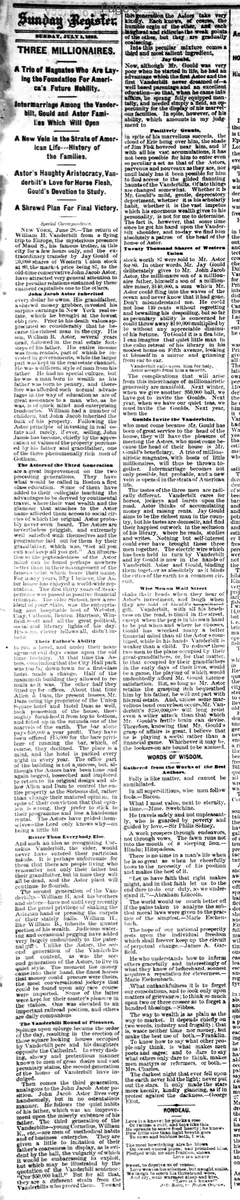
THREE MILLIONAIRES
A Trio of Magnates Who Are Laying the Foundation For America's Future Nobility.
Intermarriage Among the Vanderbilt, Gould and Astor Families Which Will Open
A New Vein in the Strata of American Life---History of
the Families.
Astor's Haughty Aristocracy, Vanderbilt's Love for Horse Flesh,
Gould's Devotion to Study.
A Shrewd Plan For Final Victory.
Special Correspondence.
NEW YORK, June 29.-The return of
William H. Vanderbilt from a flying
trip to Europe, the mysterious presence
of Maud S., his famous trotter, in this
city for a few hours only, and the ex-
traordinary transfer by Jay Gould of
20,000 shares of Western Union stock
at 80, the market price being 87, to the
old-time conservative John Jacob Astor.
have attracted very general attention to
the peculiar relations sustained by these
eminent capitalists one to the others.
John Jacob Astor inherited
every dollar he owns. His grandfather,
a shrewd money grubber, invested his
surplus earnings in New York real es-
tate, which he bought at the lowest
prices. Prior to his death values ap-
preciated so considerably that he be-
came the richest man in the city. His
son, William B. Astor, several years
deceased, followed in the real estate "foot-
steps of his father. His entire income
was from rental, part of which he in-
vested in governments, while the larger
part was kept in the real estate channel.
He was a different style of man from his
father. He had no special culture, but
he was a man born in wealth as his
father was born to penury, and there-
fore was afforded such normal advan-
tages in the way of education as are of
great assistance to a man who, as he
was, is of quick mind and enterprising
tendencies. William had a number of
children, but John Jacob inherited the
bulk of his property. Following the
Astor principle of investing in real es-
tate and rarely, if ever, selling, John
Jacob has become, chiefly by the appre-
ciation of values of the property purchas-
ed by his father and grandfather, one
of the three phenomenally rich men of
Gotham.
The Astors of the third generation
are a great improvement on the two
preceding generations. They have
what would be called in Boston a first
class education. Some of them have
added to their collegiate teaching the
advantages to be derived by continental
travel, where their vast wealth and the
glamour that attaches to the Astor
name afforded them access to social cir-
cles of which the original Astor proba-
bly never even heard. The Astors are
nevertheless priggish, and extremely
well satisfied with themselves and the
programme laid out for them by their
grandfather, which was, "get all you
can and keep all you get." An illustra-
tion of the pigheadedness of the Astor
mind can be found perhaps nowhere
better than in their management of the
famous hotel which bears their name.
For many years, fifty I believe, the As-
tor house has enjoyed a world-wide rep-
utation. The first thirty years of its ex-
perience was passed in positive financial
triumph. The elder Stetson, now a res-
ident of your State, was the enterpris-
ing and hospitable host of Webster,
Clay, Calhoun, Benton, Harrison, Win-
field Scott and all the great political,
social and literary lights of his day.
His sons, clever fellows all, didn't in-
herit
Their Father's Ability
to run a hotel, and under their man-
agement evil days came upon the old
time hostelry. At that time the As-
tors, concluding that the City Hall park
was too far down town for a first-class
hotel, made a change. Half of the
mammoth building they allowed to re-
main as it was. The other half they
fitted up for offices. About that time
Allen & Dam, the present lessees, Mr.
Dam being the proprietor of the Union
Square hotel and Hotel Dam as well,
took possession of the house, thor-
oughly furnished it from top to bottom,
and fitted up in the rotunda one of the
marvels of the earth. The bar alone
pays $30,000 a year profit. They have
been offered $15,000 for the bare privi-
lege of running the bar, which, of
course, they declined. The place is a
mint, and the hotel is packed every
night in every year. The office part
of the building is not a success, but, al-
though the Astors have been time and
again begged, beseeched and implored
to return to its original design and al-
low Allen and Dam to control the en-
tire property as the Stetsons did, rather
than change their matured opinion, in
spite of their conviction that that opin-
ion is wrong, they prefer to stick to
their programme and lose a handsome
rental. The Astors have prided them-
themselves-the Lord only knows why-on
being a little bit
Better Than Everybody Else.
And such an idea as recognizing Cor-
nelius Vanderbilt, the elder, would
never have entered their patrician
minds. It is perhaps unfortunate for
them that there are people living who
remember not only their father but
their grandfather, but in time they will
all be dead, and the Astor plant will
continue to flourish.
The second generation of the Van-
derbilts-William H. and his brothers
and sisters—have not until very recently
had the proud privilege of shaking the
Astorian hand or pressing the carpets
of their stately halls. William H.,
like William B., inherits the greater
portion of his wealth. Judicious water-
ing and occasional pegging have added
very largely undoubtedly to the pater-
nal gift. Unlike the Astors, the see-
ond generation of the Vanderbilts
is not content, as was the see-
ond generation of the Astors, to live in
quiet style. The moment the money
came into their hands, the finest horses
that money could procure were theirs.
the most conversational jockeys that
could be found upon any race course
were imported. Some of the latter
were kept for their master's pleasure in
the stables. One was elevated to an
important railroad position, and others
are daily companions
The Vanderbilt Round of Pleasure.
Splurge upon splurge became the order
of the day, resulting in the erection of
those square looking houses occupied
by Vanderbilt pere and his daughters
opposite the Cathedral. In every dash-
ing, showy and pretentious manner
known to men of gross desire and vast
pecuniary status, the second generation
of the house of Vanderbilt have in-
dulged.
Then comes the third generation,
analogous to the John Jacob Astor po-
sition. John Jacob Astor lives very
handsomely, but in no ostentatious
manner. He follows the quiet habits
of his father, which was an improve-
ment upon the miserly existence of his
father. "The third generation of the
Vanderbilts—young Cornelius, William
K., etc.-are men of methodical habits
given a little to imitation of their
father's coarseness in display, as is evi-
dent by the ball, the vulgarity of which
it would be embarrassing to exploit
but which may be illustrated by the
quotation of the Vanderbilt sentence:
"Our $50,000 ball." But for all that,
they are a different strain from the
men who preceded them. Toward
this generation the Astors take very
kindly. Each knows, of course, the
humble origin of the other, and each
laughs at and ridicules the weak points
of the other, but they are gradually
coalescing.
In this peculiar mixture comes a
third and most salient ingredient,
Jay Gould.
Now, although Mr. Gould was very
poor when he started in life, he had an
advantage which the first Astor and the
first Vanderbilt never dreamed of-a
well based parentage and an excellent
education-so that, when he came into
affairs, he sprang fully equipped men-
tally, and needed simply a field, an op-
portunity for the display of his marvel-
ous faculties. In spite, however, of his
ability, which amounts in my judg-
ment to
Positively Genius,
in spite of his marvellous success, the
cloud of Erie hung over him, the shade
of Jim Fisk hovered near him, and if
with all his vast accumulations it has
not been possible for him to enter even
so peculiar a set as that of the Astors,
parvenus and nouveaux as they are, nor
until lately has it been possible for him
to find access to the gilded flaunting
haunts of the Vanderbilts. Of late things
are changed somewhat. Whether it is
Mr. Gould's mild, gentle, deprecatory
department, whether it is his scholarly
habit, whether it is the vast impetus
which his enormous wealth gives to his
personality, is not for me to determine.
The fact is, however, that some time
since he got his hand upon the Vander-
bilt shoulder, and to-day we find him
absolutely a patron of the head of the
house of Astor.
Twenty Thousand Shares of Western
Union
stock worth $87 were sold to Mr. Astor
for $80. In other words, Mr. Jay Gould
deliberately gives to Mr. John Jacob
Astor, the millionaire son of a million-
aire father, himself a son of a million-
aire miser, $140,000, a sum which Mr.
Astor could fling into the waves of the
ocean and never know that it had gone.
Don't misunderstand me. He could
not lose 10 cents without regretting
and bewailing his despoiling, but so far
as pecuniary ability is concerned he
could throw away $140,000 multiplied by
to without any appreciable diminu-
tion of his fortune. To Gould it is a flea bite.
I can imagine that quiet little man in
the calm retreat of his library in his
modest home on Fifth avenue, looking
at himself in a mirror and grinning
from ear to ear.
Vanderbilt calls upon him for help,
Astor accepts from him a benefit.
The complications that will arise
from this interchange of milionairistic
generosity are manifold. Next winter
when we give another $50,000 ball, we
have got to invite the Goulds. Next
year, when we have our quiet teas, we
must invite the Goulds. Next year
when the
Goulds invite the Vanderbilts,
who must come because Mr. Gould has
been of great service to the head of the
house, they will have the pleasure of
meeting the Astors, who must come be-
cause the head of their house is Mr.
Gould's beneficiary. A trio of milion-
aireistic magnates, with hosts of little
millionaires, will thus be thrown to-
gether. Intermarriage becomes not
only possible, but probable, and a new
vein is opened in the strata of American
life.
The tastes of the three men are radi-
cally different. Vanderbilt cares for
horses, jockeys and bursts upon the
road. Astor thinks of accumulating
money and raising rents. Jay Gould
aims to be the richest man in the coun-
try, but his tastes are domestic, and find
their happiest outwork in the seclusion
of his library, where he reads, studies
and writes. Nothing but self-interest
could ever have brought these three
men together. The electric wire which
has been held in turn by Vanderbilt
and by Gould is now in the hands of
Vanderbilt, Astor and Gould, binding
them together as absolutely as it binds
the cities of the earth to a common cir-
cuit.
Wise Men on Wall Street
shake their heads when they hear of
Astor's investment, and laugh when
they are told of Gould's magnificent
gift. Vanderbilt, with all his brash-
ness on the road, is timid in the street,
except when the peg is in his own hand
to be put when and where he chooses.
Gould has wrecked many a better
financial mind than all the Astors com-
bined, while in his hands Vanderbilt is
weaker than a child. To reduce these
two men to the plane occupied by their
great-grandfathers, or, for that matter.
to that occupied by their grandfathers
in the early days of their lives, would
be a game, the playing of which would
undoubtedly afford Mr. Gould intense
satisfaction. But, so long as Mr. Astor
retains the grasping itch bequeathed
him by his father, he will not part with
his real estate. And, unless some mar-
vellous bond convulsion occurs, Mr. Van-
derbilt's $250,000,000 will long resist
even a wilier attack than that which
Mr. Gould's fertile brain can devise.
Therefore, knowing that Mr. Gould's
grasp of affairs is great, I believe that
he is playing a social rather than a
financial game. Whichever it may be
the lookers-on are bound to be amused.
SUNDAY, JULY 1, 1883.
THREE MILLIONAIRES
A Trio of Magnates Who Are Laying the Foundation For America's Future Nobility.
Intermarriage Among the Vanderbilt, Gould and Astor Families Which Will Open
A New Vein in the Strata of American Life---History of
the Families.
Astor's Haughty Aristocracy, Vanderbilt's Love for Horse Flesh,
Gould's Devotion to Study.
A Shrewd Plan For Final Victory.
Special Correspondence.
NEW YORK, June 29.-The return of
William H. Vanderbilt from a flying
trip to Europe, the mysterious presence
of Maud S., his famous trotter, in this
city for a few hours only, and the ex-
traordinary transfer by Jay Gould of
20,000 shares of Western Union stock
at 80, the market price being 87, to the
old-time conservative John Jacob Astor.
have attracted very general attention to
the peculiar relations sustained by these
eminent capitalists one to the others.
John Jacob Astor inherited
every dollar he owns. His grandfather,
a shrewd money grubber, invested his
surplus earnings in New York real es-
tate, which he bought at the lowest
prices. Prior to his death values ap-
preciated so considerably that he be-
came the richest man in the city. His
son, William B. Astor, several years
deceased, followed in the real estate "foot-
steps of his father. His entire income
was from rental, part of which he in-
vested in governments, while the larger
part was kept in the real estate channel.
He was a different style of man from his
father. He had no special culture, but
he was a man born in wealth as his
father was born to penury, and there-
fore was afforded such normal advan-
tages in the way of education as are of
great assistance to a man who, as he
was, is of quick mind and enterprising
tendencies. William had a number of
children, but John Jacob inherited the
bulk of his property. Following the
Astor principle of investing in real es-
tate and rarely, if ever, selling, John
Jacob has become, chiefly by the appre-
ciation of values of the property purchas-
ed by his father and grandfather, one
of the three phenomenally rich men of
Gotham.
The Astors of the third generation
are a great improvement on the two
preceding generations. They have
what would be called in Boston a first
class education. Some of them have
added to their collegiate teaching the
advantages to be derived by continental
travel, where their vast wealth and the
glamour that attaches to the Astor
name afforded them access to social cir-
cles of which the original Astor proba-
bly never even heard. The Astors are
nevertheless priggish, and extremely
well satisfied with themselves and the
programme laid out for them by their
grandfather, which was, "get all you
can and keep all you get." An illustra-
tion of the pigheadedness of the Astor
mind can be found perhaps nowhere
better than in their management of the
famous hotel which bears their name.
For many years, fifty I believe, the As-
tor house has enjoyed a world-wide rep-
utation. The first thirty years of its ex-
perience was passed in positive financial
triumph. The elder Stetson, now a res-
ident of your State, was the enterpris-
ing and hospitable host of Webster,
Clay, Calhoun, Benton, Harrison, Win-
field Scott and all the great political,
social and literary lights of his day.
His sons, clever fellows all, didn't in-
herit
Their Father's Ability
to run a hotel, and under their man-
agement evil days came upon the old
time hostelry. At that time the As-
tors, concluding that the City Hall park
was too far down town for a first-class
hotel, made a change. Half of the
mammoth building they allowed to re-
main as it was. The other half they
fitted up for offices. About that time
Allen & Dam, the present lessees, Mr.
Dam being the proprietor of the Union
Square hotel and Hotel Dam as well,
took possession of the house, thor-
oughly furnished it from top to bottom,
and fitted up in the rotunda one of the
marvels of the earth. The bar alone
pays $30,000 a year profit. They have
been offered $15,000 for the bare privi-
lege of running the bar, which, of
course, they declined. The place is a
mint, and the hotel is packed every
night in every year. The office part
of the building is not a success, but, al-
though the Astors have been time and
again begged, beseeched and implored
to return to its original design and al-
low Allen and Dam to control the en-
tire property as the Stetsons did, rather
than change their matured opinion, in
spite of their conviction that that opin-
ion is wrong, they prefer to stick to
their programme and lose a handsome
rental. The Astors have prided them-
themselves-the Lord only knows why-on
being a little bit
Better Than Everybody Else.
And such an idea as recognizing Cor-
nelius Vanderbilt, the elder, would
never have entered their patrician
minds. It is perhaps unfortunate for
them that there are people living who
remember not only their father but
their grandfather, but in time they will
all be dead, and the Astor plant will
continue to flourish.
The second generation of the Van-
derbilts-William H. and his brothers
and sisters—have not until very recently
had the proud privilege of shaking the
Astorian hand or pressing the carpets
of their stately halls. William H.,
like William B., inherits the greater
portion of his wealth. Judicious water-
ing and occasional pegging have added
very largely undoubtedly to the pater-
nal gift. Unlike the Astors, the see-
ond generation of the Vanderbilts
is not content, as was the see-
ond generation of the Astors, to live in
quiet style. The moment the money
came into their hands, the finest horses
that money could procure were theirs.
the most conversational jockeys that
could be found upon any race course
were imported. Some of the latter
were kept for their master's pleasure in
the stables. One was elevated to an
important railroad position, and others
are daily companions
The Vanderbilt Round of Pleasure.
Splurge upon splurge became the order
of the day, resulting in the erection of
those square looking houses occupied
by Vanderbilt pere and his daughters
opposite the Cathedral. In every dash-
ing, showy and pretentious manner
known to men of gross desire and vast
pecuniary status, the second generation
of the house of Vanderbilt have in-
dulged.
Then comes the third generation,
analogous to the John Jacob Astor po-
sition. John Jacob Astor lives very
handsomely, but in no ostentatious
manner. He follows the quiet habits
of his father, which was an improve-
ment upon the miserly existence of his
father. "The third generation of the
Vanderbilts—young Cornelius, William
K., etc.-are men of methodical habits
given a little to imitation of their
father's coarseness in display, as is evi-
dent by the ball, the vulgarity of which
it would be embarrassing to exploit
but which may be illustrated by the
quotation of the Vanderbilt sentence:
"Our $50,000 ball." But for all that,
they are a different strain from the
men who preceded them. Toward
this generation the Astors take very
kindly. Each knows, of course, the
humble origin of the other, and each
laughs at and ridicules the weak points
of the other, but they are gradually
coalescing.
In this peculiar mixture comes a
third and most salient ingredient,
Jay Gould.
Now, although Mr. Gould was very
poor when he started in life, he had an
advantage which the first Astor and the
first Vanderbilt never dreamed of-a
well based parentage and an excellent
education-so that, when he came into
affairs, he sprang fully equipped men-
tally, and needed simply a field, an op-
portunity for the display of his marvel-
ous faculties. In spite, however, of his
ability, which amounts in my judg-
ment to
Positively Genius,
in spite of his marvellous success, the
cloud of Erie hung over him, the shade
of Jim Fisk hovered near him, and if
with all his vast accumulations it has
not been possible for him to enter even
so peculiar a set as that of the Astors,
parvenus and nouveaux as they are, nor
until lately has it been possible for him
to find access to the gilded flaunting
haunts of the Vanderbilts. Of late things
are changed somewhat. Whether it is
Mr. Gould's mild, gentle, deprecatory
department, whether it is his scholarly
habit, whether it is the vast impetus
which his enormous wealth gives to his
personality, is not for me to determine.
The fact is, however, that some time
since he got his hand upon the Vander-
bilt shoulder, and to-day we find him
absolutely a patron of the head of the
house of Astor.
Twenty Thousand Shares of Western
Union
stock worth $87 were sold to Mr. Astor
for $80. In other words, Mr. Jay Gould
deliberately gives to Mr. John Jacob
Astor, the millionaire son of a million-
aire father, himself a son of a million-
aire miser, $140,000, a sum which Mr.
Astor could fling into the waves of the
ocean and never know that it had gone.
Don't misunderstand me. He could
not lose 10 cents without regretting
and bewailing his despoiling, but so far
as pecuniary ability is concerned he
could throw away $140,000 multiplied by
to without any appreciable diminu-
tion of his fortune. To Gould it is a flea bite.
I can imagine that quiet little man in
the calm retreat of his library in his
modest home on Fifth avenue, looking
at himself in a mirror and grinning
from ear to ear.
Vanderbilt calls upon him for help,
Astor accepts from him a benefit.
The complications that will arise
from this interchange of milionairistic
generosity are manifold. Next winter
when we give another $50,000 ball, we
have got to invite the Goulds. Next
year, when we have our quiet teas, we
must invite the Goulds. Next year
when the
Goulds invite the Vanderbilts,
who must come because Mr. Gould has
been of great service to the head of the
house, they will have the pleasure of
meeting the Astors, who must come be-
cause the head of their house is Mr.
Gould's beneficiary. A trio of milion-
aireistic magnates, with hosts of little
millionaires, will thus be thrown to-
gether. Intermarriage becomes not
only possible, but probable, and a new
vein is opened in the strata of American
life.
The tastes of the three men are radi-
cally different. Vanderbilt cares for
horses, jockeys and bursts upon the
road. Astor thinks of accumulating
money and raising rents. Jay Gould
aims to be the richest man in the coun-
try, but his tastes are domestic, and find
their happiest outwork in the seclusion
of his library, where he reads, studies
and writes. Nothing but self-interest
could ever have brought these three
men together. The electric wire which
has been held in turn by Vanderbilt
and by Gould is now in the hands of
Vanderbilt, Astor and Gould, binding
them together as absolutely as it binds
the cities of the earth to a common cir-
cuit.
Wise Men on Wall Street
shake their heads when they hear of
Astor's investment, and laugh when
they are told of Gould's magnificent
gift. Vanderbilt, with all his brash-
ness on the road, is timid in the street,
except when the peg is in his own hand
to be put when and where he chooses.
Gould has wrecked many a better
financial mind than all the Astors com-
bined, while in his hands Vanderbilt is
weaker than a child. To reduce these
two men to the plane occupied by their
great-grandfathers, or, for that matter.
to that occupied by their grandfathers
in the early days of their lives, would
be a game, the playing of which would
undoubtedly afford Mr. Gould intense
satisfaction. But, so long as Mr. Astor
retains the grasping itch bequeathed
him by his father, he will not part with
his real estate. And, unless some mar-
vellous bond convulsion occurs, Mr. Van-
derbilt's $250,000,000 will long resist
even a wilier attack than that which
Mr. Gould's fertile brain can devise.
Therefore, knowing that Mr. Gould's
grasp of affairs is great, I believe that
he is playing a social rather than a
financial game. Whichever it may be
the lookers-on are bound to be amused.
What sub-type of article is it?
Biography
Historical Event
What themes does it cover?
Social Manners
Fortune Reversal
Family
What keywords are associated?
Millionaire Families
Vanderbilt Family
Astor Family
Gould Family
Intermarriage
American Nobility
New York Wealth
Social Alliances
What entities or persons were involved?
William H. Vanderbilt
Jay Gould
John Jacob Astor
Cornelius Vanderbilt
William B. Astor
Where did it happen?
New York
Story Details
Key Persons
William H. Vanderbilt
Jay Gould
John Jacob Astor
Cornelius Vanderbilt
William B. Astor
Location
New York
Event Date
June 29, 1883
Story Details
The article explores the histories of the Astor, Vanderbilt, and Gould families, their wealth accumulation through real estate, railroads, and investments, and the recent financial transaction by Gould to Astor, signaling growing social alliances and potential intermarriages among these millionaire dynasties.