Thank you for visiting SNEWPapers!
Sign up free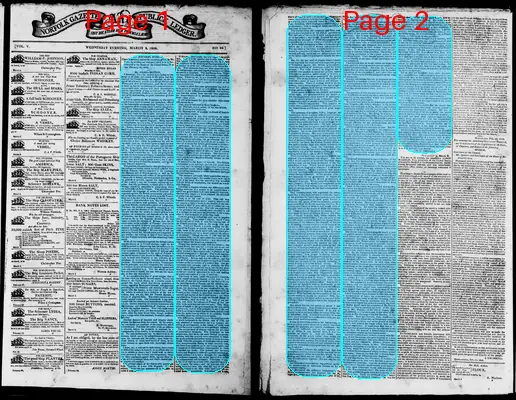
Norfolk Gazette And Publick Ledger
Norfolk, Virginia
What is this article about?
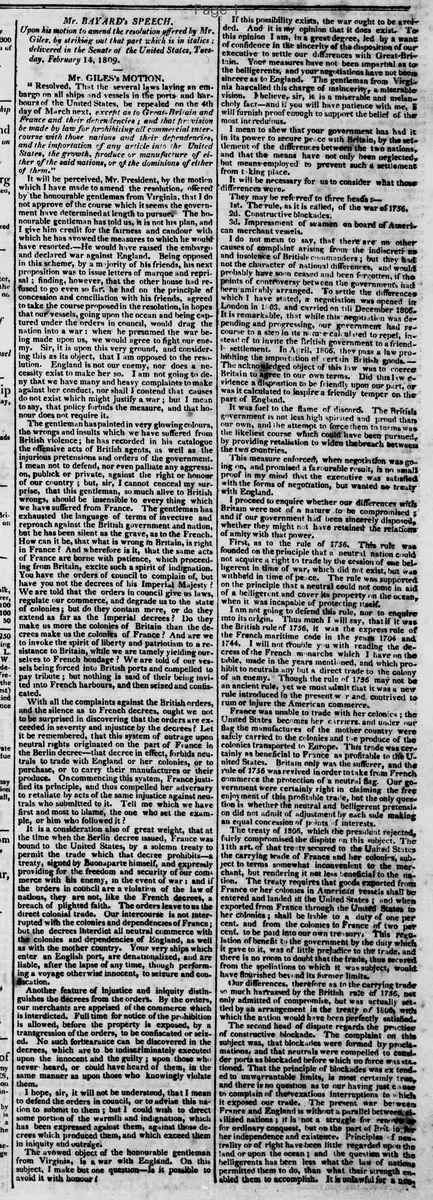
In a U.S. Senate speech on February 14, 1809, Mr. Bayard opposes Mr. Giles's resolution to repeal the embargo except against Britain and France, arguing against war with England, criticizing French decrees as worse than British orders, and accusing the executive of insincerity in negotiations, particularly rejecting the 1806 Monroe-Pinkney treaty.
Merged-components note: Merged continuation of Mr. Bayard's speech across columns on page 1 and to page 2.
Clippings
1 of 2
OCR Quality
Full Text
Upon his motion to amend the resolution offered by Mr.
Giles, by striking out that part which is in italics;
delivered in the Senate of the United States, Tuesday,
February 14, 1809.
Mr. GILES's MOTION.
"Resolved, That the several laws laying an embargo on all ships and vessels in the ports and har-
bours of the United States, be repealed on the 4th
day of March next, except as to Great Britain and
France and their dependencies: and that provision
be made by law for prohibiting all commercial intercourse with those nations and their dependencies.
and the importation of any article into the United
States, the growth, produce or manufacture of either
of the said nations, or of the dominions of either
of them."
It will be perceived, Mr. President, by the motion
which I have made to amend the resolution, offered
by the honourable gentleman from Virginia, that I do
not approve of the course which it seems the government have determined at length to pursue. The honourable gentleman has told us, it is not his plan, and
I give him credit for the fairness and candour with
which he has avowed the measures to which he would
have resorted. He would have raised the embargo
and declared war against England. Being opposed
in this scheme, by a majority of his friends, his next
proposition was to issue letters of marque and reprisal; finding, however, that the other house had refused to go even so far, he had on the principle of
concession and conciliation with his friends, agreed
to take the course proposed in the resolution, in hopes
that our vessels, going upon the ocean and being captured under the orders in council, would drag the
nation into a war: when he presumed the war being made upon us, we would agree to fight our enemy. Sir, it is upon this very ground, and considering this as its object, that I am opposed to the resolution. England is not our enemy, nor does a necessity exist to make her so. I am not going to deny that we have many and heavy complaints to make
against her conduct, nor shall I contend that causes
do not exist which might justify a war; but I mean
to say, that policy forbids the measure, and that honour does not require it.
The gentleman has painted in very glowing colours,
the wrongs and insults which we have suffered from
British violence; he has recorded in his catalogue
the offensive acts of British agents, as well as the
injurious pretensions and orders of the government.
I mean not to defend, nor even palliate any aggression, public or private, against the right or honour
of our country; but, sir, I cannot conceal my surprise, that this gentleman, so much alive to British
wrongs, should be insensible to every thing which
we have suffered from France. The gentleman has
exhausted the language of terms of invective and
reproach against the British government and nation,
but he has been silent as the grave, as to the French.
How can it be, that what is wrong in Britain, is right
in France? And wherefore is it, that the same acts
of France are borne with patience, which proceeding from Britain, excite such a spirit of indignation.
You have the orders of council to complain of, but
have you not the decrees of his Imperial Majesty?
We are told that the orders in council give us laws,
regulate our commerce, and degrade us to the state
of colonies; but do they contain more, or do they
extend as far as the Imperial decrees? Do they
make us more the colonies of Britain than the decrees make us the colonies of France? And are we
to invoke the spirit of liberty and patriotism to a resistance to Britain, while we are tamely yielding ourselves to French bondage? We are told of our vessels being forced into British ports and compelled to
pay tribute; but nothing is said of their being invited into French harbours, and then seized and confiscated.
With all the complaints against the British orders,
and the silence as to French decrees, ought we not
to be surprised in discovering that the orders are exceeded in severity and injustice by the decrees? Let
it be remembered, that this system of outrage upon
neutral rights originated on the part of France in
the Berlin decree--that decree in effect, forbids neutrals to trade with England or her colonies, or to
purchase, or to carry their manufactures or their
produce. On commencing this system, France justified its principle, and thus compelled her adversary
to retaliate by acts of the same injustice against neutrals who submitted to it. Tell me which we have
first and most to blame, the one who set the example, or him who followed it?
It is a consideration also of great weight, that at
the time when the Berlin decree issued, France was
bound to the United States, by a solemn treaty to
permit the trade which that decree prohibits--a treaty, signed by Buonaparte himself, and expressly
providing for the freedom and security of our commerce with his enemy, in the event of war: and if
the orders in council are a violation of the law of
nations, they are not, like the French decrees, a
breach of plighted faith. The orders leave to us the
direct colonial trade. Our intercourse is not interrupted with the colonies and dependencies of France:
but the decrees interdict all neutral commerce with
the colonies and dependencies of England, as well
as with the mother country. Your very ships which
enter an English port, are denationalized, and are
liable, after the lapse of any time, though performing a voyage otherwise innocent, to seizure and confiscation.
Another feature of injustice and iniquity distinguishes the decrees from the orders. By the orders,
our merchants are apprised of the commerce which
is interdicted. Full time for notice of the prohibition is allowed, before the property is exposed, by a
transgression of the orders, to be confiscated or seized. No such forbearance can be discovered in the
decrees, which are to be indiscriminately executed
upon the innocent and the guilty; upon those who
never heard, or could have heard of them, in the
same manner as upon those who knowingly violate
them.
I hope, sir, it will not be understood, that I mean
to defend the orders in council, or to advise this nation to submit to them: but I could wish to direct
some portion of the warmth and indignation, which
has been expressed against them, against those decrees which produced them, and which exceed them
in iniquity and outrage
The avowed object of the honourable gentleman
from Virginia, is a war with England. On this
subject, I make but one question-Is it possible to
avoid it with honour?
If this possibility exists, the war ought to be avoided. And it is my opinion that it does exist. To
this opinion I am, in a great degree, led by a want
of confidence in the sincerity of the disposition of our
executive to settle our differences with Great Britain. Your measures have not been impartial as to
the belligerents, and your negotiations have not been
sincere as to England. The gentleman from Virginia has called this charge of insincerity a miserable
vision. I believe, sir, it is a miserable and melancholy fact--and if you will have patience with me, I
will furnish proof enough to support the belief of the
most incredulous.
I mean to show that your government has had it
in its power to secure peace with Britain, by the settlement of the differences between the two nations,
and that the means have not only been neglected,
but means employed to prevent such a settlement
from taking place.
It will be necessary for us to consider what those
differences were--
They may be referred to three heads:
1st. The rule, as it is called, of the war of 1756.
2d. Constructive blockades:
3d. Impressment of seamen on board of American merchant vessels.
I do not mean to say, that there are no other
causes of complaint arising from the indiscretions
and insolence of British commanders; but they had
not the character of national differences, and would
probably have soon ceased and been forgotten, if the
points of controversy between the governments had
been amicably arranged. To settle the differences
which I have stated, a negotiation was opened in
London in 1803, and carried on till December 1806.
It is remarkable, that while this negotiation was depending and progressing, our government had recourse to a step in its nature calculated to repel, instead of to invite the British government to a friendly settlement. In April, 1806, they pass a law prohibiting the importation of certain British goods--
The acknowledged object of this law was to coerce
Britain to agree to our own terms. Did this law evidence a disposition to be friendly upon our part, or
was it calculated to inspire a friendly temper on the
part of England.
It was fuel to the flame of discord. The British
government is not less high spirited and proud than
our own, and the attempt to force them to terms was
the likeliest course which could have been pursued,
by providing retaliation to widen the breach between
the two countries.
This measure enforced, when negotiation was going on, and promised a favourable result, is no small
proof in my mind that the executive was satisfied
with the forms of negotiation, but wanted no treaty
with England.
I proceed to enquire whether our differences with
Britain were not of a nature to be compromised; and if our government had been sincerely disposed,
whether they might not have retained the relations
of amity with that power.
First, as to the rule of 1756. This rule was
founded on the principle that a neutral nation could
not acquire a right to trade by the cession of one belligerent in time of war, which did not exist, but was
withheld in time of peace. The rule was supported
on the principle that a neutral could not come in aid
of a belligerent and cover its property on the ocean,
when it was incapable of protecting itself.
I am not going to defend this rule, nor to enquire
into its origin. Thus much I will say, that if it was
the British rule of 1756, it was the express rule of
the French maritime code in the years 1704 and
1744. I will not trouble you with reading the decrees of the French monarchs which I have on the
table, made in the years mentioned, and which prohibit to neutrals any but a direct trade to the colony
of an enemy. Though the rule of 1756 may not be
an ancient rule, yet we must admit that it was a new
rule introduced in the present war, and, contrived to
ruin or injure the American commerce.
France was unable to trade with her colonies; the
United States becomes her carriers. and under our
flag the manufactures of the mother country were
safely carried to the colonies and the produce of the
colonies transported to Europe. This trade was certainly as beneficial to France as profitable to the United States. Britain only was the sufferer, and the
rule of 1756 was revived in order to take from French
commerce the protection of a neutral flag. Our government were certainly right in claiming the free
enjoyment of this profitable trade, but the only question is whether the neutral and belligerent pretensions did not admit of adjustment by each side making
an equal concession of points of interest.
The treaty of 1806, which the president rejected,
fairly compromised the dispute on this subject. The
11th art. of that treaty secured to the United States
the carrying trade of France and her colonies, subject to terms somewhat inconvenient to the merchant, but rendering it not less beneficial to the nation. The treaty requires that goods exported from
France or her colonies in American vessels shall be
entered and landed in the United States; and when
exported from France through the United States to
her colonies; shall be liable to a duty of one per
cent. and from the colonies to France of two per
cent. to be paid into our own treasury. This regulation of benefit to the government by the duty which
it gave to it, was of little prejudice to the trade, and
there is no room to doubt that the trade, thus secured
from the spoliations to which it was subject; would
have flourished beyond its former limits.
Our differences, therefore as to the carrying trade
so much harassed by the British rule of 1756, not
only admitted of compromise, but was actually settled by an arrangement in the treaty of 1806, with
which the nation would have been perfectly satisfied.
The second head of dispute regards the practice
of constructive blockade. The complaint on this
subject was, that blockades were formed by proclamations, and that neutrals were compelled to consider ports as blockaded before which no force was stationed. That the principle of blockades was extended to unwarrantable limits, is most certainly true,
and there is no question as to our having just cause
to complain of the vexatious interruptions to which
it exposed our trade. The present war between
France and England is without a parallel between civilized nations; it is not a struggle for renown
for ordinary conquest, but on the part of Britain for
her independence and existence. Principles of neutrality or of right have been little regarded upon the
land or upon the ocean; and the question with the
belligerents has been less what the law of nations
permitted them to do, than what their strength enabled them to accomplish. It is unlawful for a neutral
It is neutral to attempt to enter a blockaded port but a port cannot be considered as blockaded unless a force adequate to the end is stationed before it. The blockades, therefore, which England created simply by a proclamation, were an abuse of which neutrals had just cause to complain.
The United States did complain, and these complaints were listened to by the British government. The 10th art. of the treaty of 1806, has made provision on the subject ; and though England has not renounced the principle of which we complain, yet it is qualified by the notice which is required to be given to the vessel attempting to enter a blockaded port, before she is exposed to seizure and confiscation.
The provision in the treaty would no doubt have corrected in a considerable degree the abuse from which we had suffered, and it was our policy to have waited for better times for a complete remedy for the evil.
But, sir, the last head of dispute which I enumerated was made the chief and most important ground of complaint against the British government--I mean the searching of American vessels for British seamen. The right claimed by England was to seize her own seamen on board our private vessels. The right to search a public vessel, or to seize an American sailor was never asserted by the government. The claim, however, which was insisted on, involved a point of equal interest and delicacy to both countries. There is nothing novel in the pretension, that a nation engaged in war had a right to recall her subjects from foreign countries or from foreign service to assist her in the war.
Every nation in Europe has claimed and exercised the right. Our government has not denied it ; but the consequences of the manner of exercising it have formed the ground of our complaint. Has a belligerent a right to search a neutral vessel for her seamen ? I should suppose not. This question between other nations is of small importance ; between the United States and Britain, it is of great magnitude.
The sameness of manners, habits, language and appearance render it always difficult and sometimes impossible to distinguish between an English and an American sailor. If the right to search for British seamen were admitted, there would no longer be security for the American sailor : the right admitted. I have no doubt our navigation would be ruined. As an American therefore I would never concede the principle. Let us see however how the case stands in relation to Britain. Her navy is the shield of her salvation-whatever impairs its strength diminishes her power and safety. Tenacious as she has ever been of personal liberty at home, yet when men are wanted for her fleets, the Habeas Corpus sleeps.
Her sailors are her right arm, which withers as she is deprived of them. From the seductions of our maritime service she has every thing to dread. Our merchants can give her seamen a dollar for every shilling which she is able to afford them. They shall be better fed, more gently treated, and exposed less to hardships and danger. Let them find a secure asylum on board our merchant ships, and how soon will the decks be thinned of the English ships of war. Which has the more at stake on this subject, England or America ? I will not decide the question : but this is evident, that neither will ever unconditionally relinquish the principle for which she has contended. At the present crisis it was impossible for our government to expect the formal abandonment by the British government, of this right of search.' What course then should they have pursued ? They should have temporised on the point, as Britain was willing to do, and waited for a more propitious epoch, for the final arrangement of the dispute.
Your commissioners, who negotiated the treaty, found that it was impracticable to obtain the cession of the principle for which they contended, and upon their own responsibility, to their great honour, to preserve the peace of the two countries, accepted assurances from the British ministry, which in their opinion, and I have no doubt in fact, would have effectually removed the abuses of which we complained. I beg pardon of the senate for reading an extract from the letter of Messrs. Monroe and Pinkney, of the 3d January, 1807, which contains the assurances to which I refer ; " we are sorry to add, that this treaty contains no provision against the impressment of our seamen ; our dispatch of the 11th of November communicated to you the result of our labours on that subject, and our opinion that altho this government did not feel itself at liberty to relinquish by treaty, its claim to search our merchant vessels for British seamen, its practice would nevertheless be essentially, if not completely abandoned. That opinion has been since confirmed by frequent conferences on the subject with the British commissioners, who have repeatedly assured us, that in their judgment we were made as secure against the exercise of their pretensions, by the policy which their government had adopted in regard to that very delicate and important question, as we could have been by treaty. It is proper to observe however, that the good effect of this disposition and its continuance may depend in a great measure, on the means which may be taken by the congress hereafter, to check desertions from the British service. If the treaty is ratified, and a perfect good understanding produced between the two nations, it will be easy for their government by friendly communications, to state to each other what they respectively desire, and in that mode to arrange the business as satisfactorily as it could be done by treaty." Such was the footing upon which our commissioners were wisely disposed to leave this delicate affair. And would to God that our president wishing as sincerely as his friends profess for him to accommodate the differences between the two countries, had as prudently agreed to the arrangement made for him by his ministers! What has been the consequence of this excessive anxiety to secure our seamen? Why, that your service has lost more sailors in one year of the embargo, than it would have lost in ten years of impressment.
But, sir, in this lies the secret-a secret I will dare to pronounce. Your president never meant to have a treaty with Great Britain. If he had intended it, he would have taken the treaty of the 31st of December, 1806. If he had intended it he would never have fettered the commissioners with sine qua nons which were insuperable.
It was an invariable article in the instructions, to form no treaty unless the claim to search merchant vessels for deserters was utterly abandoned ; this was never expected, and at the arduous crisis at which it was insisted upon, it was impossible to expect it. And yet rather than temporize on the point, rather than accept the actual abandonment of the principle without its formal renunciation, a treaty, the work of years, negotiated by his favourite minister and calculated to appease the animosities existing between the two nations is rejected.
You will bear with me, Sir, while I say that this precipitate and fatal measure is the cause of all the embarrassments which we have felt, which we are feeling, and which we are likely to suffer; I ask why was this treaty rejected? We are told for two reasons.
1st. Because it contained no engagement against the impressment of American seamen on board merchant vessels,
2d. Because of the collateral declaration of the British commissioners that England retained the right to retaliate upon France the principles of the Berlin decree. if the United States should submit to its execution.
I have shewn from the publick documents furnished to us by the President, the footing upon which our ministers placed the point of impressments. Our commissioners considered the assurances given them by the British ministers a better pledge for the safety of our seamen than a formal provision in the treaty. But if these assurances had even not been given, the treaty would not have compromised our rights or prejudiced our interests on the subject; in the mean time it would have induced more friendly relations and prepared both countries for further concessions as their mutual interest might require. To me it is a matter both novel and surprizing to discover in our president, this strong and unyielding attachment to the highest points of our maritime rights. I had thought before, that he was not so friendly to our navy, to our merchants, and to our commerce.
I had thought that he would rather our ships were exchanged for farming utensils and our seamen converted into husbandmen. But now, sir, it seems so highly does he value our navigation, that he prefers hazarding all the calamities of war rather than suffer one feather to be forcibly plucked from the wings of commerce.
Can any one believe that our government seriously intended to conclude a treaty with England, when our commissioners were instructed to make no treaty unless Britain formally consented, that our merchant flag should protect every deserter from her navy?
The insertion of this sine qua non in the instructions is sufficient to satisfy my mind, that there was no sincerity in the negociation which was carried on with the British government.
We have been asked by the honourable gentleman from Virginia, (Mr. Giles) whether it can be imagined, that such men as King, Monroe and Pinkney would have colluded with the executive,' or if they would not have borne evidence of his insincerity, if such had been the fact. Mr. King, he tells us, is a federalist to whom we have lately given proof of confidence and attachment-Mr. Monroe he represents of a disposition lately not to be guilty of concealment through affection for the administration, and Mr. Pinkney is said also to be a federalist.
All this the gentleman may take as true. But Mr. King, sir, was never engaged in this negociation ; and to Mr. Monroe and Mr. Pinkney, I most clearly acquit them of any collusion with the president ; because so far from colluding with him, they have acted against his secret and express instructions. Surely I have no reason to doubt the sincere disposition of these gentlemen, to make a treaty with England, when they concluded one under the responsibility of acting against their orders. No, my charge of insincerity against the executive is founded upon the nature of the objections which have uniformly obstructed the adjustment of our differences with Britain.
The second impediment to the ratification of the treaty, was the declaration of lords Holland and Auckland which accompanied it. What did this paper impose upon us? Resistance to the Berlin decree: and will you permit me to ask, whether it was ever your intention to submit to that decree; you do not mean to submit to the orders in council, and does not the Berlin decree go to the extent of those orders ? Are you better prepared, or more disposed to submit to France than to England? No, I hope we shall agree to fight before we consent that either of those powers shall give laws to the ocean.
I know at one time it was pretended, that the Berlin decree was designed only as a municipal regulation ; municipal when it declared England and her dependencies in a state of blockade, and their manufactures and produce liable to capture. It is true that the minister of the United States in France, got some such explanation of the decree from the French minister of marine. He did not consider it as derogating from the treaty of 1800, between France and the United States. But when the emperor is applied to, by the grand judge, his answer is " that since he had not thought proper to express any exception in his decree there is no ground to make any in the execution, with respect to any thing whatsoever." When the minister of marine was applied for his construction of the decree, he gave his opinion, but affected not to be the proper organ of communication on the subject. In this you see that craft and force were both united for the most destructive execution of the decree.
The decree was allowed to sleep for nearly a year -a publick minister delivers his opinion that it was not to infract our treaty -and, after our property, to an immense amount, is allured by these deceitful appearances into French ports, his imperial majesty declares, in effect, through his minister of justice, that the treaty with the United States was not expressed as an exception in the decree, and therefore its provisions were to form no obstruction to its execution. So, sir, we have probably lost some millions of dollars by our anxiety to consider this decree as a municipal regulation. Suppose, however, it had not designed what its terms so plainly express, the blockade of the British isles. In such case,, what embarrassment would our government have incurred by agreeing to the proposition of the English commissioners, to resist the decree if executed against our neutral rights? If France had confined the execution of the decree to her own ports, Britain could not have complained of the execution of her own law, within her own jurisdiction, and we should have had nothing to which we were to oppose resistance. But suppose the decree had been executed on the ocean, and you had become bound to oppose its execution by force-would your undertaking have been greater than the offer you lately made to England, in case she would repeal her orders in council ?
I shall hereafter have occasion to view this subject in another point of light; but at present I ask, did not Mr. Pinkney mean to tell Mr. Canning, under his instructions from the president, that if Great Britain would repeal her orders in council, the United States' would resist the execution of the French decrees ?-This is stated in the letter of Mr. Canning to Mr. Pinkney, of the 23d of August, 1808, and admitted, as it is not denied, in the letter of Mr. Pinkney to Mr. Canning of the 8th October, in the same year. Your government, then, would now agree to the terms which they so indignantly repelled when proposed to them, and on the ground of which, in part, they refused the treaty which their ministers had negotiated. It would seem then that no other material ground remains for the rejection of the treaty, than the want of a formal clause to secure our merchant seamen against impressment.
Is it your intention ever to have a treaty with Britain, or are the nations always to continue in a state of strife and contention? You were offered the treaty of 1794, and you refused it. Messrs. Monroe and Pinkney negotiate a treaty in 1806. The president rejects it, and insists on a point in the most obnoxious form, which he knows will never be conceded, and without the concession of which, no treaty is ever to be made. Does all this look like a sincere disposition to adjust our differences with England?
It is of importance, Mr. President, to consider, in the late negociation, who were the men in power in the respective countries. Can our president expect ever to see an English administration more disposed to treat upon favourable terms with this country, than the Fox administration ? The name of Fox is the most grateful English name that is known to an American ear. From my childhood I have heard that Fox was the friend of America. He was the early champion of our rights, when Britain first attempted to deprive us of them. His voice was always raised in our favour, in opposition to the power of the crown.-Fox was at the head of the ancient whig interest of England, and a firm supporter of the principles of freedom. He was, too, a philanthropist, and deemed in sentiment, by some, a citizen of the world. He was additionally, sir, a French citizen, as well as our worthy president.
I hope it will not be thought that I mention, with any invidious view, this last circumstance-I state it only for the material purpose of shewing the community of character between these great men, which recommended them to the fraternization of the French people. If Mr. Jefferson was not willing to accept the treaty which Mr. Fox offered him, from what administration in England can he ever expect a better ? And may I not ask also if he can look to other men in the United States in whom he will have more confidence, for their skill and integrity, than in those whom he employed in the late negociation. We have all heard that Mr. Monroe was his early and bosom friend, and we have all seen that he has been his favourite minister.
Let us also not forget the time, when the treaty was concluded--no time could have been more propitious-it was at the moment when England was sinking under the triumphs of her adversary, Bonaparte had just broken to pieces the power of Prussia, driven the Russians to their frontier, and converted their emperor from an enemy into an ally. If you are not satisfied with the terms which England was willing to grant you at a moment of depression, can you look for better when she has less to fear from your enmity, or to hope from your friendship?
You find, sir, that your president was favoured by every circumstance in the negociation of the treaty which he finally rejected.
It is not a little remarkable that he should have undertaken to reject this treaty without consulting the senate, his constitutional advisers. He was in possession of a copy of the treaty while the senate were in session-they were not allowed to see it :- he would not trust their opinions upon it: they might have approved it; and the responsibility would have been still greater to have rejected it after they had agreed to it. You will pardon me for speaking plainly-it is my duty to express my conviction, though I may happen to be wrong.
To me it has always appeared that your president was taken by surprize when he found a British treaty laid at his door. His instructions to his ministers precluded the possibility of a treaty, and it never entered his head that they would have been daring enough to conclude a treaty against his orders. But the ministers having obtained what they considered the substance, disregarded the form, and sent a treaty as little looked for, as desired.
(To be continued.)
What sub-type of article is it?
What themes does it cover?
What keywords are associated?
What entities or persons were involved?
Where did it happen?
Story Details
Key Persons
Location
Senate Of The United States
Event Date
Tuesday, February 14, 1809
Story Details
Mr. Bayard delivers a speech opposing Mr. Giles's resolution to repeal the embargo against Britain and France, arguing that French decrees are more unjust than British orders in council, accusing the executive of insincerity in rejecting the 1806 Monroe-Pinkney treaty over impressment and other issues, and advocating for avoiding war with England through compromise.