Thank you for visiting SNEWPapers!
Sign up free
Daily Los Angeles Herald
Los Angeles, Los Angeles County, California
What is this article about?
On October 30, 1878, California's Constitutional Convention received Amendment No. 444 from the Committee on Corporations, proposing strict rules for corporate formation, liabilities, banking restrictions, railroad operations, and a new state Railroad Commission to regulate transportation.
Merged-components note: Continuous article on proposed constitutional amendments regarding corporations and railroads, spanning multiple components due to parsing breaks; includes sections and signatures as part of the single logical unit.
Clipping
OCR Quality
Full Text
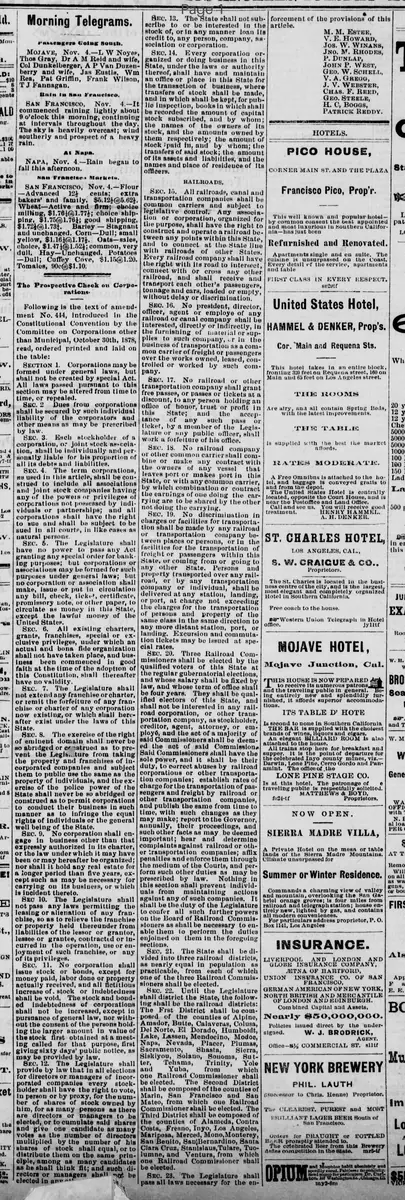
Following is the text of amendment No. 444, introduced in the Constitutional Convention by the Committee on Corporations other than Municipal, October 30th, 1878, read, ordered printed and laid on the table:
Section 1. Corporations may be formed under general laws, but shall not be created by special Act. All laws passed pursuant to this section may be altered from time to time, or repealed.
Sec. 2. Dues from corporations shall be secured by such individual liability of the corporators and other means as may be prescribed by law.
Sec. 3. Each stockholder of a corporation, or joint stock association, shall be individually and personally liable for his proportion of all its debts and liabilities.
Sec. 4. The term corporations, as used in this article, shall be construed to include all associations and joint stock companies having any of the powers or privileges of corporations not possessed by individuals or partnerships; and all corporations shall have the right to sue and shall be subject to be sued in all courts, in like cases as natural persons.
Sec. 5. The Legislature shall have no power to pass any Act granting any special charter for banking purposes; but corporations or associations may be formed for such purposes under general laws; but no corporation or association shall make, issue or put in circulation any bill, check, ticket, certificate, promissory note, or other paper, to circulate as money in this State, except the lawful money of the United States.
Sec. 6. All existing charters, grants, franchises, special or exclusive privileges, under which an actual and bona fide organization shall not have taken place, and business been commenced in good faith at the time of the adoption of this Constitution, shall thereafter have no validity.
Sec. 7. The Legislature shall not extend any franchise or charter, or remit the forfeiture of any franchise or charter of any corporation now existing, or which shall hereafter exist under the laws of this State.
Sec. 8. The exercise of the right of eminent domain shall never be so abridged or construed as to prevent the Legislature from taking the property and franchises of incorporated companies and subject them to public use the same as the property of individuals, and the exercise of the police power of the State shall never be so abridged or construed as to permit corporations to conduct their business in such manner as to infringe the equal rights of individuals or the general well being of the State.
Sec. 9. No corporation shall engage in business other than that expressly authorized in its charter, or the law under which it may have been or may hereafter be organized; nor shall it hold any real estate for a longer period than five years, except such as may be necessary for carrying on its business, or which is incident thereto.
Sec. 10. No corporation shall issue stock or bonds, except for money paid, labor done or property actually received, and all fictitious increase of stock or indebtedness shall be void. The stock and bonded indebtedness of corporations shall not be increased, except in pursuance of general law, nor without the consent of the persons holding the larger amount in value of the stock first obtained at a meeting called for that purpose, first giving sixty days' public notice, as may be provided by law.
Sec. 11. The Legislature shall provide by law that in all elections for directors or managers of incorporated companies every stockholder shall have the right to vote, in person or by proxy, for the number of shares of stock owned by him, for as many persons as there are directors or managers to be elected, or to cumulate said shares and give one candidate as many votes as the number of directors multiplied by the number of his shares of stock shall equal, or to distribute them on the same principle, among as many candidates as he shall think fit; and such directors or managers shall not be elected in any other manner.
Sec. 13. The State shall not subscribe to or be interested in the stock of, or in any manner loan its credit to, any person, company, association or corporation.
Sec. 14. Every corporation organized or doing business in this State, under the laws or authority thereof, shall have and maintain an office or place in this State for the transaction of business, where transfers of stock shall be made, and in which shall be kept, for public inspection, books in which shall be recorded the amount of capital stock subscribed, and by whom; the names of the owners of its stock, and the amounts owned by them respectively; the amount of stock paid in, and by whom; the transfers of said stock; the amount or its assets and liabilities, and the names and place of residence of its officers.
RAILROADS.
Sec. 15. All railroads, canal and transportation companies shall be common carriers and subject to legislative control. Any association or corporation, organized for the purpose, shall have the right to construct and operate a railroad between any points within this State, and to connect at the State line with railroads of other States. Every railroad company shall have the right with its road to intersect, connect with or cross any other railroad, and shall receive and transport each other's passengers, tonnage and cars, loaded or empty, without delay or discrimination.
Sec. 16. No president, director, officer, agent or employe of any railroad or canal company shall be interested, directly or indirectly, in the furnishing of material or supplies to such company, or in the business of transportation as a common carrier of freight or passengers over the works owned, leased, controlled or worked by such company.
Sec. 17. No railroad or other transportation company shall grant free passes, or passes or tickets at a discount, to any person holding an office of honor, trust or profit in this State; and the acceptance of any such pass or ticket, by a member of the Legislature or any public officer, shall work a forfeiture of his office.
Sec. 18. No railroad company or other common carrier shall combine or make any contract with the owners of any vessel that leaves port or makes port in this State, or with any common carrier, by which combination or contract the earnings of one doing the carrying are to be shared by the other not doing the carrying.
Sec. 19. No discrimination in charges or facilities for transportation shall be made by any railroad or transportation company between places or persons, or in the facilities for the transportation of freight or passengers within this State, or coming from or going to any other State. Persons and property transported over any railroad, or by any transportation company or individual, shall be delivered at any station, landing, or port, at charges not exceeding the charges for the transportation of persons and property of the same class in the same direction to any more distant station, port, or landing. Excursion and commutation tickets may be issued at special rates.
Sec. 20. Three Railroad Commissioners shall be elected by the qualified voters of this State at the regular gubernatorial elections, and whose salary shall be fixed by law, and whose term of office shall be four years. They shall be qualified electors of this State, and shall not be interested in any railroad corporation, or other transportation company, as stockholder, creditor, agent, attorney, or employé, and the act of a majority of said Commissioners shall be deemed the act of said Commission. Said Commissioners shall have the sole power, and it shall be their duty, to correct abuses by railroad corporations or other transportation companies; establish rates of charge for the transportation of passengers and freight by railroad or other transportation companies, and publish the same from time to time, with such changes as they may make; report to the Governor, annually, their proceedings, and such other facts as may be deemed important; hear and determine complaints against railroad or other transportation companies; affix penalties and enforce them through the medium of the Courts, and perform such other duties as may be prescribed by law. Nothing in this section shall prevent individuals from maintaining actions against any of such companies. It shall be the duty of the Legislature to confer all such further powers on the Board of Railroad Commissioners as shall be necessary to enable them to perform the duties enjoined on them in the foregoing sections.
Sec. 21. The State shall be divided into three railroad districts, as nearly equal in population as practicable, from each of which one of the three Railroad Commissioners shall be elected.
Sec. 22. Until the Legislature shall district the State, the following shall be the railroad districts: The First District shall be composed of the counties of Alpine, Amador, Butte, Calaveras, Colusa, Del Norte, El Dorado, Humboldt, Lake, Lassen, Mendocino, Modoc, Napa, Nevada, Placer, Plumas, Sacramento, Shasta, Sierra, Siskiyou, Solano, Sonoma, Sutter, Tehama, Trinity, Yolo and Yuba, from which One Railroad Commissioner shall be elected. The Second District shall be composed of the counties of Marin, San Francisco and San Mateo, from which one Railroad Commissioner shall be elected. The Third District shall be composed of the counties of Alameda, Contra Costa, Fresno, Inyo, Los Angeles, Mariposa, Merced, Mono, Monterey, San Benito, San Bernardino, Santa Clara, Stanislaus, Tulare, Tuolumne, and Ventura, from which one Railroad Commissioner shall be elected.
Sec. 23. The Legislature shall pass all laws necessary for the enforcement of the provisions of this article.
M. M. ESTEE,
V. E. HOWARD,
Jos. W. Winans,
JNO. M. RHODES,
P. DUNLAP,
John P. West,
GEO. W. SCHELL,
V. A. GREGG,
J. V. WEBSTER,
CHAS. F. REED,
GEO. STEELE,
H. C. Boggs,
PATRICK REDDY.
What sub-type of article is it?
What keywords are associated?
What entities or persons were involved?
Where did it happen?
Domestic News Details
Primary Location
California
Event Date
October 30th, 1878
Key Persons
Event Details
Amendment No. 444 introduced by the Committee on Corporations other than Municipal in the Constitutional Convention, outlining regulations on corporate formation under general laws, individual liability of stockholders, restrictions on special charters for banking, invalidation of unorganized existing charters, prohibitions on extending franchises, eminent domain and police powers, business limitations, stock issuance rules, voting rights for directors, state non-involvement in corporate stock, maintenance of business offices, and specific provisions for railroads including common carrier status, conflicts of interest, free passes prohibition, anti-discrimination, and establishment of a three-member Railroad Commission with districts defined by counties.