Thank you for visiting SNEWPapers!
Sign up free
The Enquirer
Richmond, Henrico County, Virginia
What is this article about?
Extract of a letter from Washington dated Jan. 6, 1809, describes a grueling overnight congressional session debating and passing a bill to enforce the Embargo Act, thwarting Federalist attempts to repeal it via Chittenden's resolution. Republicans favor continuing the embargo until May or June, potentially convening next Congress early to decide on war.
Clipping
OCR Quality
Full Text
RICHMOND, JANUARY 10, 1809.
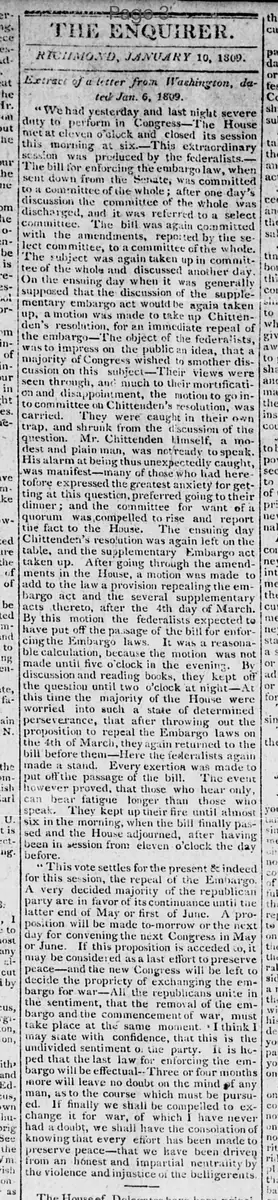
Extract of a letter from Washington, dated Jan. 6, 1809.
"We had yesterday and last night severe duty to perform in Congress—The House met at eleven o'clock and closed its session this morning at six.—This extraordinary session was produced by the federalists.— The bill for enforcing the embargo law, when sent down from the Senate, was committed to a Committee of the whole; after one day's discussion the committee of the whole was discharged, and it was referred to a select committee. The bill was again committed with the amendments, reported by the select committee, to a committee of the whole. The subject was again taken up in committee of the whole and discussed another day. On the ensuing day when it was generally supposed that the discussion of the supplementary embargo act would be again taken up, a motion was made to take up Chittenden's resolution, for an immediate repeal of the embargo—The object of the federalists, was to impress on the public an idea, that a majority of Congress wished to smother discussion on this subject—Their views were seen through, and much to their mortification and disappointment, the motion to go into committee on Chittenden's resolution, was carried. They were caught in their own trap, and shrunk from the discussion of the question. Mr. Chittenden himself, a modest and plain man, was not ready to speak. His alarm at being thus unexpectedly caught, was manifest—many of those who had heretofore expressed the greatest anxiety for getting at this question, preferred going to their dinner: and the committee for want of a quorum was compelled to rise and report the fact to the House. The ensuing day Chittenden's resolution was again left on the table, and the supplementary Embargo act taken up. After going through the amendments in the House, a motion was made to add to the law a provision repealing the embargo act and the several supplementary acts thereto, after the 4th day of March. By this motion the federalists expected to have put off the passage of the bill for enforcing the Embargo laws. It was a reasonable calculation, because the motion was not made until five o'clock in the evening. By discussion and reading books, they kept off the question until two o'clock at night—At this time the majority of the House were worried into such a state of determined perseverance, that after throwing out the proposition to repeal the Embargo laws on the 4th of March, they again returned to the bill before them—Here the federalists again made a stand. Every exertion was made to put off the passage of the bill. The event however proved, that those who hear only, can bear fatigue longer than those who speak. They kept up their fire until almost six in the morning, when the bill finally passed and the House adjourned, after having been in session from eleven o'clock the day before.
This vote settles for the present & indeed for this session, the repeal of the Embargo. A very decided majority of the republican party are in favor of its continuance until the latter end of May or first of June. A proposition will be made to-morrow or the next day for convening the next Congress in May or June. If this proposition is acceded to, it may be considered as a last effort to preserve peace—and the new Congress will be left to decide the propriety of exchanging the embargo for war—All the republicans unite in the sentiment, that the removal of the embargo and the commencement of war, must take place at the same moment. I think I may state with confidence, that this is the undivided sentiment of the party. It is hoped that the last law for enforcing the embargo will be effectual—Three or four months more will leave no doubt on the mind of any man, as to the course which must be pursued. If finally we shall be compelled to exchange it for war, of which I have never had a doubt, we shall have the consolation of knowing that every effort has been made to preserve peace—that we have been driven from an honest and impartial neutrality by the violence and injustice of the belligerents."
What sub-type of article is it?
What keywords are associated?
What entities or persons were involved?
Where did it happen?
Domestic News Details
Primary Location
Washington
Event Date
Jan. 6, 1809
Key Persons
Outcome
the bill for enforcing the embargo law passed after a session from eleven o'clock the previous day to six in the morning, settling the repeal of the embargo for the present session.
Event Details
Congress held an extraordinary session produced by federalists on the bill for enforcing the embargo law. The bill underwent committee reviews and discussions. A motion to take up Chittenden's resolution for immediate repeal was carried, but the committee lacked quorum and rose. The next day, the supplementary Embargo act was taken up, amendments passed, and a motion to repeal after March 4 was thrown out. Federalists delayed until morning, but the bill passed.