Thank you for visiting SNEWPapers!
Sign up free
Ottumwa Tri Weekly Courier
Ottumwa, Wapello County, Iowa
What is this article about?
In 1907, the Wapello County Bar Association hosted a banquet at the Ballingall Hotel in Ottumwa, Iowa, celebrating the new federal court. Attendees included Judge McPherson, former Congressman John F. Lacey, Congressman Dan W. Hamilton, and various attorneys and judges. Speeches addressed federal vs. state practice, the Iowa lawyer, criminal jurisdiction, and Lacey's appreciation of Chief Justice John Marshall.
Clipping
OCR Quality
Full Text
Large Dining Room is Comfortably Filled
Judge McPherson, and Court Clerks, Congressman Dan W. Hamilton and Former Congressman John F. Lacey Attend
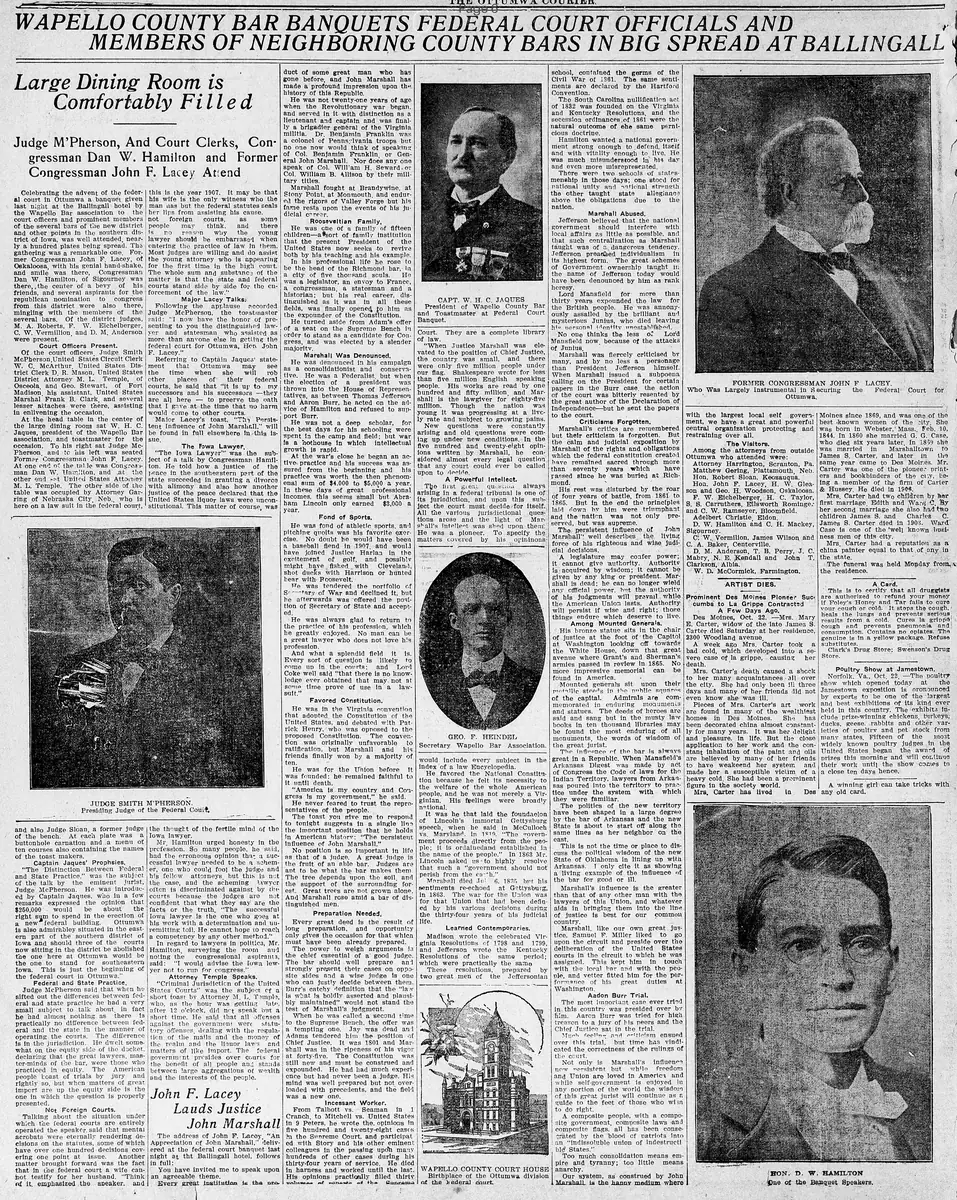
Celebrating the advent of the federal court in Ottumwa a banquet given last night at the Ballingall hotel by the Wapello Bar association to the court officers and prominent members of the several bars of the new district and other points in the southern district of Iowa, was well attended, nearly a hundred plates being spread. The gathering was a remarkable one. Former Congressman John F. Lacey, of Oskaloosa, with his genial hand-shake, and smile was there, Congressman Dan W. Hamilton, of Sigourney was there, the center of a bevy of his friends, and several aspirants for the republican nomination to congress from this district were also there, mingling with the members of the several bars. Of the district judges, M. A. Roberts, F. W. Eichelberger, C. W. Vermillion and D. M. Anderson were present.
Court Officers Present.
Of the court officers Judge Smith McPherson, United States Circuit Clerk W. C. McArthur, United States District Clerk D. R. Mason, United States District Attorney M. L. Temple, of Osceola and Geo. Stewart, of Fort Madison his assistant, United States Marshal Frank B. Clark, and several lesser attaches were there, assisting in enlivening the occasion.
At the head table in the center of the large dining room sat W. H. C. Jaques, president of the Wapello Bar association, and toastmaster for the occasion. To his right sat Judge McPherson and to his left was seated Former Congressman John F. Lacey. At one end of the table was Congressman Dan W. Hamilton, and at the other end sat United States Attorney M. L. Temple. The other side of the table was occupied by Attorney Garing of Nebraska City, Neb., who is here on a law suit in the federal court.
Captain Jaques' Prophecies.
"The Distinction Between Federal and State Practice." was the subject of the talk by the eminent jurist, Judge McPherson. He was introduced by Captain Jaques, who in a few remarks expressed the opinion that $250,000 would be about the right sum to spend in the erection of a new federal building. Ottumwa is also admirably situated in the eastern part of the southern district of Iowa and should three of the courts now sitting in the district be abolished the one here at Ottumwa would be the one to stand for southeastern Iowa. This is just the beginning of the federal court in Ottumwa.
Federal and State Practice.
Judge McPherson said that when he sifted out the differences between federal and state practice he had a very small subject to talk about, in fact he had almost nothing as there is practically no difference between federal and the state in the manner of operating the courts. The difference is in the jurisdiction. He dwelt some what on the equity side of the docket, declaring that the great lawyers, master-minds of the bar, were those who practiced in equity. The American people boast of trials by jury and rightly so, but when matters of great import are up the equity side is the one in which the question is properly presented.
Not Foreign Courts.
Talking about the situation under which the federal courts are entirely operated the speaker, said that mental acrobats were eternally rendering decisions on the statutes, some of which have over one hundred decisions covering one point at issue. Another matter brought forward was the fact that in the federal court a wife cannot testify for her husband. "Think of it," emphasized the speaker, and this is the year 1907. It may be that his wife is the only witness who the man has but the federal statutes seals her lips from assisting his cause. not foreign courts, as some people may think, and there is no reason why the young lawyer should be embarrassed when entering the practice of law in them. Most judges are willing and do assist the young attorney who is appearing for the first time in the high court. The whole sum and substance of the matter is that the state and federal courts stand side by side for the enforcement of the law."
Major Lacey Talks.
Following the applause accorded Judge McPherson, the toastmaster said: "I now have the honor of presenting to you the distinguished lawyer and statesman who assisted as more than anyone else in getting the federal court for Ottumwa, Hon. John F. Lacey."
Referring to Captain Jaques' statement that Ottumwa may see the time when she will rob other places of their federal courts, he said that "it is up to my successors and his successors—they are all here—to preserve the oath that I gave at the time that no harm would come to other courts."
Major Lacey's toast, "The Persistent Influence of John Marshall," will be found in full elsewhere in this issue.
The Iowa Lawyer
"The Iowa Lawyer" was the subject of a talk by Congressman Hamilton. He told how a justice of the peace in the southeastern part of the state succeeded in granting a divorce with alimony and also how another justice of the peace declared that the United States liquor laws were unconstitutional. This matter of course, was the thought of the fertile mind of the Iowa lawyer. Mr. Hamilton urged honesty in the profession. So many people, he said, had the erroneous opinion that a successful lawyer needed to be a schemer, one who could fool the judge and his fellow attorneys but this is not the case, and the scheming lawyer often is discriminated against by the courts because the judges are not confident that what they say are the facts or the truth. "The successful Iowa lawyer is the one who goes at his work with a determination and unremitting toil. He cannot hope to reach a competency by any other method."
In regard to lawyers in politics, Mr. Hamilton, surveying the room and noting the congressional aspirants, said: "I would advise the Iowa lawyer not to run for congress.
and also Judge Sloan, a former judge of the bench. At each plate was a buttonhole carnation and a menu of ten courses also containing the names of the toast makers.
Attorney Temple Speaks.
"Criminal Jurisdiction of the United States Courts" was the subject of a short toast by Attorney M. L. Temple, who, as the hour was getting late, after 12 o'clock, did not speak but a short time. He said that all offenses against the government were statutory offenses, dealing with the regulation of the mails and the money of the realm and the liquor laws and matters of like import. The federal government presides over courts for the benefit of all people and stands between large aggregations of wealth and the interests of the people.
John F. Lacey Lauds Justice John Marshall
The address of John F. Lacey, "An Appreciation of John Marshall," delivered at the federal court banquet last night at the Ballingall hotel, follows in full:
You have invited me to speak upon an agreeable theme. Every great institution is the product of some great man who has gone before, and John Marshall has made a profound impression upon the history of this Republic.
He was not twenty-one years of age when the Revolutionary war began, and served in it with distinction as a lieutenant and captain and was finally a brigadier general of the Virginia militia. Dr. Benjamin Franklin was a colonel of Pennsylvania troops but no one now would think of speaking of Col. Benjamin Franklin or General John Marshall. Nor does any one speak of Col. William H. Seward or Col. William B. Allison by their military titles.
Marshall fought at Brandywine, at Stony Point, at Monmouth, and endured the rigors of Valley Forge but his fame rests upon the events of his judicial career.
Rooseveltian Family.
He was one of a family of fifteen children—a sort of family institution that the present President of the United States now seeks to revive both by his teaching and his example. In his professional life he rose to be the head of the Richmond bar, in a city of five thousand souls. He was a legislator, an envoy to France, a congressman, a statesman and a historian; but his real career, distinguished as it was in all these fields, was finally opened to him as the expounder of the Constitution.
He turned aside from Adams' offer of a seat on the Supreme Bench in order to stand as a candidate for Congress, and was elected by a slender majority.
Marshall Was Denounced.
He was denounced in his campaign as a consolidationist and conservative. He was a Federalist, but when the election of a president was thrown into the House of Representatives, as between Thomas Jefferson and Aaron Burr, he acted on the advice of Hamilton and refused to support Burr.
He was not a deep scholar, for the best days for his schooling were spent in the camp and field; but war is a hothouse in which intellectual growth is rapid.
At the war's close he began an active practice and his success was assured from the beginning and his practice was worth the then phenomenal sum of $4,000 to $5,000 a year. In these days of great professional incomes, this seems small but Abraham Lincoln only earned $3,000 a year.
Fond of Sports.
He was fond of athletic sports, and pitching quoits was his favorite exercise. No doubt he would have been a baseball fiend in 1907, and would have joined Justice Harlan in the excitement of golf, and possibly might have fished with Cleveland shot ducks with Harrison or hunted bear with Roosevelt.
He was tendered the portfolio of Secretary of War and declined it, but he afterwards was offered the position of Secretary of State and accepted. He was always glad to return to the practice of his profession, which he greatly enjoyed. No man can be a great lawyer who does not love his profession.
And what a splendid field it is. Every sort of question is likely to come up in the courts: and Lord Coke well said "that there is no knowledge ever obtained that may not at some time prove of use in a law-suit."
Favored Constitution.
He was in the Virginia convention that adopted the Constitution of the United States, and debated with Patrick Henry, who was opposed to the proposed Constitution. The convention was originally unfavorable to ratification, but Marshall and his friends finally won by a majority of ten.
He was for the Union before it was founded: he remained faithful to it until death.
"America is my country and Congress is my government," he said. He never feared to trust the representatives of the people.
The toast you give me to respond to tonight suggests in a single line the important position that he holds in American history: "The persistent Influence of John Marshall."
No position is so important in life as that of a judge. A great judge is the fruit of an able bar. Judges are apt to be what the bar makes them. The tree depends upon the soil and the support of the surrounding forest. Great trees are not grown alone. And Marshall rose amid a bar of distinguished men.
Preparation Needed.
Every great deed is the result of long preparation, and opportunity only gives the occasion for that which must have been already prepared. The power to weigh arguments is the chief essential of a good judge. The bar should well prepare and strongly present their cases on opposite sides and a wise judge is one who can justly decide between them. Burr's catchy definition that the "law is what is boldly asserted and plausibly maintained" would not stand the test of Marshall's judgment.
When he was called a second time to the Supreme Bench, the offer was a tempting one. Jay was dead and Adams tendered him the position of Chief Justice. It was 1801 and Marshall was in the ripeness of his vigor at forty-five. The Constitution was still new and must be construed and expounded. He had had much experience but had never been a judge. His mind was well prepared but not overloaded with precedents, and the field was a new one.
Incessant Worker.
From Talbott vs. Seaman in 1 Cranch, to Mitchell vs. United States in 9 Peters, he wrote the opinions in five hundred and twenty-eight cases in the Supreme Court, and participated with Story and his other eminent colleagues in the passing upon many hundreds of other cases during his thirty-four years of service. He died in harness and worked until the last. His opinions practically filled thirty volumes of reports of the Supreme
CAPT. W. H. C. JAQUES President of Wapello County Bar and Toastmaster at Federal Court Banquet.
Court. They are a complete library of law.
"When Justice Marshall was elevated to the position of Chief Justice, the country was small, and there were only five million people under our flag. Shakespeare wrote for less than five million English speaking people. His works are read by one hundred and fifty million and Marshall is the lawgiver for eighty-five million.
Though the nation was young it was progressing at a lively rate and subject to growing pains. New questions were constantly arising and old questions were coming up under new conditions. In the five hundred and twenty-eight opinions written by Marshall, he considered almost every legal question that any court could ever be called upon to decide.
A Powerful Intellect.
The first great question always arising in a federal tribunal is one of its jurisdiction, and upon this subject the court must decide for itself. All the various jurisdictional questions arose and the light of Marshall's intellect was shed upon them. He was a pioneer. To specify the matters covered by his opinions would include every subject in the index of a law Encyclopedia.
He favored the National Constitution because he felt its necessity to the welfare of the whole American people, and he was not merely a Virginian. His feelings were broadly national.
It was he that laid the foundation of Lincoln's immortal Gettysburg speech, when he said in McCulloch vs. Maryland, in 1819, "The government proceeds directly from the people; it is ordained and established in the name of the people."
In 1863 Mr. Lincoln asked us to highly resolve that such a government should not perish from the earth.
Marshall died July 6, 1835 but his sentiments re-echoed at Gettysburg in 1863.
The war for the Union was for that Union that had been defined by his various decisions during the thirty-four years of his judicial life.
Learned Contemporaries.
Madison wrote the celebrated Virginia Resolutions of 1798 and 1799, and Jefferson wrote the Kentucky Resolutions of the same period; which were practically the same.
These resolutions prepared by two great men of the Jeffersonian
WAPELLO COUNTY COURT HOUSE Birthplace of the Ottumwa division of the Federal court
school, contained the germs of the Civil War of 1861. The same sentiments are declared by the Hartford Convention. The South Carolina nullification act of 1832 was founded on the Virginia and Kentucky Resolutions, and the secession ordinances of 1861 were the natural outcome of the same pernicious doctrine.
Hamilton wanted a national government strong enough to defend itself and with vitality enough to live. He was much misunderstood in his day and even more misrepresented.
There were two schools of statesmanship in those days: one stood for national unity and national strength the other taught state allegiance above the obligations due to the nation.
Marshall Abused
Jefferson believed that the national government should interfere with local affairs as little as possible, and that such centralization as Marshall taught was of a dangerous tendency. Jefferson preached individualism in its highest form. The great schemes of Government ownership taught in the name of Jefferson today would have been denounced by him as rank heresy.
Lord Mansfield for more than thirty years expounded the law for the British people. He was anonymously assailed by the brilliant and mysterious Junius, who died leaving his personal identity unestablished. No one thinks the less of Lord Mansfield now because of the attacks of Junius.
Marshall was fiercely criticised by many, and by no less a personage than President Jefferson himself. When Marshall issued a subpoena calling on the President for certain papers in the Burr case, the action of the court was bitterly resented by the great author of the Declaration of Independence—but he sent the papers to the court.
Criticisms Forgotten,
Marshall's critics are remembered but their criticism is forgotten. But the calm and judicial exposition by Marshall of the rights and obligations which the federal constitution created have remained sacred through more than seventy years which have passed since he was buried at Richmond.
His rest was disturbed by the roar of four years of battle, from 1861 to 1865. But in the end the principles laid down by him were triumphant and the nation was not only preserved, but was supreme.
The persistent influence of John Marshall well describes the living force of his righteous and wise judicial decisions.
A legislature may confer power: it cannot give authority. Authority is acquired by wisdom; it cannot be given by any king or president. Marshall is dead: he can no longer wield any official power, but the authority of his judgments will prevail, while the American Union lasts. Authority will persist if wise and right; those things endure which deserve to live.
Among Mounted Generals.
His bronze statue sits in the chair of justice at the foot of the Capitol at Washington looking off towards the White House, down that great avenue where Grant's and Sherman's armies passed in review in 1865. No more impressive memorial can be found in America.
Mounted generals sit upon their metallic steeds in the public squares of the capital. Admirals are commemorated in enduring monuments and statues. The deeds of heroes are said and sang but in the musty law books in ten thousand libraries may be found the most enduring of all monuments, the words of wisdom of the great jurist.
The influence of the bar is always great in a Republic. When Mansfield's Arkansas Digest was made by act of Congress the Code of laws for the Indian Territory, lawyers from Arkansas poured into the territory to practice under the system with which they were familiar.
The politics of the new territory have been shaped in a large degree by the bar of Arkansas and the new State is about to start off along the same lines as her neighbor on the east.
This is not the time or place to discuss the political wisdom of the new State of Oklahoma in lining up with Arkansas. I only cite it as showing a living example of the influence of the bar for good or ill.
Marshall's influence is the greater than that of any other man with the lawyers of this Union, and whatever aids in bringing them into the line of justice is best for our common country.
Marshall, like our own great justice, Samuel F. Miller liked to go upon the circuit and preside over the deliberation of the United States courts in the circuit to which he was assigned. This kept him in touch with the local bar and with the people, and better fitted him for the performance of his great duties at Washington.
Aaron Burr Trial.
The most important case ever tried in this country was presided over by him. Aaron Burr was tried for high treason to a jury of his peers and the Chief Justice sat in the trial. Much feeling and criticism ensued over this trial, but time has vindicated the correctness of the rulings of the court.
Not only is Marshall's influence now persistent but while freedom and Union are loved in America and while self-government is enjoyed in any portion of the world the wisdom of this great jurist will continue as a guide to the feet of those who wish to do right.
A composite people, with a composite government, composite laws and composite flags, all has been consecrated by the blood of patriots into an "indissoluble union of indestructible States."
Too much consolidation means empire and tyranny: too little means anarchy.
Our system, as construed by John Marshall is the happy medium where
with the largest local self government, we have a great and powerful central organization protecting and restraining over all.
The Visitors.
Among the attorneys from outside Ottumwa who attended were:
Attorney Harrington, Scranton, Pa. Matthew Gering, Plattsmouth, Neb. Hon. Robert Sloan, Keosauqua, Hon. John F. Lacey, H. W. Gleason and Geo. H. Woodson, Oskaloosa. F. W. Eichelberger, H. C. Taylor, S. S. Carruthers, Ellsworth Rominger and C. W. Ramseyer, Bloomfield. Adelbert Christie Eldon D. W. Hamilton and C. H. Mackey, Sigourney. C. W. Vermilion, James Wilson and C. A. Baker, Centerville. D. M. Anderson, T. B. Perry, J. C. Mabry, N. E. Kendall and John T. Clarkson, Albia. W. D. McCormick, Farmington.
FORMER CONGRESSMAN JOHN F. LACEY Who Was Largely Instrumental in Securing the Federal Court for Ottumwa
What sub-type of article is it?
What themes does it cover?
What keywords are associated?
What entities or persons were involved?
Where did it happen?
Story Details
Key Persons
Location
Ballingall Hotel, Ottumwa, Iowa
Event Date
1907
Story Details
The Wapello Bar Association banquet celebrated the new federal court in Ottumwa, with speeches by Judge McPherson on federal vs. state practice, Hamilton on the Iowa lawyer emphasizing honesty, Temple on criminal jurisdiction, and Lacey's full address appreciating Chief Justice John Marshall's influence on American law and union.