Thank you for visiting SNEWPapers!
Sign up free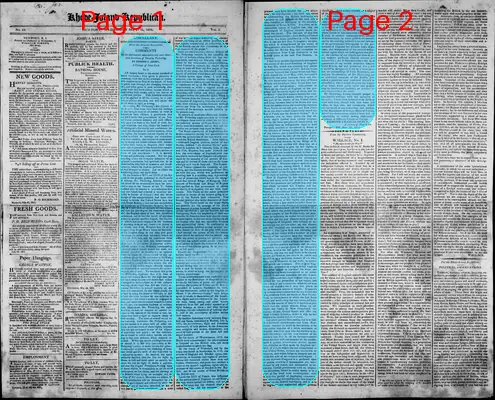
The Rhode Island Republican
Newport, Newport County, Rhode Island
What is this article about?
Edmond C. Genet's commentary criticizes Timothy Pickering's claims that US Commodore Rodgers' 1811 engagement with the British sloop Little Belt was an unlawful act of war favoring France. Genet defends it as justified under US maritime sovereignty inherited from Britain via treaties and law.
Merged-components note: This is a continuation of Edmond C. Genet's 'Comments on the diplomatick absurdities... ' spanning multiple columns on page 1 and into page 2. Relabeled the third part from letter_to_editor to editorial as it fits an opinion piece series.
Clippings
1 of 2
OCR Quality
Full Text
From the Albany Register.
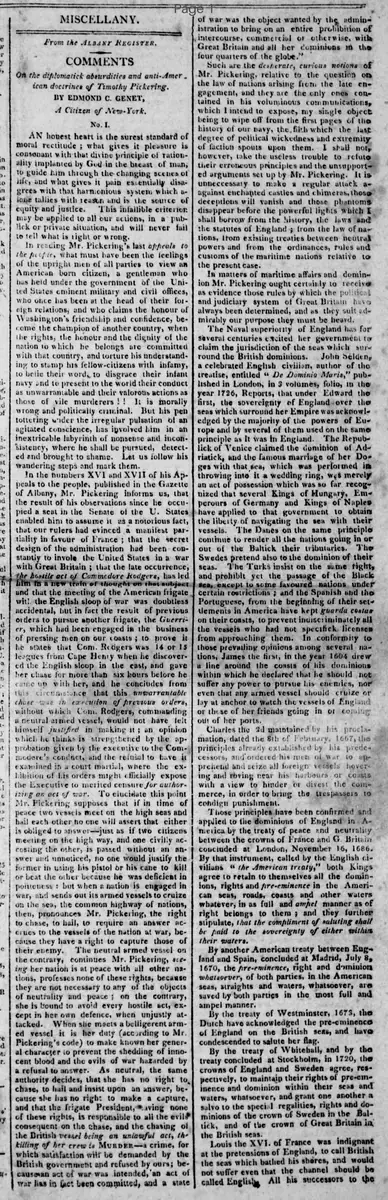
COMMENTS
On the diplomatick absurdities and anti-American doctrines of Timothy Pickering
BY EDMOND C. GENET,
A Citizen of New-York.
No. I.
AN honest heart is the surest standard of moral rectitude; what gives it pleasure is consonant with that divine principle of rationality implanted by God in the breast of man, to guide him through the changing scenes of life, and what gives it pain essentially disagrees with that harmonious system which always tallies with reason and is the source of equity and justice. This infallible criterion may be applied to all our actions, in a publick or private situation, and will never fail to tell what is right or wrong.
In reading Mr. Pickering's last appeals to the publick, what must have been the feelings of the upright men of all parties to view an American born citizen, a gentleman who has held under the government of the United States eminent military and civil offices, who once has been at the head of their foreign relations, and who claims the honour of Washington's friendship and confidence, become the champion of another country, when the rights, the honour and the dignity of the nation to which he belongs are committed with that country, and torture his understanding to stamp his fellow-citizens with infamy, to belie their word, to disgrace their infant navy and to present to the world their conduct as unwarrantable and their valorous actions as those of vile murderers !! It is morally wrong and politically criminal. But his pen tottering under the irregular pulsation of an agitated conscience, has involved him in an inextricable labyrinth of nonsense and inconsistency, where he shall be pursued, detected and brought to shame. Let us follow his wandering steps and mark them.
In the numbers XVI and XVII of his Appeals to the people, published in the Gazette of Albany, Mr. Pickering informs us, that the result of his observations since he occupied a seat in the Senate of the U. States enabled him to assume it as a notorious fact, that our rulers had evinced a manifest partiality in favour of France: that the secret design of the administration had been—constantly to involve the United States in a war with Great Britain; that the late occurrence, the hostile act of Commodore Rodgers, has led him in a new train of thought on that subject and that the meeting of the American frigate with the English sloop of war was doubtless accidental, but in fact the result of previous orders to pursue another frigate, the Guerriere, which had been engaged in the business of pressing men on our coasts; to prove it he states that Com. Rodgers was 14 or 15 leagues from Cape Henry when he discovered the English sloop in the east, and gave her chase for more than six hours before he came up with her, and he concludes from this circumstance that this unwarrantable chase was in execution of previous orders, without which Com. Rodgers, commanding a neutral armed vessel, would not have felt himself justified in making it; an opinion which he thinks is strengthened by the approbation given by the executive to the Commodore's conduct, and the refusal to have it examined in a court martial, where the exhibition of his orders might officially expose the Executive to merited censure for authorizing an act of war. To elucidate this point Mr. Pickering supposes that if in time of peace two vessels meet on the high seas and hail each other no one will assert that either is obliged to answer—just as if two citizens meeting on the high way, and one civilly accosting the other, is passed without an answer and unnoticed, no one would justify the former in using his pistol or his cane to kill or beat the other because he was deficient in politeness: but when a nation is engaged in war, and sends out its armed vessels to cruize on the sea, the common highway of nations, then, pronounces Mr. Pickering, the right to chase, to hail, to require an answer accrues to the vessels of the nation at war, because they have a right to capture those of their enemy. The neutral armed vessel on the contrary, continues Mr. Pickering, seeing her nation is at peace with all other nations, professes none of these rights, because they are not necessary to any of the objects of neutrality and peace; on the contrary, she is bound to avoid every hostile act, except in her own defence, when unjustly attacked. When she meets a belligerent armed vessel it is her duty (according to Mr. Pickering's code) to make known her general character to prevent the shedding of innocent blood and the evils of war hazarded by a refusal to answer. As neutral, the same authority decides, that she has no right to chase, to hail and insist upon an answer, because she has no right to make a capture, and that the frigate President, having none of these rights, is responsible to all the evils consequent on the chase, and the chasing of the British vessel being an unlawful act, the killing of her crew is murder—a crime, for which satisfaction will be demanded by the British government and refused by ours; because an act of war was intended, an act of war has in fact been committed, and a state of war was the object wanted by the administration to bring on an entire prohibition of intercourse, commercial or otherwise, with Great Britain and all her colonies in the four quarters of the globe."
Such are the desperate, curious notions of Mr. Pickering, relative to the question on the law of nations arising from the late engagement, and they are the only ones contained in his voluminous communications, which I intend to expose, my single object being to wipe off from the first pages of the history of our navy, the filth which the last degree of political wickedness and extremity of passion spouts upon them. I shall not, however, take the useless trouble to refute their erroneous principles and the unsupported arguments set up by Mr. Pickering: It is unnecessary to make a regular attack against enchanted castles and chimeras, those deceptions will vanish and those phantoms disappear before the powerful lights which I shall borrow from the history, the laws and the statutes of England; from the law of nations, from existing treaties between neutral powers and from the ordinances, rules and customs of the maritime nations relative to the present case.
In matters of maritime affairs and dominion Mr. Pickering ought certainly to receive as evidence those rules by which the political and judiciary system of Great Britain has always been determined, and as they suit admirably our purpose they must be heard.
The Naval superiority of England has for several centuries excited her government to claim the jurisdiction of the seas which surround the British dominions. John Selden, a celebrated English civilian, author of the treatise, entitled "De Dominio Maris," published in London, in 2 volumes, folio, in the year 1672, Reports, that under Edward the first, the sovereignty of England over the seas which surround her Empire was acknowledged by the majority of the powers of Europe and by several of them used on the same principle as it was in England. The Republick of Venice claimed the dominion of Adriatick, and the famous marriage of her Doges with that sea, which was performed in throwing into it a wedding ring, was merely an act of possession which was so far recognized that several Kings of Hungary, Emperours of Germany and Kings of Naples have applied to that government to obtain the liberty of navigating the sea with their vessels. The Danes on the same principle continue to render all the nations going in or out of the Baltick their tributaries. The Swedes pretend also to the dominion of their seas. The Turks insist on the same right, and prohibit yet the passage of the Black sea, except to some favoured nations under certain restrictions; and the Spanish and the Portuguese, from the beginning of their settlements in America have kept guarda costas on their coasts, to prevent indiscriminately all the vessels who had not specifick licenses from approaching them. In conformity to those prevailing opinions among several nations; James the first, in the year 1604 drew a line around the coasts of his dominions within which he declared that he should not suffer any power to pursue his enemies, nor even that any armed vessel should cruize or lay at anchor to watch the vessels of England or those of her friends going in or coming out of her ports.
Charles the 2d maintained by his proclamation, dated the 8th of February, 1667, the principles already established by his predecessors, and ordered his men of war to apprehend and seize all foreign vessels hovering and roving near his harbours or coasts with a view to hinder or divert the commerce, in order to bring the trespassers to condign punishment.
Those principles have been confirmed and applied to the dominions of England in America by the treaty of peace and neutrality between the crowns of France and G. Britain concluded at London, November 16, 1686. By that instrument, called by the English civilians "the American treaty," both Kings agree to retain to themselves all the dominions, rights and pre-eminence in the American seas, roads, coasts and other waters whatever, in as full and ample manner as of right belongs to them; and they further stipulate, that the compliment of saluting shall be paid to the sovereignty of either within their waters.
By another American treaty between England and Spain, concluded at Madrid, July 8, 1670, the pre-eminence, right and dominion whatsoever, of both parties, in the American seas, straights and waters, whatsoever, are saved by both parties in the most full and ample manner.
By the treaty of Westminster, 1673, the Dutch have acknowledged the pre-eminence of England on the British seas, and have condescended to salute her flag.
By the treaty of Whitehall, and by the treaty concluded at Stockholm, in 1720, the crowns of England and Sweden agree, respectively, to maintain their rights of pre-eminence and dominion within their seas and waters, whatsoever, and grant one another a salvo to the special regalities, rights and dominions of the crown of Sweden in the Baltick, and of the crown of Great Britain in the British seas.
Louis the XVI. of France was indignant at the pretensions of England, to call British the seas which bathed his shores, and would not suffer even that the channel should be called English All his successors to the At the present time have inhaled the same abhorrence for that doctrine; but their opposition notwithstanding the British hydrographers continue to call British all the seas which they consider as belonging to the maritime dominion of Great Britain. It is then, an incontestable axiom of English law, that the sovereignty of England extends much beyond her coasts. The distance of that line is not precisely known.--Jean Bodin, a French civilian, in a treatise published in 1576, thinks that it was not less than 30 leagues; an opinion which is strengthened by the treaty of Westminster, wherein the Dutch condescend to salute the British flag, and recognize its pre-eminence from Cape Finisterre to the middle point of the land Van Stauten, in Norway.
I find in no ancient diplomatick instrument the extent of the naval dominion of England in America, which was certainly very ample according to the treaty of 1686. But the treaty of peace between the United States and England, signed the 3d of May, 1783, has settled definitely that point between them and her. By that memorable treaty, the king of Great Britain acknowledges these States free, sovereign and independent; relinquishes to them all the claims of England to the propriety and territorial rights of them, and determines "that their eastern boundaries comprehend all islands within twenty leagues of any part of the shores of the United States, and lying between lines to be drawn due east from the points where the boundaries between Nova Scotia on the one part, and East Florida on the other--shall respectively touch the bay of Fundy and the Atlantic Ocean." It is probable, that in some parts, the line extends much further than twenty leagues. But by the most unequivocal implication, we certainly have an indisputable right to hold the land, covered or uncovered by water, at the distance of twenty leagues from any part of the shores, and to exercise on those premises (whenever we can) all the right of pre-eminence, dominion, and sovereignty which were exercised thereon, by the Kings of G. Britain--for no civilian will deny that as a nation is at liberty to give up her rights, another is also at liberty to acquire them, and that the first are bound to submit to their cession, and the second to maintain themselves by force in possession of the advantages which they have obtained against that nation particularly. Grotius reports several examples of that sort, among which I shall note the renunciation made by the House of Austria in behalf of the English and of the Dutch, of the right of sending vessels to the E. Indies.
Now if England by her diplomacy, her laws, and more so by her power, has maintained her dominion and jurisdiction over the seas which surround her Empire and her Colonies; if by the acquiescence of several States, her pretensions are become the law of nations, whenever she could enforce them, and if she has made to the United States an absolute cession of her rights and pre-eminence, within a line which includes these Islands situated at the distance of twenty leagues from their shore--how can the conduct of a frigate which was protecting, agreeable to the ancient custom of the British navy, our maritime jurisdiction, be called unwarrantable? And how can the just chastisement given to the subjects of England, who refused to acknowledge our pre-eminence on our shores, and who troubled our commerce, be called murder? The Little Belt was hovering and roving on our coasts with a number of other vessels of her nation to snap the vessels of our friends and our own, under the most frivolous pretexts, and to kidnap our men. She was a perfect publick nuisance, and as such, agreeable to a charge given at an admiralty session, held at the old bailey by Sir Lionel Jenkins, she was not only liable to be chased, hailed and fired at, but also to be taken and fetch'd in as a malicious violater of our treaties, and a disturber of our trade, to answer and satisfy our damages. This is good English law, grounded on a right which England has never ceased to use over the weak, and which having been transmitted to us unimpaired, is become American law and American right--and that right will not only be essential for the protection of our coasts, and the safety of our commerce, when we awaken from our stupor; but it may also prove to be an immense source of wealth. It appears by several observations that the sea withdraws progressively from the shoals of New Foundland, in consequence of which the fish favor more and more every day our coasts and bays, and in the course of time it is more than probable that the gulph stream, filling up entirely the banks of New Foundland, the shores of the United States will offer the most valuable fisheries, which it will be her interest to secure her vi et armis.
Let every patriot then confess that it is really a fortunate circumstance that Com. Rodgers, whether he acted by instruction, or by the native impulse of a noble sentiment of dignity, which no man who has not had to defend the honour and the true interest of his country can feel in all its fervour--should have entered with the thunder of his cannon, such a gallant preservative protest against the violation so often made by England herself, of a right which she has relinquished to the United States, without any restriction or reserve, and which forms an integral and unalienable part of our national sovereignty. I doubt whether Congress in a profound state of peace, could by a spontaneous act, unsolicited by any nation, and unimpelled by necessity, curtail gratuitously such an important dominion, which in reality seems to be a part of the local state sovereignties, over which the power of regulating commerce, and protecting the confederacy, has been delegated to the federal legislature, and it is to be regretted that unguarded official opinions should have been hastily emitted on a subject of that magnitude.
I have endeavoured by these comments to establish the naval dominion and pre-eminence of the United States, on strong diplomatick ground, and to convict of inconsistency and want of information, one of the warmest supporters of the British doctrine, on the whole extent of this immense continent. And I shall in another communication, attempt to demonstrate, by other publick documents, and by the existing military laws and customs of the governments who oppose to the pretensions of England her modern laws of nations, that independent of the neutral and acquired rights which we hold against that power, the conduct of our frigate has been in every respect, perfectly neutral correct and honourable; and it does not evince the least appearance of any hostile intention towards Great Britain, nor any projected war; that it would be derogatory to try by a court martial, the proceedings of Com. Rodgers, and that the lucubrations of Mr. Pickering, are an additional example of the facility with which a politician may confound himself in absurdities, which would disgrace the tongue of an idiot, when party spirit and passion clog his intellectual faculties, or private instructions enchain his mind.
Mr. Pickering, having thought proper to sanction his writings with the authority of his name, I have been induced to be fairly at issue with him, though with less fame and talent, to sign also, my comments, which are the result of my researches and studies, in the department of foreign affairs of France, and of the observations which I have had, an opportunity to collect during diplomatick missions, at different Courts of Europe.
EDMOND CHARLES GENET.
A citizen of New-York.
Prospect-Hill, Aug. 20, 1811.
What sub-type of article is it?
What keywords are associated?
What entities or persons were involved?
Editorial Details
Primary Topic
Defense Of Us Maritime Sovereignty And Naval Actions Against British Vessels
Stance / Tone
Strongly Pro Us Sovereignty And Anti Pickering
Key Figures
Key Arguments