Thank you for visiting SNEWPapers!
Sign up free
The Newport Gazette
Newport, Newport County, Rhode Island
What is this article about?
Congress secretary Charles Thompson demands from British Commodore Sir George Collier the release or justification for harsh treatment of American citizen and former naval commander Gustavus Conyngham. Collier's secretary John Marr refuses accountability, states Conyngham will be sent to England for punishment as a criminal.
Clipping
OCR Quality
Full Text
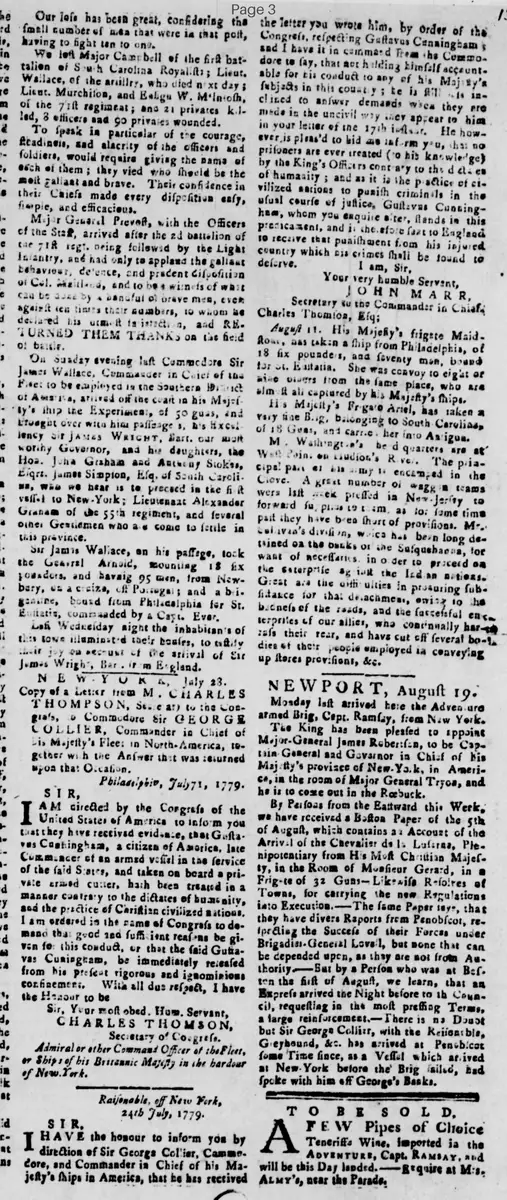
Copy of a Letter from Mr. CHARLES THOMPSON, Secretary to the Congress, to Commodore Sir GEORGE COLLIER, Commander in Chief of his Majesty's Fleet in North-America, together with the Answer that was returned upon that Occasion.
Philadelphia, July 17, 1779.
SIR,
I AM directed by the Congress of the United States to inform you that they have received evidence, that Gustavus Conyngham, a citizen of America, late commander of an armed vessel in the service of the said States, and taken on board a private armed cutter, hath been treated in a manner contrary to the dictates of humanity, and the practice of Christian civilized nations.
I am ordered in the name of Congress to demand that good and sufficient reasons be given for this conduct, or that the said Gustavus Conyngham, be immediately released from his present rigorous and ignominious confinement. With all due respect, I have the Honour to be
Sir, Your most obt. humble Servant,
CHARLES THOMPSON,
Secretary of Congress.
To the Admiral or other Commanding Officer of the Fleet, Ships of his Britannic Majesty in the Harbour of New-York.
Raisonable, off New York,
24th July, 1779.
SIR,
I HAVE the honour to inform you by direction of Sir George Collier, Commodore, and Commander in Chief of his Majesty's ships in America, that he has received the letter you wrote him, by Order of the Congress, respecting Gustavus Conyngham; and I have it in command from the Commodore to say, that not holding himself accountable for his conduct to any of his Majesty's subjects in this country; he is still less inclined to answer demands when they proceed in the uncivil way they appear to him, in your letter of the 17th instant. He however is pleased to bid me inform you, that no prisoners are ever treated (to his knowledge) by the King's Officers contrary to the dictates of humanity; and as it is the practice of civilized nations to punish criminals in the usual course of justice, Gustavus Conyngham, whom you enquire after, stands in this predicament, and is therefore not to England to receive that punishment from his injured country which his crimes shall be found to deserve.
I am, Sir,
Your very humble Servant,
JOHN MARR,
Secretary to the Commander in Chief.
Charles Thomson, Esq.
What sub-type of article is it?
What keywords are associated?
What entities or persons were involved?
Where did it happen?
Domestic News Details
Primary Location
Philadelphia
Event Date
July 17, 1779
Key Persons
Outcome
gustavus conyngham to be sent to england for punishment as a criminal.
Event Details
Congress directs Secretary Charles Thompson to demand from British Commodore Sir George Collier reasons for or release of American citizen Gustavus Conyngham from harsh confinement. Collier's secretary John Marr refuses to account, asserts humane treatment of prisoners and Conyngham's criminal status warranting trial in England.