Thank you for visiting SNEWPapers!
Sign up free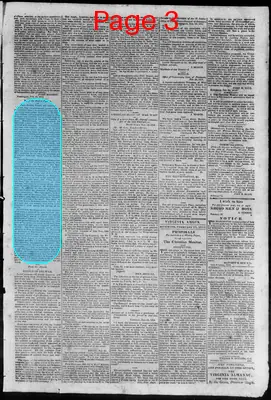
Story
February 25, 1815
Virginia Argus
Richmond, Virginia
What is this article about?
Editorial from Boston Patriot celebrates the honorable peace ending the War of 1812, highlighting American victories at New Orleans, York, Chippewa, and others, which elevated U.S. national character and humbled Britain on sea and land.
Clipping
OCR Quality
98%
Excellent
Full Text
From the Boston Patriot.
Peace between Britain and America.
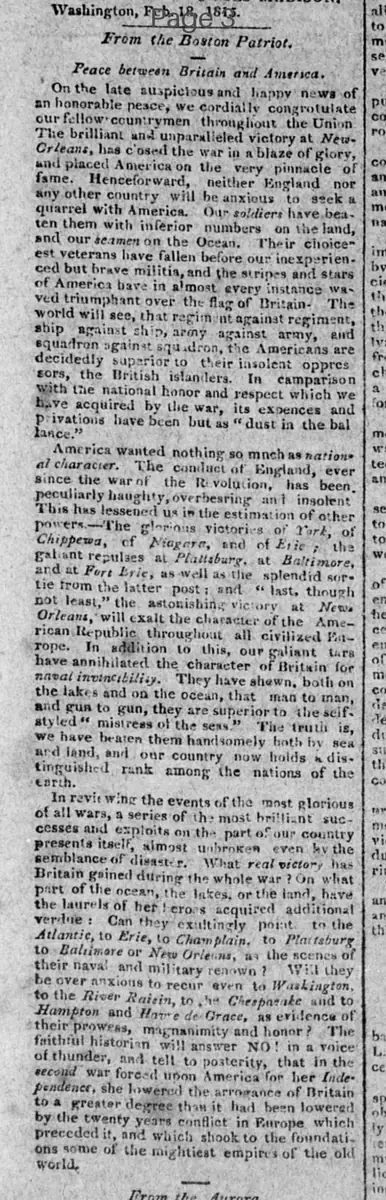
On the late auspicious and happy news of an honorable peace, we cordially congratulate our fellow countrymen throughout the Union. The brilliant and unparalleled victory at New Orleans, has closed the war in a blaze of glory, and placed America on the very pinnacle of fame. Henceforward, neither England nor any other country will be anxious to seek a quarrel with America. Our soldiers have beaten them with inferior numbers on the land, and our seamen on the Ocean. Their choicest veterans have fallen before our inexperienced but brave militia, and the stripes and stars of America have in almost every instance waved triumphant over the flag of Britain. The world will see, that regiment against regiment, ship against ship, army against army, and squadron against squadron, the Americans are decidedly superior to their insolent oppressors, the British islanders. In comparison with the national honor and respect which we have acquired by the war, its expenses and privations have been but as "dust in the balance."
America wanted nothing so much as national character. The conduct of England, ever since the war of the Revolution, has been peculiarly haughty, overbearing and insolent. This has lessened us in the estimation of other powers. The glorious victories of York, of Chippewa, of Niagara, and of Erie; the gallant repulses at Plattsburg, at Baltimore, and at Fort Erie, as well as the splendid sortie from the latter post: and "last, though not least," the astonishing victory at New Orleans, will exalt the character of the American Republic throughout all civilized Europe. In addition to this, our gallant tars have annihilated the character of Britain for naval invincibility. They have shewn, both on the lakes and on the ocean, that man to man, and gun to gun, they are superior to the self-styled "mistress of the seas." The truth is, we have beaten them handsomely both by sea and land, and our country now holds a distinguished rank among the nations of the earth.
In reviewing the events of the most glorious of all wars, a series of the most brilliant successes and exploits on the part of our country presents itself, almost unbroken even by the semblance of disaster. What real victory, has Britain gained during the whole war? On what part of the ocean, the lakes, or the land, have the laurels of her heroes acquired additional verdure: Can they exultingly point to the Atlantic, to Erie, to Champlain, to Plattsburg, to Baltimore or New Orleans, as the scenes of their naval and military renown? Will they be over anxious to recur even to Washington, to the River Raisin, to the Chesapeake and to Hampton and Havre de Grace, as evidence of their prowess, magnanimity and honor? The faithful historian will answer NO! in a voice of thunder, and tell to posterity, that in the second war forced upon America for her Independence, she lowered the arrogance of Britain to a greater degree than it had been lowered by the twenty years conflict in Europe which preceded it, and which shook to the foundations some of the mightiest empires of the old world.
Peace between Britain and America.
On the late auspicious and happy news of an honorable peace, we cordially congratulate our fellow countrymen throughout the Union. The brilliant and unparalleled victory at New Orleans, has closed the war in a blaze of glory, and placed America on the very pinnacle of fame. Henceforward, neither England nor any other country will be anxious to seek a quarrel with America. Our soldiers have beaten them with inferior numbers on the land, and our seamen on the Ocean. Their choicest veterans have fallen before our inexperienced but brave militia, and the stripes and stars of America have in almost every instance waved triumphant over the flag of Britain. The world will see, that regiment against regiment, ship against ship, army against army, and squadron against squadron, the Americans are decidedly superior to their insolent oppressors, the British islanders. In comparison with the national honor and respect which we have acquired by the war, its expenses and privations have been but as "dust in the balance."
America wanted nothing so much as national character. The conduct of England, ever since the war of the Revolution, has been peculiarly haughty, overbearing and insolent. This has lessened us in the estimation of other powers. The glorious victories of York, of Chippewa, of Niagara, and of Erie; the gallant repulses at Plattsburg, at Baltimore, and at Fort Erie, as well as the splendid sortie from the latter post: and "last, though not least," the astonishing victory at New Orleans, will exalt the character of the American Republic throughout all civilized Europe. In addition to this, our gallant tars have annihilated the character of Britain for naval invincibility. They have shewn, both on the lakes and on the ocean, that man to man, and gun to gun, they are superior to the self-styled "mistress of the seas." The truth is, we have beaten them handsomely both by sea and land, and our country now holds a distinguished rank among the nations of the earth.
In reviewing the events of the most glorious of all wars, a series of the most brilliant successes and exploits on the part of our country presents itself, almost unbroken even by the semblance of disaster. What real victory, has Britain gained during the whole war? On what part of the ocean, the lakes, or the land, have the laurels of her heroes acquired additional verdure: Can they exultingly point to the Atlantic, to Erie, to Champlain, to Plattsburg, to Baltimore or New Orleans, as the scenes of their naval and military renown? Will they be over anxious to recur even to Washington, to the River Raisin, to the Chesapeake and to Hampton and Havre de Grace, as evidence of their prowess, magnanimity and honor? The faithful historian will answer NO! in a voice of thunder, and tell to posterity, that in the second war forced upon America for her Independence, she lowered the arrogance of Britain to a greater degree than it had been lowered by the twenty years conflict in Europe which preceded it, and which shook to the foundations some of the mightiest empires of the old world.
What sub-type of article is it?
Historical Event
Military Action
Personal Triumph
What themes does it cover?
Triumph
Bravery Heroism
Justice
What keywords are associated?
War Of 1812
Peace With Britain
American Victories
New Orleans Battle
National Character
British Arrogance
Where did it happen?
United States And Britain
Story Details
Location
United States And Britain
Event Date
War Of 1812
Story Details
Celebration of peace after American victories in the War of 1812, including New Orleans, which established U.S. superiority over Britain in military and naval engagements, enhancing national prestige.