Thank you for visiting SNEWPapers!
Sign up free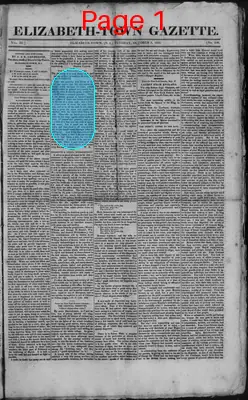
Story
October 3, 1820
Elizabeth Town Gazette
Elizabeth, Union County, New Jersey
What is this article about?
A practical method from the New-London Advocate for making high-quality vinegar cheaply and quickly using fallen apples, straw, and water, signed W. B.
Clipping
OCR Quality
98%
Excellent
Full Text
From the New-London Advocate.
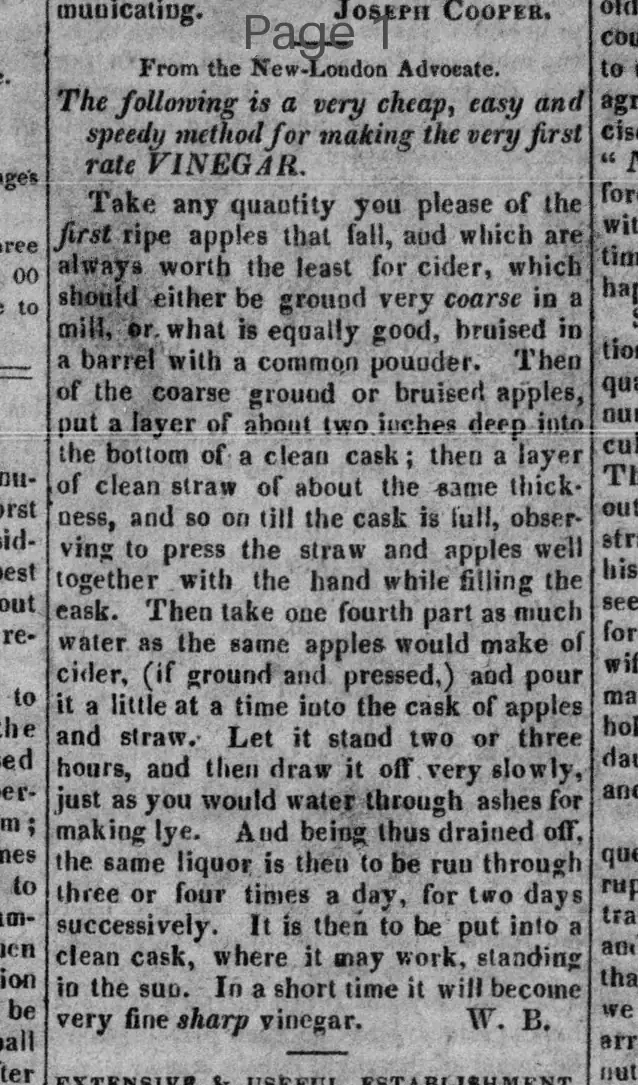
The following is a very cheap, easy and speedy method for making the very first rate VINEGAR.
Take any quantity you please of the first ripe apples that fall, and which are always worth the least for cider, which should either be ground very coarse in a mill, or what is equally good, bruised in a barrel with a common pounder. Then of the coarse ground or bruised apples, put a layer of about two inches deep into the bottom of a clean cask; then a layer of clean straw of about the same thickness, and so on till the cask is full, observing to press the straw and apples well together with the hand while filling the cask. Then take one fourth part as much water as the same apples would make of cider, (if ground and pressed,) and pour it a little at a time into the cask of apples and straw. Let it stand two or three hours, and then draw it off very slowly, just as you would water through ashes for making lye. And being thus drained off, the same liquor is then to be run through three or four times a day, for two days successively. It is then to be put into a clean cask, where it may work, standing in the sun. In a short time it will become very fine sharp vinegar.
W. B.
The following is a very cheap, easy and speedy method for making the very first rate VINEGAR.
Take any quantity you please of the first ripe apples that fall, and which are always worth the least for cider, which should either be ground very coarse in a mill, or what is equally good, bruised in a barrel with a common pounder. Then of the coarse ground or bruised apples, put a layer of about two inches deep into the bottom of a clean cask; then a layer of clean straw of about the same thickness, and so on till the cask is full, observing to press the straw and apples well together with the hand while filling the cask. Then take one fourth part as much water as the same apples would make of cider, (if ground and pressed,) and pour it a little at a time into the cask of apples and straw. Let it stand two or three hours, and then draw it off very slowly, just as you would water through ashes for making lye. And being thus drained off, the same liquor is then to be run through three or four times a day, for two days successively. It is then to be put into a clean cask, where it may work, standing in the sun. In a short time it will become very fine sharp vinegar.
W. B.
What sub-type of article is it?
Recipe
Instructional Guide
What keywords are associated?
Vinegar Recipe
Fallen Apples
Homemade Vinegar
Apple Cider Method
Straw Fermentation
What entities or persons were involved?
W. B.
Story Details
Key Persons
W. B.
Story Details
Method involves layering bruised fallen apples and straw in a cask, adding water, draining repeatedly, and fermenting in the sun to produce fine vinegar.