Thank you for visiting SNEWPapers!
Sign up free
The National Intelligencer And Washington Advertiser
Washington, District Of Columbia
What is this article about?
Transcript of a U.S. House debate on April 19 on a Senate bill allowing the President to suspend the Embargo Act during Congress's recess. Speakers including Findley, Rowan, and Randolph argue over constitutionality, precedents, and policy implications, with amendments rejected and the bill reported.
Merged-components note: These components form a continuous narrative of the congressional debate on the embargo bill, spanning pages 1 and 2 with explicit continuation indicators.
Clippings
1 of 2
OCR Quality
Full Text
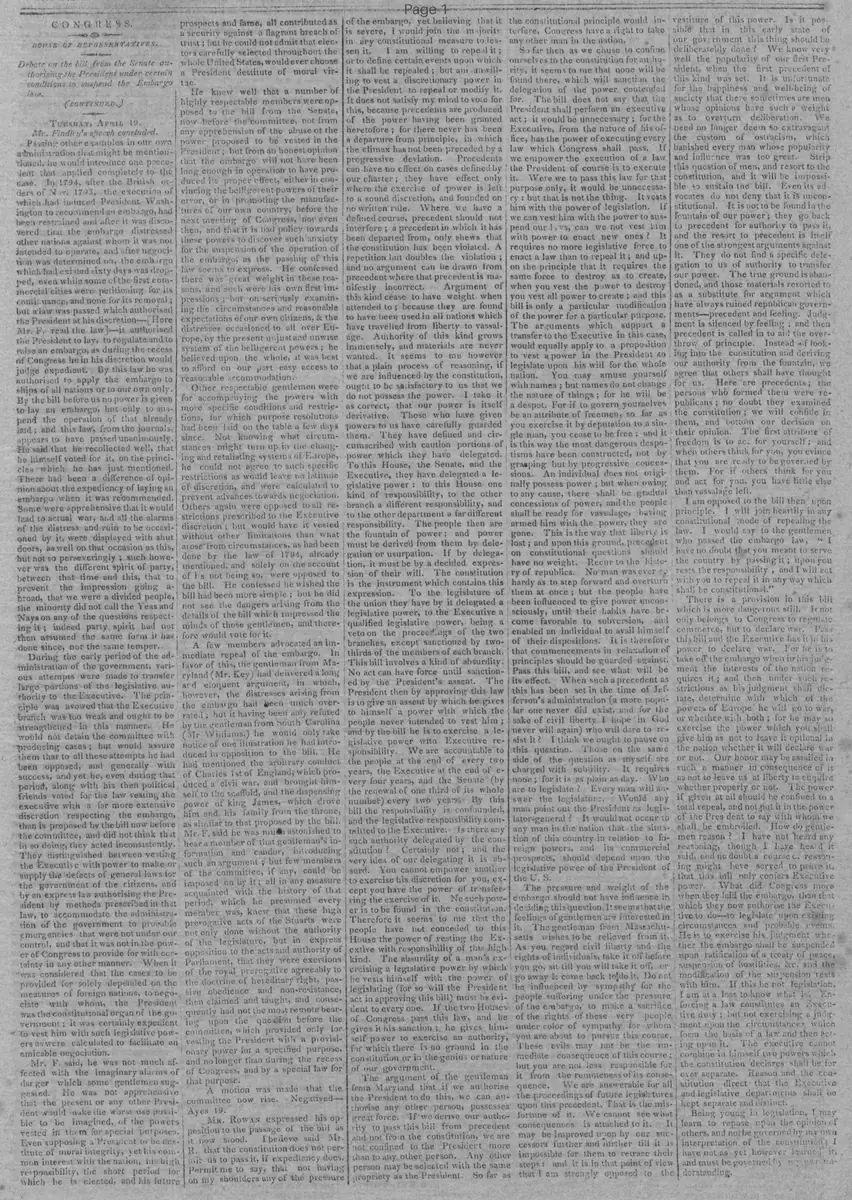
(CONTINUED.)
TUESDAY, APRIL 19.
Mr. Findley's speech concluded.
Passing other examples in our own administration that might be mentioned, he would introduce one precedent that applied completely to the case. In 1794, after the British orders of Nov. 1793, the execution of which had induced President Washington to recommend an embargo, had been restrained and after it was discovered that the embargo distressed other nations against whom it was not intended to operate, and after negotiation was determined on, the embargo which had existed sixty days was dropped, even while some of the first commercial cities were petitioning for its continuance, and none for its removal; but a law was passed which authorised the President at his discretion---Here Mr. F. read the law---it authorised the President to lay, to regulate and to raise an embargo, as during the recess of Congress he in his discretion would judge expedient. By this law he was authorised to apply the embargo to ships of all nations or to our own only. By the bill before us no power is given to lay an embargo, but only to suspend the operation of that already laid; and this law, from the journals, appears to have passed unanimously. He said that he recollected well, that he himself voted for it, on the principles which he has just mentioned. There had been a difference of opinion about the expediency of laying an embargo when it was recommended. Some were apprehensive that it would lead to actual war, and all the alarms of the distress and ruin to be occasioned by it, were displayed with shut doors, as well on that occasion as this, but not so perseveringly; such however was the different spirit of party, between that time and this, that to prevent the impression going abroad, that we were a divided people, the minority did not call the Yeas and Nays on any of the questions respecting it; indeed party spirit had not then assumed the same form it has done since, nor the same temper. During the early period of the administration of the government, various attempts were made to transfer large portions of the legislative authority to the Executive. The principle was avowed that the Executive branch was too weak and ought to be strengthened in this manner. He would not detain the committee with producing cases; but would assure them that to all these attempts he had been opposed, and generally with success, and yet, he, even during that period, along with his then political friends voted for the law vesting the executive with a far more extensive discretion respecting the embargo, than is proposed by the bill now before the committee, and did not think that in so doing, they acted inconsistently. They distinguished between vesting the Executive with power to make or supply the defects of general laws for the government of the citizens, and by an express law authorising the President by methods prescribed in that law, to accommodate the administration of the government to probable emergencies that were not under our control, and that it was not in the power of Congress to provide for with certainty in any other manner. When it was considered that the cases to be provided for solely depended on the measures of foreign nations, to negotiate with whom, the President was the constitutional organ of the government; it was certainly expedient to vest him with such legislative powers as were calculated to facilitate an amicable negotiation. Mr. F. said, he was not much affected with the imaginary alarms of danger which some gentlemen suggested. He was not apprehensive that the present or any other President would make the worst use possible to be imagined, of the powers vested in them for special purposes. Even supposing a President to be destitute of moral integrity, yet his common interest with the nation, his high responsibility, the short period for which he is elected, and his future prospects and fame, all contributed as a security against a flagrant breach of trust; but he could not admit that electors carefully selected throughout the whole United States, would ever choose a President destitute of moral virtue. He knew well that a number of highly respectable members were opposed to the bill from the Senate, now before the committee, not from any apprehension of the abuse of the power proposed to be vested in the President; but from an honest opinion that the embargo will not have been long enough in operation to have produced its proper effect, either in convincing the belligerent powers of their error, or in promoting the manufactures of our own country, before the next meeting of Congress, nor even then, and that it is bad policy towards these powers to discover such anxiety for the suspension of the operation of the embargo, as the passing of this law seems to express. He confessed there was great weight in these reasons, and such were his own first impressions; but on seriously examining the circumstances and reasonable expectations of our own citizens, & the distresses occasioned to all over Europe, by the present unjust and unwise system of the belligerent powers; he believed upon the whole, it was best to afford on our part easy access to reasonable accommodation. Other respectable gentlemen were for accompanying the powers with more specific conditions and restrictions, for which purpose resolutions had been laid on the table a few days since. Not knowing what circumstances might turn up in the changing and retaliating systems of Europe, he could not agree to such specific restrictions as would leave no latitude of discretion, and were calculated to prevent advances towards negotiation. Others again were opposed to all restrictions prescribed to the Executive discretion; but would have it vested without other limitations than what arose from circumstances, as had been done by the law of 1794, already mentioned, and solely on the account of its not being so, were opposed to the bill. He confessed he wished the bill had been more simple; but he did not see the dangers arising from the details of the bill which impressed the minds of those gentlemen, and therefore would vote for it.
A few members advocated an immediate repeal of the embargo. In favor of this, the gentleman from Maryland (Mr. Key) had delivered a long and eloquent argument, in which, however, the distresses arising from the embargo had been much over-rated; but it having been ably refuted by the gentleman from South Carolina (Mr. Williams.) he would only take notice of one illustration he had introduced in opposition to the bill. He had mentioned the arbitrary conduct of Charles I st of England, which produced a civil war, and brought himself to the scaffold, and the dispensing power of king James, which drove him and his family from the throne, as similar to that proposed by the bill. Mr. F. said he was much astonished to hear a member of that gentleman's information and candor, introducing such an argument; but few members of the committee, if any, could be imposed on by it; all in any measure acquainted with the history of that period, which he presumed every member was, knew that these high prerogative acts of the Stuarts were not only done without the authority of the legislature, but in express opposition to the acts and authority of Parliament, that they were exertions of the royal prerogative agreeably to the doctrine of hereditary right, passive obedience and non-resistance, then claimed and taught, and consequently had not the most remote bearing upon the question before the committee, which provided only for vesting the President with a provisional power for a specified purpose, and no longer than during the recess of Congress, and by a special law for that purpose.
A motion was made that the committee now rise. Negatived---Ayes 19.
Mr. Rowan expressed his opposition to the passage of the bill as it now stood. I believe said Mr. R. that the constitution does not permit us to pass it, if expediency does. Permit me to say, that not having on my shoulders any of the pressure of the embargo, yet believing that it is severe, I would join the majority in any constitutional measure to lessen it. I am willing to repeal it; or to define certain events upon which it shall be repealed; but unwilling to vest a discretionary power in the President to repeal or modify it. It does not satisfy my mind to vote for this, because precedents are produced of the power having been granted heretofore; for there never has been a departure from principle, in which the climax has not been preceded by a progressive deviation. Precedents can have no effect on cases defined by our charter; they have effect only where the exercise of power is left to a sound discretion, and founded on no written rule. Where we have a defined course, precedent should not interfere; a precedent in which it has been departed from, only shews that the constitution has been violated. A repetition but doubles the violation; and no argument can be drawn from precedent where that precedent is manifestly incorrect. Argument of this kind cease to have weight when attended to; because they are found to have been used in all nations which have travelled from liberty to vassalage. Authority of this kind grows immensely, and materials are never wanted. It seems to me however that a plain process of reasoning, if we are influenced by the constitution, ought to be satisfactory to us that we do not possess the power. I take it as correct, that our power is itself derivative. Those who have given powers to us have carefully guarded them. They have defined and circumscribed with caution portions of power which they have delegated. To this House, the Senate, and the Executive, they have delegated a legislative power: to this House one kind of responsibility, to the other branch a different responsibility, and to the other department a far different responsibility. The people then are the fountain of power; and power must be derived from them by delegation or usurpation. If by delegation, it must be by a decided expression of their will. The constitution is the instrument which contains this expression. To the legislature of the union they have by it delegated a legislative power, to the Executive a qualified legislative power, being a veto on the proceedings of the two branches, except sanctioned by two-thirds of the members of each branch. This bill involves a kind of absurdity. No act can have force until sanctioned by the President's assent. The President then by approving this law is to give an assent by which he gives to himself a power with which the people never intended to vest him; and by the bill he is to exercise a legislative power with Executive responsibility. We are accountable to the people at the end of every two years, the Executive at the end of every four years, and the Senate (by the renewal of one third of its whole number every two years. By this bill the responsibility is confounded, and the legislative responsibility committed to the Executive. Is there any such authority delegated by the constitution? Certainly not; and the very idea of our delegating it is absurd. You cannot empower another to exercise his discretion for you, except you have the power of transferring the exercise of it. No such power is to be found in the constitution. Therefore it seems to me that the people have not conceded to this House the power of vesting the Executive with responsibility of this high kind. The absurdity of a man's exercising a legislative power by which he vests himself with the power of legislating (for so will the President act in approving this bill) must be evident to every one. If the two Houses of Congress pass this law, and he gives it his sanction; he gives himself power to exercise an authority, for which there is no ground in the constitution or in the genius or nature of our government. The argument of the gentleman from Maryland that if we authorise the President to do this, we can authorise any other person, possesses great force. If we derive our authority to pass this bill from precedent and not from the constitution, we are not confined to the President more than to any other person. Any other person may be selected with the same propriety as the President. So far as the constitutional principle would interfere, Congress have a right to take any other man in the nation. So far then as we chuse to confine ourselves to the constitution for authority, it seems to me that none will be found there, which will sanction the delegation of the power contended for. The bill does not say that the President shall perform an executive act; it would be unnecessary; for the Executive, from the nature of his office, has the power of executing every law which Congress shall pass. If we empower the execution of a law the President of course is to execute it. Here we to pass this law for that purpose only, it would be unnecessary: but that is not the thing. It vests him with the power of legislation. If we can vest him with the power to suspend our laws, can we not vest him with power to enact new ones? It requires no more legislative force to enact a law than to repeal it; and upon the principle that it requires the same force to destroy as to create, when you vest the power to destroy you vest all power to create; and this bill is only a particular modification of the power for a particular purpose. The arguments which support a transfer to the Executive in this case, would equally apply to a proposition to vest a power in the President to legislate upon his will for the whole nation. You may amuse yourself with names; but names do not change the nature of things; or he will be a despot. For if to govern yourselves be an attribute of freemen, so far as you exercise it by deputation to a single man, you cease to be free; and it is this way the most dangerous despotisms have been constructed, not by grasping but by progressive concessions. An individual does not originally possess power; but when owing to any cause, there shall be gradual concessions of power, and the people shall be ready for vassalage, having armed him with the power, they are gone. This is the way that liberty is lost; and upon this ground, precedent on constitutional questions should have no weight. Recur to the history of republics. No man was ever hardy as to step forward and overturn them at once; but the people have been influenced to give power unconsciously, until their habits have become favorable to subversion, and enabled an individual to avail himself of their dispositions. It is therefore that commencements in relaxation of principles should be guarded against. Pass this bill, and see what will be its effect. When such a precedent as this has been set in the time of Jefferson's administration (a more popular one never did exist. and for the sake of civil liberty I hope in God never will again who will dare to resist it? I think we ought to pause on this question. Those on the same side of the question as myself are charged with subtlety. It requires none; for it is as plain as day. Who are to legislate? Every man will answer the legislature. Would any man point out the President as legislator-general? It would not occur to any man in the nation that the situation of this country in relation to foreign powers, and its commercial prospects, should depend upon the legislative power of the President of the U. S. The pressure and weight of the embargo should not have influence in deciding this question. It seems that the feelings of gentlemen are interested in it. The gentleman from Massachusetts wishes to be relieved from it. As you regard civil liberty and the rights of individuals, take it off before you go, sit till you will take it off, or go away & come back to do it. Do not be influenced by sympathy or the people suffering under the pressure of the embargo, to make a sacrifice of the rights of these very people under color of sympathy for whom you are about to pursue this course. These evils may not be the immediate consequence of this course; but you are not less responsible for it from the remoteness of its consequence. We are answerable for all the proceedings of future legislatures upon this precedent. That is the misfortune of it. We cannot see what consequences is attached to it. It may be improved upon by our successors either and further till it is impossible for them to retrace their steps: and it is in that point of view that I am strongly opposed to the vestiture of this power. Is it possible that in this early state of our government this thing should be deliberately done? We know very well the popularity of our first President, when the first precedent of this kind was set. It is unfortunate for the happiness and well-being of society that there sometimes are men whose opinions have such a weight as to overturn deliberation. We need no longer deem so extravagant the custom of ostracism, which banished every man whose popularity and influence was too great. Strip this question of men, and resort to the constitution, and it will be impossible sustain the bill. Even its advocates do not deny that it is unconstitutional. It is not to be found in the fountain of our power; they go back to precedent for authority to pass it, and the resort to precedent is itself one of the strongest arguments against it. They do not find a specific delegation to us of authority to transfer our power. The true ground is abandoned, and those materials resorted to as a substitute for argument which have always ruined republican governments---precedent and feeling. Judgment is silenced by feeling; and then precedent is called in to aid the overthrow of principle. Instead of looking into the constitution and deriving our authority from the fountain, we agree that others shall have thought for us. Here are precedents; the persons who formed them were republicans; no doubt they examined the constitution; we will confide in them, and bottom our decision on their opinion. The first attribute of freedom is to act for yourself; and when others think for you, you evince that you are ready to be governed by them. For if others think for you and act for you, you have little else than vassalage left. I am opposed to the bill then upon principle. I will join heartily in any constitutional mode of repealing the law. I would say to the gentlemen who passed the embargo law, "I have no doubt that you meant to serve the country by passing it; upon you rests the responsibility, and I will act with you to repeal it in any way which shall be constitutional." There is a provision in this bill which is more dangerous still. It not only belongs to Congress to regulate commerce, but to declare war. Pass this bill and the Executive has it in his power to declare war. For he is to take off the embargo when in his judgment the interests of the nation requires it; and then under such restrictions as his judgment shall dictate, determine with which of the powers of Europe he will go to war, or whether with both; or he may so exercise the power which you shall give him as not to leave it optional in the nation whether it will declare war or not. Our honor may be assailed in such a manner in consequence of it as not to leave us at liberty to enquire whether properly or not. The power if given at all should be confined to a total repeal, and not put it in the power of the President to say with whom we shall be embroiled. How do gentlemen reason? I have not heard any reasoning, though I have heard it said, and no doubt a course of reasoning might have served to prove it, that this bill only confers Executive power. What did Congress more when they laid the embargo, than that which they now authorise the Executive to do---to legislate upon existing circumstances and probable events. He is to exercise his judgment whether the embargo shall be suspended upon ratification of a treaty of peace, suspension of hostilities, &c. and the modification of the suspension rests with him. If this be not legislation, I am at a loss to know what is. Enforcing a law constitutes an executive duty; but not exercising a judgment upon the circumstances which form the basis of a law and then acting upon it. The executive cannot combine in himself two powers which the constitution declares shall be for ever separate. Reason and the constitution direct that the Executive and legislative departments shall be kept separate and distinct. Being young in legislation, I may learn to repose upon the opinion of others, and not be governed by my own interpretation of the constitution; I have not as yet however learned it, and must be governed by my own understanding.
The power of borrowing money has been assimilated to the present power, and it is said that you must admit the census to be parallel. The legislature in that case determines whether they want money and what sum they want. The Executive does not exercise a legislative discretion before he borrows the money. When it is determined by the legislature that a certain sum of money is necessary, the Executive when notified of it performs an Executive, not a legislative, duty in procuring it. So in case of contagion. The legislature declares that there shall be no intercourse with contagious cities. They may say that after a certain confirmation to the Executive that the epidemic has ceased, he shall proclaim the fact and the restriction shall cease. The same is the course I presume in all that description of cases; and so, according to the amendment of the gentleman from Virginia, I am willing to vote in this case; but I cannot consent that the Executive shall exercise a legislative authority, because such an exercise would be a violation of the constitution, which should ever remain inviolate.
I believe the bill is dangerous, and I lament that it should pass under the present administration; because it is believed by a large majority of the nation that nothing in violation of civil liberty can have their sanction.
Mr. Lyon moved that the committee rise. Negatived 58 to 13.
The question was then taken on Mr. Randolph's amendment and negatived, Ayes 14.
Mr. Randolph moved to strike out of the bill the words "under such restrictions as the public interest and the circumstances of the case may appear to require." This bill, said he, contains two separate and distinct provisions. The first gives the President of the United States power, in the event of such peace in Europe or such changes in the measures of the belligerents in relation to our commerce, as shall in his opinion render it sufficiently safe, to suspend the acts laying an embargo. On that subject it is not my wish to say anything, as everything has been said by the gentleman from Maryland, and no reply—nothing like a semblance of argument by way of reply has been made. The bill exclusively of that (in my judgement) highly dangerous power, contains another power which will enable the President of the United States to lay an embargo under any limitation or restrictions according to his discretion as to penalty, country, species of bottoms, sort of cargo—in fact to enact embargo laws to the same extent to which the legislature is competent to go, granting that the legislature possesses the power of laying an embargo. That power is contained in the words which I have moved to strike out. He may change the nature of bond and security to be given, of the penalty—he may in fact regulate the commerce of the United States as he pleases. He may, I do not say he will—I am far from suspecting it. I am speaking of the nature of the power granted by the bill. You give him a carte blanche to lay embargo laws, under any restriction that his will may prescribe. I venture to say that you may hunt up all the laws since the commencement of the government, and find nothing analogous to this. The President of the United States may by this bill except Danish, Swedish, British or French bottoms from entering particular ports or any port, and may prevent our own vessels from going to such and such countries. He may alter bonds, he may—in fact, he has the power of ringing all the changes human ingenuity can suggest on the trade of the United States.
This is a power to which, if this House were intent on investigating the merits of this bill as they are on adjourning on Monday next, they would never consent. I wish some gentleman would point out any analogous grants of power under this government. I do not know why, if a sedition bill was now brought in, a precedent of the former sedition law might not be adduced as a conclusive argument in its favor. In the case of which I am speaking, we have a precedent under the worst administration which this country has yet known. I do believe that when the President of the United States prohibited commercial intercourse with France and her dependencies, a power of this sort, though infinitely less dangerous, and less liable to abuse than this, was granted. I hope the sense of the committee will be taken on this question, not only here but in the House, that so the record may be left for those who follow us, to enable them to judge of the height to which blind Executive confidence rose in one administration; that, like the torrent of the Nile, some new current may be
found to direct its stream. and fertilize the nation by its filth.
The question was put on Mr. Randolph's amendment, and negatived 43 to 32.
Mr. Quincy moved an amendment to authorize the President of the United States "whenever the public good shall require, during the recess of Congress, to suspend the embargo."
Negatived, Ayes 8.
Mr. Lewis moved to amend the bill so as to REPEAL the embargo from and after the passing of this bill.
Mr. Randolph said this motion of his colleague's went pretty directly to the root of the evil. There had been a variety of propositions before the committee. For myself, said he, I have no hesitation in saying that if we must grant a discretion to the President of the U. States, I should wish that discretion, so far as it relates to the suspension of the embargo, to be as ample as possible; for if the constitution is to be violated, the greatest good attending that violation should flow from it, if indeed good can flow from the violation of the constitution. But I think benefits have flowed from constitutional violations, and why should they not again? Our body politic is not of so tender a nature as to die outright even of so violent an assault as this; there are stamina in it which will ultimately restore it to its wonted vigor.
I understand that the gentleman from Virginia who makes this motion does it from the apprehension that an idea will go forth that he is not in favor of raising the embargo, although he voted against it originally. I conceive it impossible that such an idea should go forth. Is it possible that those who voted against laying the embargo can now be insensible to its pressure? What is the operation of the embargo, and what will be the operation of this confidence which we are about to repose in the Executive of the U.S.? Why, when the embargo was laid, there were those who made money on it, because they got earlier intelligence of it than their fellow-citizens; and now, when the embargo is in operation, there are those who do not suffer under it. I have it from good information that at least 100,000 barrels of flour have been shipped from Baltimore alone since it was laid. It may be recollected that the gentleman from Maryland who the other day gave us so able an illustration of the question, urged as an argument against it, that the embargo operated unequally. I should be sorry to put myself on a par with that gentleman in any knowledge, much less could I assume to possess a better knowledge of his own district than he himself possesses; but I believe it has been said by a gentleman said to be possessed of considerable commercial knowledge, that many thousand barrels of flour had been shipped from that gentleman's district alone, thro' Baltimore. I was in hopes that this reply would have been made before; because coming from the quarter whence it must have come, it would have operated as an argument to estimate the value of this measure on the West India islands: and it is evident that nothing but an evasion of this kind would keep up the price, low as it is; or when I single out Baltimore, I have no doubt the same game is going on elsewhere—at Eastern Point and Passamaquoddy particularly.
The operation of the embargo is to furnish rogues with an opportunity of getting rich at the expense of honest men. The man who is hardy enough to give bond and leave his security in the lurch can make great returns; whereas the honest merchant and planter are suffering at home, and bearing the burden. It is for the benefit of the dishonest trader; for the planter is out of the question, as he cannot be a partner in the act which contravenes the law of the land. Is this all the operation of the embargo? No; for I will tell you another operation it has: that while the sheriff is hunting the citizen from bailiwick to bailiwick with a writ, his produce lying on his hands worth nothing, your shaving gentry—accommodation men—five per cent. per month men, are making 50 or 60 per cent. by usury; or making still more by usury of a worse sort—buying the property of their neighbor at less than one-half its value. And well they may afford to appropriate their money to such profitable uses, supposing character, morals, religion, honor, and everything dear to man trodden under foot by Mammon. Are these alone the effects which result from the embargo? No, sir; you are teaching your merchants, on whose fidelity—on whose sacred observation of an oath, when the course of events returns to its natural channel, your whole revenue depends—you are putting them to school, and must expect to take the consequences of their education. You are, by the pressure of the embargo, which is almost too strong for
human nature, laying calculations and snares in the way, teaching them to disregard their oath for the sake of profit—and do you expect your commerce to return to its natural channel without smuggling? You may take all your navy, and gun-boats into the bargain: with all which you cannot stop them. Those men who now export so many barrels of flour from our markets, will not pay the high duties on wines and groceries, when they can avoid it by evasion of the laws; for they will have learnt the art of evading laws; they will have taken their degrees in the school of embargo. This is the necessary result. You lay temptations before them too strong for their virtue to resist, and then, having cast your daughters into a brothel, you expect them to come out pure and uncontaminated. It is out of the question; and I venture to predict that the effect of this measure upon our imports and our morals too, sir, will be felt when not one man in this assembly shall be alive. Every arrival from the West Indies tells you of the cargoes of flour daily carried in, until it becomes a point of honor not to tell of one another.
On this subject, though not immediately connected with it, yet as the observation was made during the pending of the bill, I think proper to notice it—among other encouragements given to the American people, are the sentiments of lord Grenville, lord Erskine and other conspicuous members of the British Parliament; and really there has been an eulogy on the greatness of the opposition generally, that does not so well comport with the correctness of this assembly. But pray who are this opposition so much relied on as the sheet anchor of our affairs in Great Britain, as the mouthpiece of the agriculturers and manufacturers? That very ministry who negociated the rejected treaty with you—who attached to that treaty the humiliating note which you are told prostrated the independence of the U. States. The same individuals who were prompt leaders of the Grenville and Fox ministry now speak the language of the British opposition.
Suppose them successful and others out of power. We shall then be in the same situation as we were on the 31st Dec. 1806, having no chance of better terms than those which have been already spurned. I mention this to shew the inconsistency of those gentlemen who wish to continue the embargo. The very same people who, you are triumphantly told, have moved for a revocation of the orders of council of the 11th November, are the very persons who negociated that treaty which was rejected—not only rejected, but rejected with scorn and indignation. Gentlemen speak in one breath with the utmost abhorrence and indignation of the treaty and the ministry who formed it, and of the same persons in the same breath in the highest terms of eulogium.
Mr. Lewis's amendment was then negatived, Ayes 22.
The committee rose and reported the bill.
(DEBATE TO BE CONTINUED.)
What sub-type of article is it?
What themes does it cover?
What keywords are associated?
What entities or persons were involved?
Story Details
Key Persons
Event Date
Tuesday, April 19.
Story Details
Continuation of debate in congressional committee on Senate bill authorizing President to suspend Embargo Act. Mr. Findley concludes supporting bill citing 1794 precedent. Mr. Rowan opposes on constitutional grounds arguing against delegating legislative power to Executive. Amendments by Randolph, Quincy, Lewis to modify or repeal embargo are negatived; committee reports bill.