Thank you for visiting SNEWPapers!
Sign up free
Letter to Editor
July 15, 1863
Clearfield Republican
Clearfield, Clearfield County, Pennsylvania
What is this article about?
A satirical letter from a Philipsburg citizen mocks a group of local Abolitionists who volunteered for military service in June 1863 but retreated without enlisting upon rumors of enemy approach, criticizing their cowardice and responding to Leroi's praise in the Raftsman's Journal.
Clipping
OCR Quality
98%
Excellent
Full Text
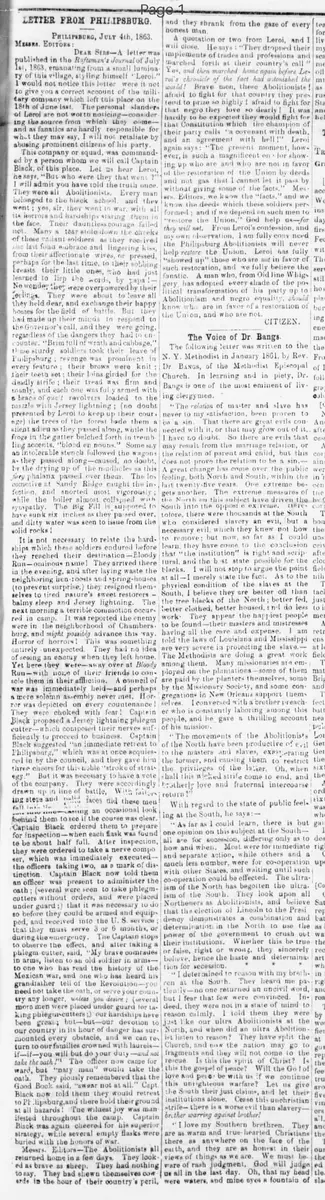
LETTER FROM PHILIPSBURG.
PHILIPSBURG, July 4th, 1863.
Messrs. Editors:
Dear Sirs—A letter was published in the Raftsman's Journal of July 1st, 1863, emanating from a small luminary of this village, styling himself 'Leroi.' I would not notice this letter were it not to give you a correct account of the military company which left this place on the 18th of June last. The personal slanders of Leroi are not worth noticing—considering the source from which they come—and as fanatics are hardly responsible for what they may say. I will not retaliate by abusing prominent citizens of his party.
This company or squad, was commanded by a person whom we will call Captain Black, of this place. Let us hear Leroi, he says. "But who were they that went?" I will admit you have told the truth once. They were all Abolitionists. Every man belonged to the black school and they went; yes, sir, they went to war, with all its horrors and hardships staring them in the face. Their dauntless courage failed not. Many a tear stole down the cheeks of these valiant soldiers as they received the last fond embrace and lingering kiss from their affectionate wives, or pressed, perhaps for the last time, to their sobbing breasts their little ones, who had just learned to lisp the words, by zapa!
No wonder they were overpowered by their feelings. They were about to leave all they held dear, and exchange their happy homes for the field of battle. But they had made up their minds to respond to the Governor's call, and they were going, regardless of the dangers they had to encounter. "Brim full of wrath and cabbage," these sturdy soldiers took their leave of Philipsburg; revenge was prominent in every feature; their brows were knit; their teeth set; their loins girded for the deadly strife; their tread was firm and manly, and each one was fully armed with a brace of gutta revolvers loaded to the muzzle with Jersey lightning: (no doubt presented by Leroi to keep up their courage) the trees of the forest bade them a silent adieu as they passed along, while the frogs in the gutter belched forth in trembling accents, "blood and nouns." Some say an intolerable stench followed the wagons as they passed along—caused, no doubt, by the drying up of the mud puddles as this fiery phalanx passed over them. The locomotive at Sandy Ridge caught the infection, and snorted most vigorously; while the boiler almost collapsed with sympathy. The Big Fill is supposed to have sunk six inches as they passed over, and dirty water was seen to issue from the solid rocks!
It is not necessary to relate the hardships which these soldiers endured before they reached their destination—Bloody Run—ominous name! They arrived there in the evening, and after laying waste the neighboring hen-roosts and spring-houses (to prevent surprise), they resigned themselves to tired nature's sweet restorer—balmy sleep and Jersey lightning. The next morning a terrible commotion occurred in camp. It was reported the enemy were in the neighborhood of Chambersburg, and might possibly advance this way. Horror of horrors! This was something entirely unexpected. They had no idea of seeing an enemy when they left home. Yet here they were—away over at Bloody Run—with none of their friends to console them in their affliction. A council of war was immediately held—and perhaps a more solemn assembly never met. Horror was depicted on every countenance. They were choked with fear! Captain Black proposed a Jersey lightning phlegm cutter—which composed their nerves sufficiently to proceed to business. Captain Black suggested "an immediate retreat to Philipsburg," which was at once acquiesced in by the council, and they gave him three cheers for this noble "stroke of strategy."
But it was necessary to have a vote of the company. They were accordingly drawn up in line of battle, with faltering steps and pallid faces did these men fall in, casting an occasional look behind them to see if the course was clear. Captain Black ordered them to prepare for inspection—when each flask was found to be about half full. After inspection, they were ordered to take a nerve composer, which was immediately executed—the officers taking two, as a mark of distinction. Captain Black now told them an officer was present to administer the oath; (several were seen to take phlegm-cutters without orders, and were placed under guard;) that it was necessary to do so before they could be armed and equipped, and received into the U. S. service; that they must serve 3 or 6 months, or during the emergency. The Captain stops to observe the effect, and after taking a phlegm cutter, said, "My brave comrades in arms, listen to an old soldier in arms—to one who has read the history of the Mexican war, and one who has heard his grandfather tell of the Revolution—you need not take the oath, or serve your country any longer, unless you desire;" (several more men were placed under guard for taking phlegm-cutters;) "our hardships have been great; but—but—our devotion to our country in its hour of danger has surmounted every obstacle, and we can return to our families crowned with laurels—if—if—you will but do your duty—and not take the oath!" The officer now came forward, but "nary man" would take the oath. They piously remembered that the Good Book said, "swear not at all." Capt. Black now told them they would retreat to Philipsburg, and there hold their ground at all hazards! The wildest joy was manifested throughout the camp. Captain Black was again cheered for his superior strategy, while several empty flasks were buried with the honors of war.
Messrs. Editors—The Abolitionists all returned home in a few days. They looked as brave as sheep. They had nothing to say. They had shown themselves cowards in the hour of their country's peril, and they shrank from the gaze of every honest man.
A quotation or two from Leroi, and I will close. He says: "They dropped their implements of trades and professions and marched forth at their country's call." Yes, and then marched home again before Leroi's chronicle of the fact had astonished the world! Brave men, these Abolitionists! afraid to fight for that country they pretend to prize so highly! afraid to fight for that negro they love so dearly! It was hardly to be expected they would fight for that Constitution which the champion of their party calls 'a covenant with death and an agreement with hell!' Leroi again says: "The present moment, however, is such a magnificent one for showing up who are and who are not in favor of the restoration of the Union by deeds and not gas that I cannot let it pass by without giving some of the facts." Messrs. Editors, we know the "facts," and we know the deeds which these soldiers performed; and if we depend on such men to "restore the Union," God help us—for they will not. From Leroi's confession, and my own observation, I am fully convinced the Philipsburg Abolitionists will never help restore the Union. Leroi has fully "showed up" those who are not in favor of such restoration, and we fully believe the fanatic. A man who, from old line Whig Tory, has adopted every shade of the political transformation of his party up to Abolitionism and negro equality, should know who are in favor of a restoration of the Union, and who are not.
CITIZEN.
PHILIPSBURG, July 4th, 1863.
Messrs. Editors:
Dear Sirs—A letter was published in the Raftsman's Journal of July 1st, 1863, emanating from a small luminary of this village, styling himself 'Leroi.' I would not notice this letter were it not to give you a correct account of the military company which left this place on the 18th of June last. The personal slanders of Leroi are not worth noticing—considering the source from which they come—and as fanatics are hardly responsible for what they may say. I will not retaliate by abusing prominent citizens of his party.
This company or squad, was commanded by a person whom we will call Captain Black, of this place. Let us hear Leroi, he says. "But who were they that went?" I will admit you have told the truth once. They were all Abolitionists. Every man belonged to the black school and they went; yes, sir, they went to war, with all its horrors and hardships staring them in the face. Their dauntless courage failed not. Many a tear stole down the cheeks of these valiant soldiers as they received the last fond embrace and lingering kiss from their affectionate wives, or pressed, perhaps for the last time, to their sobbing breasts their little ones, who had just learned to lisp the words, by zapa!
No wonder they were overpowered by their feelings. They were about to leave all they held dear, and exchange their happy homes for the field of battle. But they had made up their minds to respond to the Governor's call, and they were going, regardless of the dangers they had to encounter. "Brim full of wrath and cabbage," these sturdy soldiers took their leave of Philipsburg; revenge was prominent in every feature; their brows were knit; their teeth set; their loins girded for the deadly strife; their tread was firm and manly, and each one was fully armed with a brace of gutta revolvers loaded to the muzzle with Jersey lightning: (no doubt presented by Leroi to keep up their courage) the trees of the forest bade them a silent adieu as they passed along, while the frogs in the gutter belched forth in trembling accents, "blood and nouns." Some say an intolerable stench followed the wagons as they passed along—caused, no doubt, by the drying up of the mud puddles as this fiery phalanx passed over them. The locomotive at Sandy Ridge caught the infection, and snorted most vigorously; while the boiler almost collapsed with sympathy. The Big Fill is supposed to have sunk six inches as they passed over, and dirty water was seen to issue from the solid rocks!
It is not necessary to relate the hardships which these soldiers endured before they reached their destination—Bloody Run—ominous name! They arrived there in the evening, and after laying waste the neighboring hen-roosts and spring-houses (to prevent surprise), they resigned themselves to tired nature's sweet restorer—balmy sleep and Jersey lightning. The next morning a terrible commotion occurred in camp. It was reported the enemy were in the neighborhood of Chambersburg, and might possibly advance this way. Horror of horrors! This was something entirely unexpected. They had no idea of seeing an enemy when they left home. Yet here they were—away over at Bloody Run—with none of their friends to console them in their affliction. A council of war was immediately held—and perhaps a more solemn assembly never met. Horror was depicted on every countenance. They were choked with fear! Captain Black proposed a Jersey lightning phlegm cutter—which composed their nerves sufficiently to proceed to business. Captain Black suggested "an immediate retreat to Philipsburg," which was at once acquiesced in by the council, and they gave him three cheers for this noble "stroke of strategy."
But it was necessary to have a vote of the company. They were accordingly drawn up in line of battle, with faltering steps and pallid faces did these men fall in, casting an occasional look behind them to see if the course was clear. Captain Black ordered them to prepare for inspection—when each flask was found to be about half full. After inspection, they were ordered to take a nerve composer, which was immediately executed—the officers taking two, as a mark of distinction. Captain Black now told them an officer was present to administer the oath; (several were seen to take phlegm-cutters without orders, and were placed under guard;) that it was necessary to do so before they could be armed and equipped, and received into the U. S. service; that they must serve 3 or 6 months, or during the emergency. The Captain stops to observe the effect, and after taking a phlegm cutter, said, "My brave comrades in arms, listen to an old soldier in arms—to one who has read the history of the Mexican war, and one who has heard his grandfather tell of the Revolution—you need not take the oath, or serve your country any longer, unless you desire;" (several more men were placed under guard for taking phlegm-cutters;) "our hardships have been great; but—but—our devotion to our country in its hour of danger has surmounted every obstacle, and we can return to our families crowned with laurels—if—if—you will but do your duty—and not take the oath!" The officer now came forward, but "nary man" would take the oath. They piously remembered that the Good Book said, "swear not at all." Capt. Black now told them they would retreat to Philipsburg, and there hold their ground at all hazards! The wildest joy was manifested throughout the camp. Captain Black was again cheered for his superior strategy, while several empty flasks were buried with the honors of war.
Messrs. Editors—The Abolitionists all returned home in a few days. They looked as brave as sheep. They had nothing to say. They had shown themselves cowards in the hour of their country's peril, and they shrank from the gaze of every honest man.
A quotation or two from Leroi, and I will close. He says: "They dropped their implements of trades and professions and marched forth at their country's call." Yes, and then marched home again before Leroi's chronicle of the fact had astonished the world! Brave men, these Abolitionists! afraid to fight for that country they pretend to prize so highly! afraid to fight for that negro they love so dearly! It was hardly to be expected they would fight for that Constitution which the champion of their party calls 'a covenant with death and an agreement with hell!' Leroi again says: "The present moment, however, is such a magnificent one for showing up who are and who are not in favor of the restoration of the Union by deeds and not gas that I cannot let it pass by without giving some of the facts." Messrs. Editors, we know the "facts," and we know the deeds which these soldiers performed; and if we depend on such men to "restore the Union," God help us—for they will not. From Leroi's confession, and my own observation, I am fully convinced the Philipsburg Abolitionists will never help restore the Union. Leroi has fully "showed up" those who are not in favor of such restoration, and we fully believe the fanatic. A man who, from old line Whig Tory, has adopted every shade of the political transformation of his party up to Abolitionism and negro equality, should know who are in favor of a restoration of the Union, and who are not.
CITIZEN.
What sub-type of article is it?
Satirical
Provocative
Political
What themes does it cover?
Military War
Politics
Morality
What keywords are associated?
Abolitionists
Military Company
Philipsburg
Cowardice
Civil War
Union Restoration
Draft Retreat
Satirical Account
What entities or persons were involved?
Citizen.
Messrs. Editors
Letter to Editor Details
Author
Citizen.
Recipient
Messrs. Editors
Main Argument
the philipsburg abolitionists who volunteered for military service in response to the governor's call proved to be cowards by retreating without enlisting upon hearing of potential enemy action, demonstrating they are unfit to restore the union and unworthy of leroi's praise.
Notable Details
Satirical Depiction Of Departure With 'Jersey Lightning' And Exaggerated Environmental Reactions
Mockery Of Retreat And Refusal To Take Oath, Citing Biblical 'Swear Not At All'
Quotes From Leroi's Letter To Contrast With The Events
References To Constitution As 'Covenant With Death' By Abolitionist Champion