Thank you for visiting SNEWPapers!
Sign up free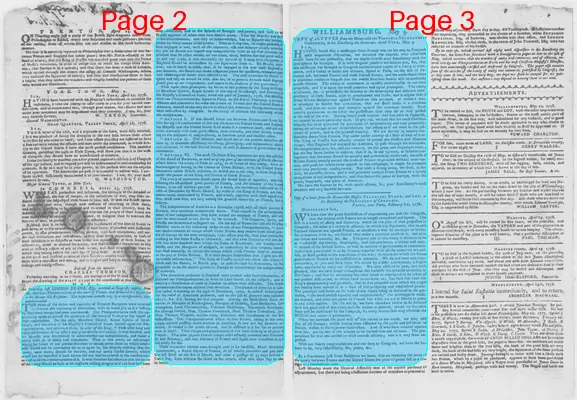
The Virginia Gazette
Richmond, Williamsburg, Richmond County, Virginia
What is this article about?
Simeon Deane arrived at Congress with dispatches from American Plenipotentiaries in France announcing the signing of a treaty of alliance and commerce on February 6, 1778, between France and the United States, acknowledging American independence and forming a mutual alliance against Britain if war ensues. Includes details on generous terms, European support, prisoner relief, and economic impacts.
Merged-components note: These components continue the same detailed report on the arrival of dispatches from France regarding the treaty of alliance and commerce, including key articles and European context.
Clippings
1 of 2
OCR Quality
Full Text
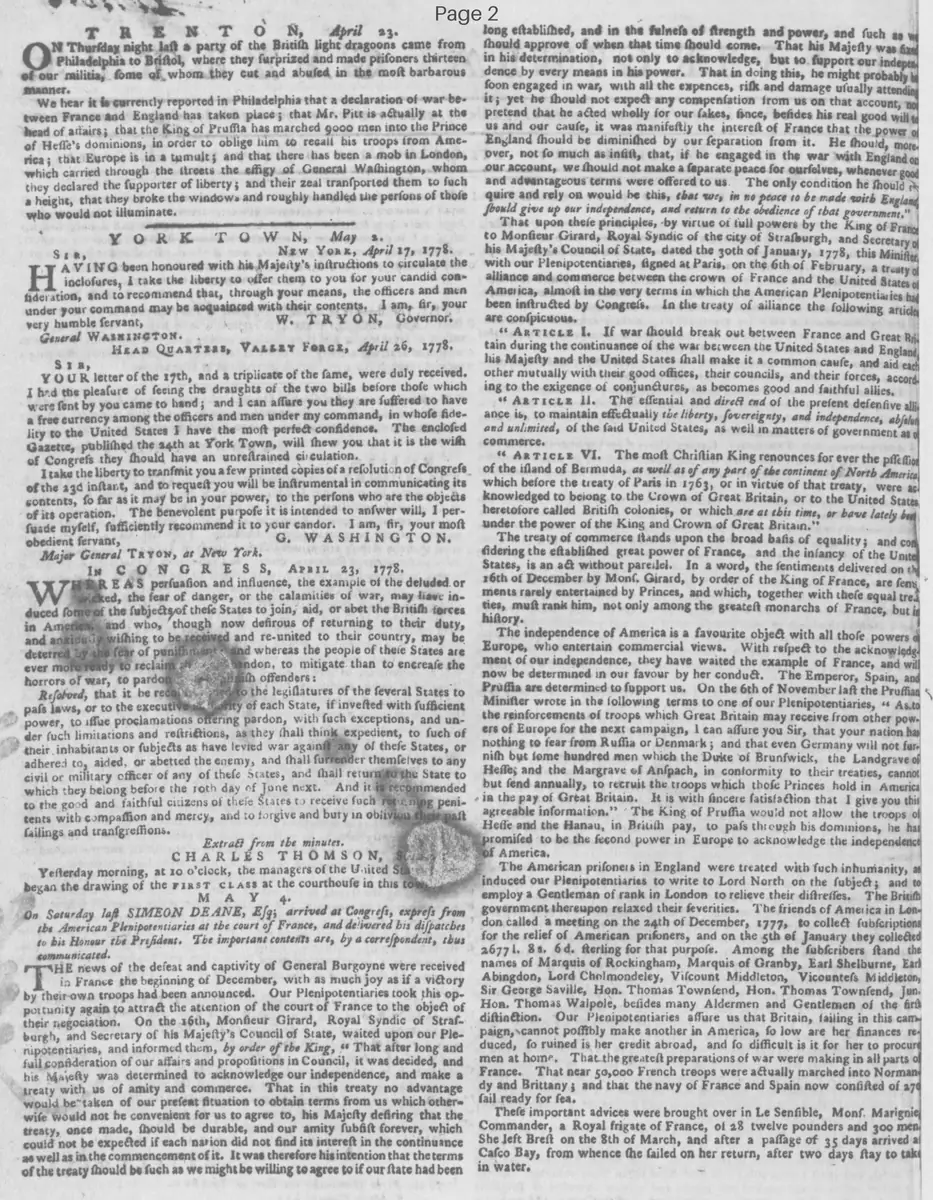
The news of the defeat and captivity of General Burgoyne were received in France the beginning of December, with as much joy as if a victory by their own troops had been announced. Our Plenipotentiaries took this opportunity again to attract the attention of the court of France to the object of their negociation. On the 16th, Monsieur Girard, Royal Syndic of Strasburgh, and Secretary of his Majesty's Council of State, waited upon our Plenipotentiaries, and informed them, by order of the King, "That after long and full consideration of our affairs and propositions in Council, it was decided, and his Majesty was determined to acknowledge our independence, and make a treaty with us of amity and commerce. That in this treaty no advantage would be taken of our present situation to obtain terms from us which otherwise would not be convenient for us to agree to, his Majesty desiring that the treaty, once made, should be durable, and our amity subsist forever, which could not be expected if each nation did not find its interest in the continuance as well as in the commencement of it. It was therefore his intention that the terms of the treaty should be such as we might be willing to agree to if our state had been long established, and in the fulness of strength and power, and such as we should approve of when that time should come. That his Majesty was fixed in his determination, not only to acknowledge, but to support our independence by every means in his power. That in doing this, he might probably be soon engaged in war, with all the expences, risk and damage usually attending it; yet he should not expect any compensation from us on that account, nor pretend that he acted wholly for our sakes, since, besides his real good will to us and our cause, it was manifestly the interest of France that the power of England should be diminished by our separation from it. He should, moreover, not so much as insist, that, if he engaged in the war with England on our account, we should not make a separate peace for ourselves, whenever good and advantageous terms were offered to us. The only condition he should require and rely on would be this, that we, in no peace to be made with England should give up our independence, and return to the obedience of that government."
That upon these principles, by virtue of full powers by the King of France to Monsieur Girard, Royal Syndic of the city of Strasburgh, and Secretary of his Majesty's Council of State, dated the 30th of January, 1778, this Minister, with our Plenipotentiaries, signed at Paris, on the 6th of February, a treaty of alliance and commerce between the crown of France and the United States of America, almost in the very terms in which the American Plenipotentiaries had been instructed by Congress. In the treaty of alliance the following articles are conspicuous.
"Article I. If war should break out between France and Great Britain during the continuance of the war between the United States and England, his Majesty and the United States shall make it a common cause, and aid each other mutually with their good offices, their councils, and their forces, according to the exigence of conjunctures, as becomes good and faithful allies."
"Article II. The essential and direct end of the present defensive alliance is, to maintain effectually the liberty, sovereignty, and independence, absolute and unlimited, of the said United States, as well in matters of government as of commerce."
"Article VI. The most Christian King renounces forever the possession of the island of Bermuda, as well as of any part of the continent of North America which before the treaty of Paris in 1763, or in virtue of that treaty, were acknowledged to belong to the Crown of Great Britain, or to the United States heretofore called British colonies, or which are at this time, or have lately been under the power of the King and Crown of Great Britain."
The treaty of commerce stands upon the broad basis of equality; and considering the established great power of France, and the infancy of the United States, is an act without parallel. In a word, the sentiments delivered on the 16th of December by Mons. Girard, by order of the King of France, are endowments rarely entertained by Princes, and which, together with these equal treaties, must rank him, not only among the greatest monarchs of France, but in history.
The independence of America is a favourite object with all those powers of Europe, who entertain commercial views. With respect to the acknowledgment of our independence, they have waited the example of France, and will now be determined in our favour by her conduct. The Emperor, Spain, and Prussia are determined to support us. On the 6th of November last the Prussian Minister wrote in the following terms to one of our Plenipotentiaries, "As to the reinforcements of troops which Great Britain may receive from other powers of Europe for the next campaign, I can assure you Sir, that your nation has nothing to fear from Russia or Denmark; and that even Germany will not furnish but some hundred men which the Duke of Brunswick, the Landgrave of Hesse and the Margrave of Anspach, in conformity to their treaties, cannot but send annually, to recruit the troops which those Princes hold in America in the pay of Great Britain. It is with sincere satisfaction that I give you this agreeable information." The King of Prussia would not allow the troops of Hesse and the Hanau, in British pay, to pass through his dominions, he has promised to be the second power in Europe to acknowledge the independence of America.
The American prisoners in England were treated with such inhumanity, as induced our Plenipotentiaries to write to Lord North on the subject; and to employ a Gentleman of rank in London to relieve their distresses. The British government thereupon relaxed their severities. The friends of America in London called a meeting on the 24th of December, 1777, to collect subscriptions for the relief of American prisoners, and on the 5th of January they collected 2677l. 8s. 6d. sterling for that purpose. Among the Subscribers stand the names of Marquis of Rockingham, Marquis of Granby, Earl Shelburne, Earl Abingdon, Lord Cholmondeley, Viscount Middleton, Viscountess Middleton, Sir George Saville, Hon. Thomas Townshend, Hon. Thomas Townshend, Jun. Hon. Thomas Walpole, besides many Aldermen and Gentlemen of the first distinction. Our Plenipotentiaries assure us that Britain, failing in this campaign, cannot possibly make another in America, so low are her finances reduced, so ruined is her credit abroad, and so difficult is it for her to procure men at home. That the greatest preparations of war were making in all parts of France. That near 50,000 French troops were actually marched into Normandy and Brittany; and that the navy of France and Spain now consisted of 27 sail ready for sea.
These important advices were brought over in Le Sensible, Mons. Marignie Commander, a Royal frigate of France, of 28 twelve pounders and 300 men. She left Brest on the 8th of March, and after a passage of 35 days arrived at Casco Bay, from whence she sailed on her return, after two days stay to take in water.
WILLIAMSBURG.
May 9.
COPY of a LETTER from the Honourable the Virginia DELEGATES at
Congress, to his Excellency the Governor, dated York, May 3.
Sir,
Having heard that a messenger from France was on his way to Congress
with important dispatches, we detained the express, who otherwise
would
have set out yesterday, that we might furnish your Excellency with the
intelligence he brought. It is with singular pleasure we inform you, Sir, that
this messenger has brought to Congress authenticated copies of a treaty of com-
merce, and a treaty of amity and alliance, signed at Paris, on the 6th of Fe-
bruary last, between France and these United States; and we understand there
is abundant reason to suppose that the whole Bourbon family will immediately
accede thereto. The treaty of commerce is exactly conformable to our own
proposals, and it is upon the most generous and equal principles. The treaty
of alliance, &c. is professedly for security of the sovereignty and absolute inde-
pendency of these States, both in government and trade, and it argues that if
Great Britain declares war against France on this account, or causes a war,
or attempts to hinder her com merce, that we shall make it a common
cause, and join our arms and councils against the common enemy.
Each
country guarantees to the other the possessions that they do or may possess
at the end of the war. Having heard these treaties read but once in Congress,
we cannot be more particular now. In general, we find that his most Christian
Majesty has been governed by principles of magnanimity and true generosity,
taking no advantage of our circumstances, but acting as if we were in the ple-
nitude of power, and in the greatest security. We are shortly to receive con-
siderable stores from France, that come under convoy of a fleet of men of war.
The King of Prussia has actually refused to permit the Hessian and Hanoverian
troops, that England had engaged for America, to pass through his territories.
We congratulate you, Sir, and our country, on this great and important event;
but we beg leave farther to observe, that it is, in our opinion, of infinite con-
sequence that the army should be quickly and powerfully reinforced; because if
Britain should meanly permit the trade of France to proceed without interrup-
tion, and push her whole force against us this campaign, it might be attended
with very pernicious consequences. But with a strong army, we shall, under
God, be perfectly secure, and it will probably compel Great Britain to a speedy
recognition of our independence, and thus secure the peace of Europe, with the
peace, happiness, and glory of America.
We have the honour to be, with much esteem, Sir, your Excellency's most
obedient and very humble servants.
Copy of a letter from the Honourable Messrs. FRANKLIN, DEANE, and LEE, to
his Excellency the President of Congress.
PASSY, near Paris, February 8th, 1778,
HONOURABLE SIR,
We have now the great satisfaction of acquainting you and the Congress,
that the treaties with France are at length completed and signed. The
first is a treaty of Amity and Commerce, much on the plan of that projected in
Congress; the other is a treaty of Alliance, in which it is stipulated, that in case
England declares war against France, or occasions a war by attempts to hinder
her commerce with us, we should then make a common cause of it, and join
our forces and councils, &c. &c. The great aim of this treaty is declared to be
to establish the liberty, sovereignty, and independency, absolute and unli-
mitted of the United States, as well in matters of government as commerce.
And this is guaranteed to us by France, together with all the countries we pos-
sess, or shall possess at the conclusion of the war; in return for which the States
guarantee to France all its possessions in America. We do not now add more
particulars, as you will soon have the whole by a safer conveyance, a frigate
being appointed to carry our dispatches. We only observe to you, and with
pleasure, that we have found throughout this business the greatest cordiality in
this Court; and that no advantage has been taken or attempted to be taken of
our present difficulties, to obtain hard terms from us; but such has been the
King's magnanimity and goodness, that he has proposed none which we might
not readily have agreed to in a state of full prosperity and established power.
The principle laid down as the basis of the treaty being as declared in the pre-
amble, "the most perfect equality and reciprocality," the privileges in trade,
are mutual, and none are given to France but what we are at liberty to grant
to any other nation. On the whole, we have abundant reason to be satisfied
with the good will of this court and the nation in general, which we therefore
hope will be cultivated by the Congress, by every means that may establish the
UNION and render it permanent.
When we mention the good will of this nation to our cause, we may add
that of all Europe; which having been offended by the pride and insolence of
Britain, wishes to see its power diminished. And all who have received injuries
from her, are by one of the articles to be invited into our alliance. The pre-
parations for war are carried on with immense activity; and it is very soon ex-
pected.
With our hearty congratulations and our duty to Congress, we have the ho-
nour to be, very respectfully, Sir, yours, &c.
By a Gentleman just from Baltimore we learn, that on receiving the news of
the treaty between France and the United States the price of goods fell in a few
days one hundred per cent.
What sub-type of article is it?
What keywords are associated?
What entities or persons were involved?
Where did it happen?
Foreign News Details
Primary Location
Paris
Event Date
1778 02 06
Key Persons
Outcome
treaty of alliance and commerce signed; france acknowledges us independence; mutual alliance if war with britain; generous terms without advantage taken; european powers to support us; relief for american prisoners in england; prices of goods fell 100% upon news.
Event Details
Simeon Deane delivered dispatches to Congress announcing treaties signed at Paris on February 6, 1778, between France and US. King of France, via Monsieur Girard, informed Plenipotentiaries on December 16 of decision to acknowledge independence and form treaties on equal terms. Treaty includes mutual aid if war with Britain, guarantee of US independence and possessions. Commerce treaty on equality. Prussian support assured, troops blocked. Preparations for war in France. Letters from delegates and Plenipotentiaries confirm details and magnanimity.