Thank you for visiting SNEWPapers!
Sign up free
Literary
September 30, 1865
The Wheeling Daily Register
Wheeling, Ohio County, West Virginia
What is this article about?
In 1660, William Harrison, steward of Viscountess Campden, disappears while collecting rents in Gloucestershire. Searches yield his cut hat-band and comb. Servant John Perry's alibi fails; he confesses his family waylaid and likely murdered Harrison for money.
Clipping
OCR Quality
75%
Good
Full Text
A
REAL
MYSTERY.
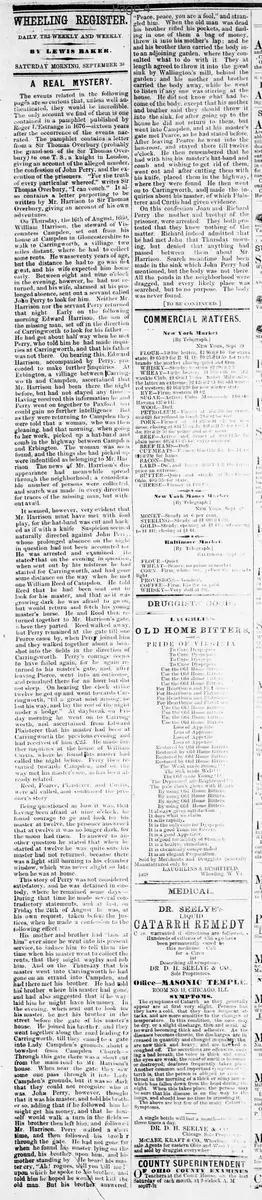
The events related in the following pages are so curious that, unless well authenticated, they would be incredible. The only account we find of them is one contained in a pamphlet published by Roger L'Estrange in 1676—sixteen years after the occurrence of the events narrated. The pamphlet contains a letter from a Sir Thomas Overbury (probably the grand-son of the Sir Thomas Overbury) to one T. S., a knight in London, giving an account of the alleged murder, the confession of John Perry, and the execution of the prisoners. "For the truth of every particular whereof," writes Sir Thomas Overbury, "I can vouch." It also contains a letter purporting to be written by Mr. Harrison to Sir Thomas Overbury, giving an account of his own adventures.
On Thursday, the 16th of August, 1660, William Harrison, the steward of Viscountess Campden, set out from his house at Campden in Gloucestershire to walk to Charringworth, a village two miles distant, where he had to collect some rents. He was seventy years of age, but the distance he had to go was not great, and his wife expected him home early. Between eight and nine o'clock in the evening, however, he had not returned, and his wife, alarmed at his prolonged absence, sent out a servant called John Perry to look for him. Neither Mr. Harrison nor the servant Perry returned that night. Early on the following morning Edward Harrison, the son of the missing man, set off in the direction of Charringworth to look for his father. He had got about half way when he met Perry, who told him he had made inquiries at Charringworth, and that his father was not there. On hearing this, Edward Harrison, accompanied by Perry, proceeded to make further inquiries. At Ebrington, a village between Charringworth and Campden, they ascertained that Mr. Harrison had been there the night before, but had not stayed any time. Having received this information he and Perry went on together to Paxford. They could gain no further intelligence. But as they were returning to Campden they were told that a woman, who was then gleaning, had that morning, when going to her work, picked up a hat-band and comb in the highway between Campden and Ebrington. The woman was soon found, and the things she had picked up were identified as belonging to Mr. Harrison. The news of Mr. Harrison's disappearance had meanwhile spread through the neighborhood; a considerable number of persons were collected and search was made in every direction for traces of the missing man, but without avail.
It seemed, however, very evident that Mr. Harrison must have met with foul play, for the hat-band was cut and hacked as if with a knife. Suspicion seemed naturally directed against John Perry, whose prolonged absence on the night in question had not been accounted for. He was arrested and examined. He stated that on the evening in question, when sent out by his mistress, he had started for Charringworth, and had gone some distance on the way when he met one William Reed of Campden. He told Reed that he had been sent out to look for his master, and that as it was growing dark he was afraid to go on, but would return and fetch his young master's horse. He and Reed then returned together to Mr. Harrison's gate, where they parted. Reed walked away but Perry remained at the gate till one Pearce came by, when Perry joined him and they walked together about a bow-shot into the fields in the direction of Charringworth. Perry's courage seems to have failed again, for he again returned to his master's gate, and, after leaving Pearce, went into an outhouse and remained there for an hour but did not sleep. On hearing the clock strike twelve he got up and went towards Charringworth, "till a great mist arising, he lost his way, and lay the rest of the night under a hedge." At daybreak on Friday morning he went on to Charringworth, and ascertained from Edward Plaisterer that his master had been at Charringworth the previous evening and had received of him £23. He made further inquiries at the house of William Curtis, where he found his master had called the night before. Perry then returned towards Campden, and on the way met his master's son, as has been already related. Reed, Pearce, Plaisterer, and Curtis, were all called, and confirmed the prisoner's story. Being questioned as how it was, that having been afraid at nine o'clock, he found courage to go and look for his master at twelve, the prisoner answered that at twelve it was no longer dark, for the moon had risen. In answer to another question he stated that when he started at twelve he was quite sure his master had not returned, because there was a light still burning in his chamber window, which was never alight so late when he was at home.
This story of Perry was not considered satisfactory, and he was detained in custody, where he remained some days. During that time he made several contradictory statements, and at last, on Friday the 24th of August he was, at his own request, taken before the justices, when he made a confession to the following effect:
His mother and brother had "lain at him" ever since he went into his present service, to induce him to tell them the time when his master went to collect the rents, that they might waylay and rob him. And on the Thursday that his master went to Charringworth he had gone on an errand into Campden, and had there met his brother. He had told his brother where his master had gone and had also suggested that if he waylaid him he might have his money. In the evening, when sent out to look for his master, he met his brother in the street before the gate of his master's house. He joined his brother, and they went together along the road leading to Charringworth, till they came to a gate into Lady Campden's grounds, about a bow-shot from Campden Church.
Through this gate there was a short cut from the main-road to Mr. Harrison's house. When near the gate they saw some one pass through it into Lady Campden's grounds, but it was so dark that they could not recognize who it was. John Perry, however, thought that it was his master, and told his brother so, adding that if he followed him he might get his money, and that he himself would walk a turn in the fields. His brother then left him, and followed Mr. Harrison. Perry waited a short time, and then followed his brother through the gate. He had not gone far when he found his master lying on the ground, his brother upon him, and his mother standing by. He heard his master cry, "Ah! rogues, will you kill me?" upon which he spoke to his brother, and told him he hoped he would not kill the old man. But his brother answered
REAL
MYSTERY.
The events related in the following pages are so curious that, unless well authenticated, they would be incredible. The only account we find of them is one contained in a pamphlet published by Roger L'Estrange in 1676—sixteen years after the occurrence of the events narrated. The pamphlet contains a letter from a Sir Thomas Overbury (probably the grand-son of the Sir Thomas Overbury) to one T. S., a knight in London, giving an account of the alleged murder, the confession of John Perry, and the execution of the prisoners. "For the truth of every particular whereof," writes Sir Thomas Overbury, "I can vouch." It also contains a letter purporting to be written by Mr. Harrison to Sir Thomas Overbury, giving an account of his own adventures.
On Thursday, the 16th of August, 1660, William Harrison, the steward of Viscountess Campden, set out from his house at Campden in Gloucestershire to walk to Charringworth, a village two miles distant, where he had to collect some rents. He was seventy years of age, but the distance he had to go was not great, and his wife expected him home early. Between eight and nine o'clock in the evening, however, he had not returned, and his wife, alarmed at his prolonged absence, sent out a servant called John Perry to look for him. Neither Mr. Harrison nor the servant Perry returned that night. Early on the following morning Edward Harrison, the son of the missing man, set off in the direction of Charringworth to look for his father. He had got about half way when he met Perry, who told him he had made inquiries at Charringworth, and that his father was not there. On hearing this, Edward Harrison, accompanied by Perry, proceeded to make further inquiries. At Ebrington, a village between Charringworth and Campden, they ascertained that Mr. Harrison had been there the night before, but had not stayed any time. Having received this information he and Perry went on together to Paxford. They could gain no further intelligence. But as they were returning to Campden they were told that a woman, who was then gleaning, had that morning, when going to her work, picked up a hat-band and comb in the highway between Campden and Ebrington. The woman was soon found, and the things she had picked up were identified as belonging to Mr. Harrison. The news of Mr. Harrison's disappearance had meanwhile spread through the neighborhood; a considerable number of persons were collected and search was made in every direction for traces of the missing man, but without avail.
It seemed, however, very evident that Mr. Harrison must have met with foul play, for the hat-band was cut and hacked as if with a knife. Suspicion seemed naturally directed against John Perry, whose prolonged absence on the night in question had not been accounted for. He was arrested and examined. He stated that on the evening in question, when sent out by his mistress, he had started for Charringworth, and had gone some distance on the way when he met one William Reed of Campden. He told Reed that he had been sent out to look for his master, and that as it was growing dark he was afraid to go on, but would return and fetch his young master's horse. He and Reed then returned together to Mr. Harrison's gate, where they parted. Reed walked away but Perry remained at the gate till one Pearce came by, when Perry joined him and they walked together about a bow-shot into the fields in the direction of Charringworth. Perry's courage seems to have failed again, for he again returned to his master's gate, and, after leaving Pearce, went into an outhouse and remained there for an hour but did not sleep. On hearing the clock strike twelve he got up and went towards Charringworth, "till a great mist arising, he lost his way, and lay the rest of the night under a hedge." At daybreak on Friday morning he went on to Charringworth, and ascertained from Edward Plaisterer that his master had been at Charringworth the previous evening and had received of him £23. He made further inquiries at the house of William Curtis, where he found his master had called the night before. Perry then returned towards Campden, and on the way met his master's son, as has been already related. Reed, Pearce, Plaisterer, and Curtis, were all called, and confirmed the prisoner's story. Being questioned as how it was, that having been afraid at nine o'clock, he found courage to go and look for his master at twelve, the prisoner answered that at twelve it was no longer dark, for the moon had risen. In answer to another question he stated that when he started at twelve he was quite sure his master had not returned, because there was a light still burning in his chamber window, which was never alight so late when he was at home.
This story of Perry was not considered satisfactory, and he was detained in custody, where he remained some days. During that time he made several contradictory statements, and at last, on Friday the 24th of August he was, at his own request, taken before the justices, when he made a confession to the following effect:
His mother and brother had "lain at him" ever since he went into his present service, to induce him to tell them the time when his master went to collect the rents, that they might waylay and rob him. And on the Thursday that his master went to Charringworth he had gone on an errand into Campden, and had there met his brother. He had told his brother where his master had gone and had also suggested that if he waylaid him he might have his money. In the evening, when sent out to look for his master, he met his brother in the street before the gate of his master's house. He joined his brother, and they went together along the road leading to Charringworth, till they came to a gate into Lady Campden's grounds, about a bow-shot from Campden Church.
Through this gate there was a short cut from the main-road to Mr. Harrison's house. When near the gate they saw some one pass through it into Lady Campden's grounds, but it was so dark that they could not recognize who it was. John Perry, however, thought that it was his master, and told his brother so, adding that if he followed him he might get his money, and that he himself would walk a turn in the fields. His brother then left him, and followed Mr. Harrison. Perry waited a short time, and then followed his brother through the gate. He had not gone far when he found his master lying on the ground, his brother upon him, and his mother standing by. He heard his master cry, "Ah! rogues, will you kill me?" upon which he spoke to his brother, and told him he hoped he would not kill the old man. But his brother answered
What sub-type of article is it?
Prose Fiction
What themes does it cover?
Death Mortality
Moral Virtue
What keywords are associated?
Mystery
Disappearance
Confession
Murder
Robbery
1660
Campden
What entities or persons were involved?
From A Pamphlet Published By Roger L'estrange; Letter From Sir Thomas Overbury
Literary Details
Title
A Real Mystery.
Author
From A Pamphlet Published By Roger L'estrange; Letter From Sir Thomas Overbury
Subject
The Disappearance And Alleged Murder Of William Harrison In 1660
Key Lines
"For The Truth Of Every Particular Whereof," Writes Sir Thomas Overbury, "I Can Vouch."
"Ah! Rogues, Will You Kill Me?"
His Mother And Brother Had "Lain At Him" Ever Since He Went Into His Present Service, To Induce Him To Tell Them The Time When His Master Went To Collect The Rents, That They Might Waylay And Rob Him.