Thank you for visiting SNEWPapers!
Sign up free
The New Hampshire Gazette And Historical Chronicle
Portsmouth, Greenland, Rockingham County, New Hampshire
What is this article about?
1771 London political scandal: Legal opinion invalidates House of Commons summons to printer John Wheble over contempt; Wilkes demands parliamentary seat, criticizes illegal proclamation. Reports highlight ministerial firmness, Wilkes's decline, and defenses of liberties against parliamentary overreach.
Merged-components note: Merging these sequential components across pages as they all pertain to the British parliamentary crisis involving Wilkes, Oliver, printers, legal opinions, and related political developments in London; the letter_to_editor fits as part of the reporting on this topic.
Clippings
1 of 2
OCR Quality
Full Text
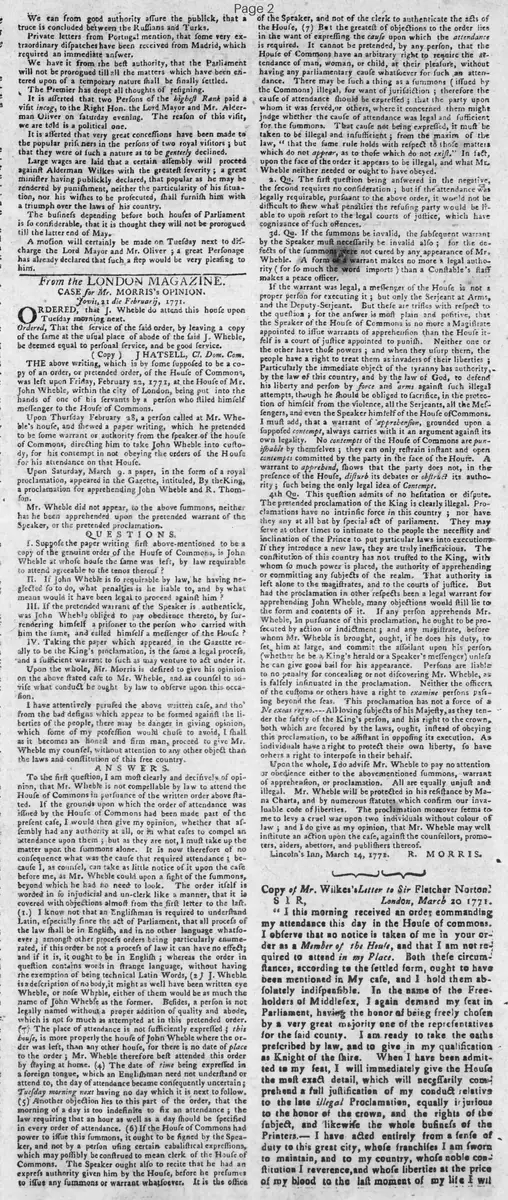
CASE for Mr. MORRIS's OPINION.
Fovis. 21 die Februarij, 1771.
ORDERED, that J. Wheble do attend this house upon Tuesday morning next.
Ordered, That the service of the said order, by leaving a copy of the same at the usual place of abode of the said J. Wheble, be deemed equal to personal service, and be good service.
(Copy) J. HATSELL, Cl. Dom. Com.
THE above writing, which is by some supposed to be a copy of an order, or pretended order, of the House of Commons, was left upon Friday, February 22, 1771, at the House of Mr. John Wheble, within the city of London, being put into the hands of one of his servants by a person who stiled himself messenger to the House of Commons.
Upon Thursday February 28, a person called at Mr. Wheble's house, and shewed a paper writing, which he pretended to be some warrant or authority from the Speaker of the house of Commons, directing him to take John Wheble into custody, for his contempt in not obeying the orders of the House for his attendance on that House.
Upon Saturday, March 2, a paper, in the form of a royal proclamation, appeared in the Gazette, intituled, By the King, a proclamation for apprehending John Wheble and R. Thomson.
Mr. Wheble did not appear, to the above summons, neither has he been apprehended upon the pretended warrant of the Speaker, or the pretended proclamation.
QUESTIONS.
I. Suppose the paper writing first above-mentioned to be a copy of the genuine order of the House of Commons, is John Wheble at whose house the same was left, by law requirable to attend agreeable to the tenor thereof?
II. If John Wheble is so requirable by law, he having neglected so to do, what penalties is he liable to, and by what means would it have been legal to proceed against him?
III. If the pretended warrant of the Speaker is authentick, was John Wheble obliged to pay obedience thereto, by surrendering himself a prisoner to the person who carried with him the same, and called himself a messenger of the House?
IV. Taking the paper which appeared in the Gazette really to be the King's proclamation, is the same a legal process, and a sufficient warrant to such as may venture to act under it.
Upon the whole, Mr. Morris is desired to give his opinion on the above stated case to Mr. Wheble, and as counsel to advise what conduct he ought by law to observe upon this occasion.
I have attentively perused the above written case, and though from the bad designs which appear to be formed against the liberties of the people, there may be danger in giving opinion, which some of my profession would choose to avoid, I shall as it becomes an honest and firm man, proceed to give Mr. Wheble my counsel, without attention to any other object than the laws and constitution of this free country.
ANSWERS
To the first question, I am most clearly and decisively of opinion, that Mr. Wheble is not compellable by law to attend the House of Commons in pursuance of the written order above stated. If the grounds upon which the order of attendance was issued by the House of Commons had been made part of the present case, I would then give my opinion, whether that assembly had any authority at all, or in what cases to compel an attendance upon them; but as they are not, I must take up the matter upon the summons alone. It is now therefore of no consequence what was the cause that required attendance; because I, as counsel, can take as little notice of it upon the case before me, as Mr. Wheble could upon a sight of the summons, beyond which he had no need to look. The order itself is worded in so injudicial and un-clerk like a manner, that it is covered with objections almost from the first letter to the last.
I know not that an Englishman is required to understand Latin, especially since the act of Parliament, that all process of the law shall be in English, and in no other language whatsoever; amongst other process orders being particularly enumerated, if this order be not a process of law it can have no effect: and if it is, it ought to be in English; whereas the order in question contains words in strange language, without having the exemption of being technical Latin Words, (a J. Wheble is a description of no body, it might as well have been written eye Wheble, or noe Wheble, either of them would be as much the name of John Wheble as the former, Besides, a person is not legally named without a proper addition of quality and abode, which is not so much as attempted at in this pretended order.
The place of attendance is not sufficiently expressed; this house, is more properly the house of John Wheble where the order was left, than any other house. for there is no date of place to the order; Mr. Wheble therefore best attended this order by staying at home. The date of time being expressed in a foreign tongue, which an Englishman need not understand or attend to, the day of attendance became consequently uncertain; Tuesday morning next having no day which it is next to follow.
Another objection lies to this part of the order, that the morning of a day is too indefinite to fix an attendance; the law requiring that an hour as well as a day should be specified in every order of attendance. If the House of Commons had power to issue this summons, it ought to be signed by the Speaker, and not by a person using certain cabalistical expressions, which may possibly be construed to mean clerk of the House of Commons. The Speaker ought also to recite that he had an express authority given him by the House, before he presumes to issue any summons or warrant whatsoever. It is the office of the Speaker, and not of the clerk to authenticate the acts of the House, But the greatest of objections to the order lies in the want of expressing the cause upon which the attendance is required. It cannot be pretended, by any person, that the House of Commons have an arbitrary right to require the attendance of man, woman, or child, at their pleasure, without having any parliamentary cause whatsoever for such an attendance. There may be such a thing as a summons (issued by the Commons) illegal, for want of jurisdiction; therefore the cause of attendance should be expressed; that the party upon whom it was served, or others, where it concerned them might judge whether the cause of attendance was legal and sufficient for the summons. That cause not being expressed, it must be taken to be illegal and insufficient; from the maxim of the law, "that the same rule holds with respect to those matters which do not appear, as to those which do not exist." In fact, upon the face of the order it appears to be illegal, and what Mr. Wheble neither needed or ought to have obeyed.
2. Qu. The first question being answered in the negative, the second requires no consideration; but if the attendance was legally requirable, pursuant to the above order, it would not be difficult to shew what penalties the refusing party would be liable to upon resort to the legal courts of justice, which have cognizance of such offences.
3d. Qu. If the summons be invalid, the subsequent warrant by the Speaker must necessarily be invalid also; for the defects of the summons were not cured by any appearance of Mr. Wheble. A form of a warrant makes no more a legal authority (for so much the word imports) than a Constable's staff makes a peace officer.
If the warrant was legal, a messenger of the House is not a proper person for executing it; but only the Serjeant at Arms, and the Deputy-Serjeant. But these are trifles with respect to the question; for the answer is most plain and positive, that the Speaker of the House of Commons is no more a Magistrate appointed to issue warrants of apprehension than the House itself is a court of justice appointed to punish. Neither one or the other have those powers; and when they usurp them, the people have a right to treat them as invaders of their liberties; particularly the immediate object of the tyranny has authority.- by the law of this country, and by the law of God, to defend his liberty and person by force and arms against such illegal attempts, though he should be obliged to sacrifice, in the protection of himself from the violence, all the Serjeants, all the Messengers, and even the Speaker himself of the House of Commons.
I must add, that a warrant of apprehension, grounded upon a supposed contempt, always carries with it an argument against its own legality. No contempts of the House of Commons are punishable by themselves; they can only restrain instant and open contempts committed by the party in the face of the House. A warrant to apprehend, shews that the party does not, in the presence of the House, disturb its debates or obstruct its authority; such being the only legal idea of Contempt.
4th Qu. This question admits of no hesitation or dispute. The pretended proclamation of the King is clearly illegal. Proclamations have no intrinsic force in this country; nor have they any at all but by special act of parliament. They may serve at other times to intimate to the people the necessity and inclination of the Prince to put particular laws into execution. If they introduce a new law, they are truly inefficacious. The constitution of this country has not trusted to the King, with whom so much power is placed, the authority of apprehending or committing any subjects of the realm. That authority is left alone to the magistrates, and to the courts of justice. But had the proclamation in other respects been a legal warrant for apprehending John Wheble, many objections would still lie to the form and contents of it. If any person apprehends Mr. Wheble, in pursuance of this proclamation, he ought to be prosecuted by action or indictment; and any magistrate, before whom Mr. Wheble is brought, ought, if he does his duty, to set him at large, and commit the assailant upon his person (whether he be a King's herald or a Speaker's messenger) unless he can give good bail for his appearance. Persons are liable to no penalty for concealing or not discovering Mr. Wheble, as is falsely insinuated in the proclamation. Neither the officers of the customs or others have a right to examine persons passing beyond the seas. This proclamation has not the force of Ne exeas regno.---All loving subjects of his Majesty, as they tender the safety of the King's person, and his right to the crown both which are secured by the laws, ought, instead of obeying this proclamation, to be assistant in opposing its execution. As individuals have a right to protect their own liberty, so have others a right to interpose in their behalf.
Upon the whole, I do advise Mr. Wheble to pay no attention or obedience either to the abovementioned summons, warrant of apprehension, or proclamation. All are equally unjust and illegal. Mr. Wheble will be protected in his resistance by Magna Charta, and by numerous statutes which confirm our invaluable code of Liberties. The proclamation moreover seems to me to levy a cruel war upon two individuals without colour of law; and I do give as my opinion, that Mr. Wheble may well institute an action upon the case, against the counsellors, promoters, aiders, abettors, and publishers thereof.
Lincoln's-Inn, March 14, 1771. R. MORRIS.
Copy of Mr. Wilkes's Letter to Sir Fletcher Norton.
SIR,
London, March 20, 1771.
I this morning received an order commanding my attendance this day in the House of Commons.
I observe that no notice is taken of me in your order as a Member of the House, and that I am not required to attend in my Place. Both these circumstances, according to the settled form, ought to have been mentioned in my case, and I hold them absolutely indispensable. In the name of the Freeholders of Middlesex, I again demand my seat in Parliament, having the honour of being freely chosen by a very great majority one of the representatives for the said county. I am ready to take the oaths prescribed by law, and to give in my qualification as Knight of the Shire. When I have been admitted to my seat, I will immediately give the House the most exact detail, which will necessarily comprehend a full justification of my conduct relative to the late illegal Proclamation, equally injurious to the honor of the crown, and the rights of the subject, and likewise the whole business of the Printers.-- I have acted entirely from a sense of duty to this great city, whose franchises I am sworn to maintain, and to my country, whose noble constitution I reverence, and whose liberties at the price of my blood to the last moment of my life I will defend.
I am, SIR, Your most humble servant,
JOHN WILKES.
To the Right Honourable Sir Fletcher Norton, Knight.
Yesterday Edward Twine Carpenter again applied at the Treasury, according to the certain assurance of a board being held, for the roll in which his Majesty is indebted to him according to his royal and most sacred promise for apprehending Wheble, and conveying him before a Magistrate. Carpenter could not for some time obtain any answer to his demand: but at last he forced from the mouth of one of the Clerks, that they were ordered by Lord North not to enter into conversation with him, because it would be communicated to Mr. Wilkes, and inserted in the papers, as their former answers to him had been. He returned no richer than he went; the promised board being still put off to the morrow, and one more day given to decide the propriety of Mr. Morris's reflection upon this affair.
Lord North's abilities being now so well known as a peace-maker, it is said that a motion will be made in a certain assembly for an address, desiring his Lordship to undertake an accommodation between them and the Heroes in the city, as they are very well aware rough treatment will not in the least stifle their patriotic ardor.
Notwithstanding Lord Chief Justice Grey has been for some time past most severely afflicted with the gout, he voluntarily sent his opinion concerning the conduct of the Lord-Mayor in regard to the Printers, to the Mansion-house, accompanied with a very polite address to his Lordship.
C. Fox (who is considered as the mouth-piece of the premier) intimated in the Lobby, that the Minister seemed determined to act with rigour against the City Magistrates.
Lord H-ke declared, that a noted motion-maker (to take up the Printers) deserved, for his officious behaviour, to be expelled the Society to which he belongs, and to which he has been the cause of so much trouble and embarrassment.
ANECDOTE relating to Lord N--th.
The terms demanded by a crown lawyer, to whom the seals were offered, it is said, were a Pension in case of removal, and a Peerage upon coming into office; these being denied by the Minister, the lawyer observed, "if he was worthy to succeed the late Chancellor upon the bench, he was worthy to be treated with equal consideration: and therefore did not either deserve the seals or did deserve the distinctions conferred on his predecessors."
To this the Minister replied, "I have an equal opinion, Sir, of your probity and judgment and respect you no less as a lawyer than as a man. But, Sir, had I possessed my present situation when the seals were last disposed of, I would not have prostituted the dignity of the Chancellorship so far as to bribe the acceptor into a condescension of stooping to the first employment an English subject can arrive at; an employment, in which he is to be invested with a kind of temporary omnipotence, and to have the glory of not only serving his sovereign, but of conferring an essential obligation on his country.-- When I came into power myself, Sir, critical as the times were, I made no bargains. I stipulated for no emoluments in the hour of dismission, nor conditioned for a title when I was to be removed. I thought a compact of this nature would be as disreputable to myself, as it would be injurious to the public; and am therefore determined, while I retain my master's confidence, to rescue the great departments of the state from contempt, and to make the offer of any office a circumstance of the highest favour, instead of paying any individual for his goodness in deigning to fill it."
PHILADELPHIA, May 4.
Extract of a Letter from London, dated February 23.
"What shall I write you of Politics that may be depended on! The Ministry continue firm, & the Minority declines. Lord North has proved himself a man of Abilities this Session. Wilkes is as low as he was once high, and deservedly so. Lord Chatham often harangues in the House, but is little attended to; he has failed in every Attempt to rise into Office. His Lordship is no longer the popular Man in this Kingdom. In real Truth, there seems to be but little public Virtue left among our Patriots; their Cry for Liberty springs only from their Lust of Power."
What sub-type of article is it?
What keywords are associated?
What entities or persons were involved?
Where did it happen?
Foreign News Details
Primary Location
London
Event Date
February March 1771
Key Persons
Outcome
legal opinion declares summons, warrant, and proclamation illegal; advises resistance and potential action against promoters; wilkes demands seat in parliament.
Event Details
Legal opinion by R. Morris on a House of Commons order summoning John Wheble, deemed invalid due to form and lack of cause; subsequent Speaker's warrant and King's proclamation also ruled illegal. Wilkes writes to Speaker Norton demanding his parliamentary seat and justifying conduct on printer affair and proclamation. Additional reports on related political tensions, ministerial actions, and anecdotes.