Thank you for visiting SNEWPapers!
Sign up free
Editorial
April 28, 1893
The Kinsley Graphic
Kinsley, Edwards County, Kansas
What is this article about?
Critique of the Greenlee railroad bill as special legislation benefiting Wichita, Hutchinson, and Salina jobbers at the expense of Kansas consumers and other areas. Republican editors like Col. Murdock and Speaker Douglass are faulted for prioritizing local interests over state equity. An amendment for fairer rates was opposed.
Clipping
OCR Quality
98%
Excellent
Full Text
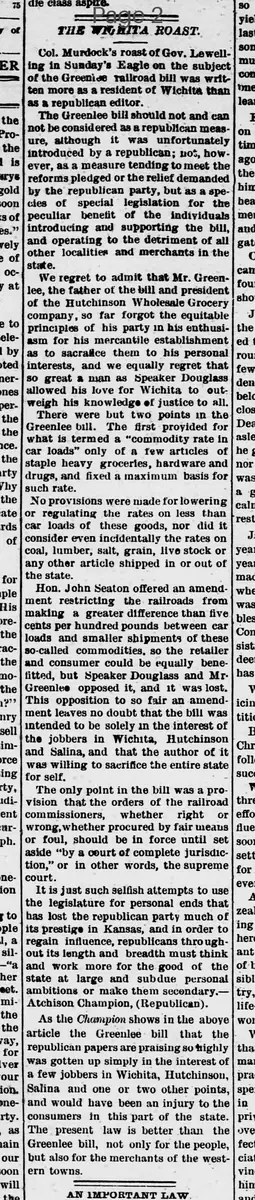
THE AGRITA ROAST.
Col. Murdock's roast of Gov. Lewelling in Sunday's Eagle on the subject of the Greenlee railroad bill was written more as a resident of Wichita than as a republican editor.
The Greenlee bill should not and cannot be considered as a republican measure, although it was unfortunately introduced by a republican; nor, however, as a measure tending to meet the reforms pledged or the relief demanded by the republican party, but as a species of special legislation for the peculiar benefit of the individuals introducing and supporting the bill, and operating to the detriment of all other localities and merchants in the state.
We regret to admit that Mr. Greenlee, the father of the bill and president of the Hutchinson Wholesale Grocery company, so far forgot the equitable principles of his party in his enthusiasm for his mercantile establishment as to sacrifice them to his personal interests, and we equally regret that so great a man as Speaker Douglass allowed his love for Wichita to outweigh his knowledge of justice to all.
There were but two points in the Greenlee bill. The first provided for what is termed a "commodity rate in car loads" only of a few articles of staple heavy groceries, hardware and drugs, and fixed a maximum basis for such rate.
No provisions were made for lowering or regulating the rates on less than car loads of these goods, nor did it consider even incidentally the rates on coal, lumber, salt, grain, live stock or any other article shipped in or out of the state.
Hon. John Seaton offered an amendment restricting the railroads from making a greater difference than five cents per hundred pounds between car loads and smaller shipments of these so-called commodities, so the retailer and consumer could be equally benefited, but Speaker Douglass and Mr. Greenlee opposed it, and it was lost.
This opposition to so fair an amendment leaves no doubt that the bill was intended to be solely in the interest of the jobbers in Wichita, Hutchinson and Salina, and that the author of it was willing to sacrifice the entire state for self.
The only point in the bill was a provision that the orders of the railroad commissioners, whether right or wrong, whether procured by fair means or foul, should be in force until set aside "by a court of complete jurisdiction," or in other words, the supreme court.
It is just such selfish attempts to use the legislature for personal ends that has lost the republican party much of its prestige in Kansas, and in order to regain influence, republicans throughout its length and breadth must think and work more for the good of the state at large and subdue personal ambitions or make them secondary.
Atchison Champion, (Republican).
As the Champion shows in the above article the Greenlee bill that the republican papers are praising so highly was gotten up simply in the interest of a few jobbers in Wichita, Hutchinson, Salina and one or two other points, and would have been an injury to the consumers in this part of the state.
The present law is better than the Greenlee bill, not only for the people, but also for the merchants of the western towns.
Col. Murdock's roast of Gov. Lewelling in Sunday's Eagle on the subject of the Greenlee railroad bill was written more as a resident of Wichita than as a republican editor.
The Greenlee bill should not and cannot be considered as a republican measure, although it was unfortunately introduced by a republican; nor, however, as a measure tending to meet the reforms pledged or the relief demanded by the republican party, but as a species of special legislation for the peculiar benefit of the individuals introducing and supporting the bill, and operating to the detriment of all other localities and merchants in the state.
We regret to admit that Mr. Greenlee, the father of the bill and president of the Hutchinson Wholesale Grocery company, so far forgot the equitable principles of his party in his enthusiasm for his mercantile establishment as to sacrifice them to his personal interests, and we equally regret that so great a man as Speaker Douglass allowed his love for Wichita to outweigh his knowledge of justice to all.
There were but two points in the Greenlee bill. The first provided for what is termed a "commodity rate in car loads" only of a few articles of staple heavy groceries, hardware and drugs, and fixed a maximum basis for such rate.
No provisions were made for lowering or regulating the rates on less than car loads of these goods, nor did it consider even incidentally the rates on coal, lumber, salt, grain, live stock or any other article shipped in or out of the state.
Hon. John Seaton offered an amendment restricting the railroads from making a greater difference than five cents per hundred pounds between car loads and smaller shipments of these so-called commodities, so the retailer and consumer could be equally benefited, but Speaker Douglass and Mr. Greenlee opposed it, and it was lost.
This opposition to so fair an amendment leaves no doubt that the bill was intended to be solely in the interest of the jobbers in Wichita, Hutchinson and Salina, and that the author of it was willing to sacrifice the entire state for self.
The only point in the bill was a provision that the orders of the railroad commissioners, whether right or wrong, whether procured by fair means or foul, should be in force until set aside "by a court of complete jurisdiction," or in other words, the supreme court.
It is just such selfish attempts to use the legislature for personal ends that has lost the republican party much of its prestige in Kansas, and in order to regain influence, republicans throughout its length and breadth must think and work more for the good of the state at large and subdue personal ambitions or make them secondary.
Atchison Champion, (Republican).
As the Champion shows in the above article the Greenlee bill that the republican papers are praising so highly was gotten up simply in the interest of a few jobbers in Wichita, Hutchinson, Salina and one or two other points, and would have been an injury to the consumers in this part of the state.
The present law is better than the Greenlee bill, not only for the people, but also for the merchants of the western towns.
What sub-type of article is it?
Infrastructure
Economic Policy
Partisan Politics
What keywords are associated?
Greenlee Bill
Railroad Rates
Kansas Republicans
Special Legislation
Commodity Rates
Jobbers
State Equity
What entities or persons were involved?
Col. Murdock
Gov. Lewelling
Mr. Greenlee
Speaker Douglass
Hon. John Seaton
Atchison Champion
Hutchinson Wholesale Grocery Company
Jobbers In Wichita, Hutchinson, Salina
Editorial Details
Primary Topic
Critique Of Greenlee Railroad Bill As Special Interest Legislation
Stance / Tone
Critical Of Bill And Republican Supporters Favoring Local Over State Interests
Key Figures
Col. Murdock
Gov. Lewelling
Mr. Greenlee
Speaker Douglass
Hon. John Seaton
Atchison Champion
Hutchinson Wholesale Grocery Company
Jobbers In Wichita, Hutchinson, Salina
Key Arguments
Greenlee Bill Is Special Legislation Benefiting Specific Merchants In Wichita, Hutchinson, Salina
Bill Ignores Rates For Less Than Car Load Shipments And Other Commodities Like Coal, Lumber
Opposition To Seaton's Amendment Shows Intent To Favor Jobbers Over Retailers And Consumers
Bill Enforces Railroad Commissioner Orders Until Supreme Court Reversal, Regardless Of Fairness
Such Selfish Legislation Harms Republican Prestige In Kansas
Republicans Must Prioritize State Good Over Personal Ambitions