Thank you for visiting SNEWPapers!
Sign up free
The Daily Worker
Chicago, Cook County, Illinois
What is this article about?
Two conferences of the Second International held in London: a Four Countries' Conference on Feb. 8-9 involving English, French, German, and Belgian socialist leaders discussing reparations, inter-allied debts, and Rhine evacuation; followed by an Executive session on Feb. 11-12 addressing disarmament and issuing a telegram to the League of Nations.
Clipping
OCR Quality
Full Text
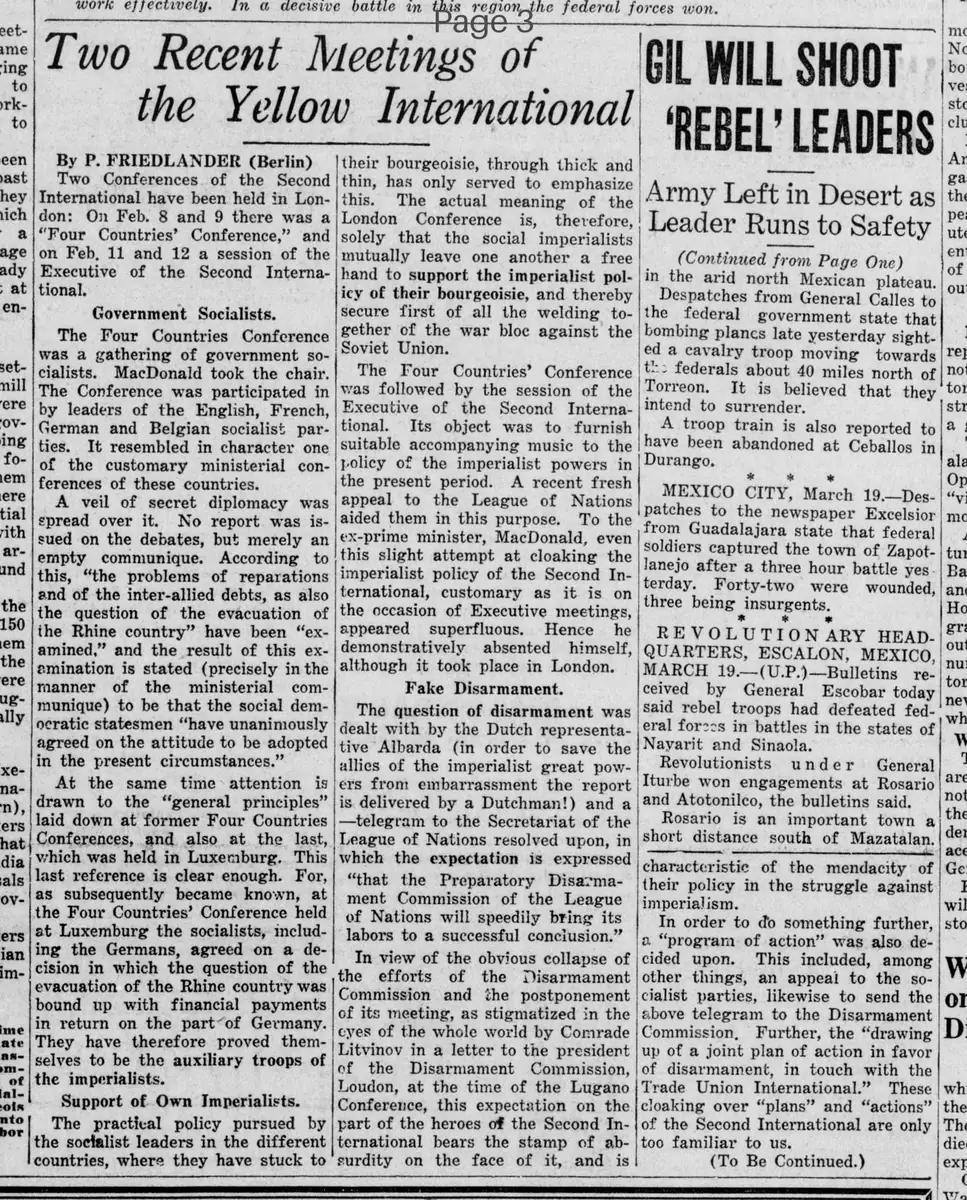
By P. FRIEDLANDER (Berlin)
Two Conferences of the Second International have been held in London: On Feb. 8 and 9 there was a "Four Countries' Conference," and on Feb. 11 and 12 a session of the Executive of the Second International.
Government Socialists.
The Four Countries Conference was a gathering of government socialists. MacDonald took the chair. The Conference was participated in by leaders of the English, French, German and Belgian socialist parties. It resembled in character one of the customary ministerial conferences of these countries.
A veil of secret diplomacy was spread over it. No report was issued on the debates, but merely an empty communique. According to this, "the problems of reparations and of the inter-allied debts, as also the question of the evacuation of the Rhine country" have been "examined," and the result of this examination is stated (precisely in the manner of the ministerial communique) to be that the social democratic statesmen "have unanimously agreed on the attitude to be adopted in the present circumstances."
At the same time attention is drawn to the "general principles" laid down at former Four Countries Conferences, and also at the last, which was held in Luxemburg. This last reference is clear enough. For, as subsequently became known, at the Four Countries' Conference held at Luxemburg the socialists, including the Germans, agreed on a decision in which the question of the evacuation of the Rhine country was bound up with financial payments in return on the part of Germany.
They have therefore proved themselves to be the auxiliary troops of the imperialists.
Support of Own Imperialists.
The practical policy pursued by the socialist leaders in the different countries, where they have stuck to their bourgeoisie, through thick and thin, has only served to emphasize this. The actual meaning of the London Conference is, therefore, solely that the social imperialists mutually leave one another a free hand to support the imperialist policy of their bourgeoisie, and thereby secure first of all the welding together of the war bloc against the Soviet Union.
The Four Countries' Conference was followed by the session of the Executive of the Second International. Its object was to furnish suitable accompanying music to the policy of the imperialist powers in the present period. A recent fresh appeal to the League of Nations aided them in this purpose. To the ex-prime minister, MacDonald, even this slight attempt at cloaking the imperialist policy of the Second International, customary as it is on the occasion of Executive meetings, appeared superfluous. Hence he demonstratively absented himself, although it took place in London.
Fake Disarmament.
The question of disarmament was dealt with by the Dutch representative Albarda (in order to save the allies of the imperialist great powers from embarrassment the report is delivered by a Dutchman!) and a telegram to the Secretariat of the League of Nations resolved upon, in which the expectation is expressed "that the Preparatory Disarmament Commission of the League of Nations will speedily bring its labors to a successful conclusion."
In view of the obvious collapse of the efforts of the Disarmament Commission and the postponement of its meeting, as stigmatized in the eyes of the whole world by Comrade Litvinov in a letter to the president of the Disarmament Commission, Loudon, at the time of the Lugano Conference, this expectation on the part of the heroes of the Second International bears the stamp of absurdity on the face of it, and is characteristic of the mendacity of their policy in the struggle against imperialism.
In order to do something further, a "program of action" was also decided upon. This included, among other things, an appeal to the socialist parties, likewise to send the above telegram to the Disarmament Commission. Further, the "drawing up of a joint plan of action in favor of disarmament, in touch with the Trade Union International." These cloaking over "plans" and "actions" of the Second International are only too familiar to us.
What sub-type of article is it?
What keywords are associated?
What entities or persons were involved?
Where did it happen?
Foreign News Details
Primary Location
London
Event Date
Feb. 8 And 9; Feb. 11 And 12
Key Persons
Outcome
unanimously agreed on attitude toward reparations, inter-allied debts, and rhine evacuation; telegram to league of nations expressing expectation for successful conclusion of preparatory disarmament commission; program of action including appeals to socialist parties and joint plan with trade union international.
Event Details
Two conferences of the Second International in London: Four Countries' Conference on Feb. 8-9, chaired by MacDonald, with leaders from English, French, German, and Belgian socialist parties, examined reparations, inter-allied debts, and Rhine evacuation under secret diplomacy, issuing a communique on agreed attitude. Followed by Executive session on Feb. 11-12, addressing disarmament via Dutch representative Albarda, sending telegram to League of Nations, and deciding on a program of action for disarmament.