Thank you for visiting SNEWPapers!
Sign up free
The Evening Telegraph
Philadelphia, Philadelphia County, Pennsylvania
What is this article about?
Report on Lafayette College's 31st Annual Commencement in Easton, PA, July 22-25, 1866, featuring baccalaureate services, addresses by clergy like Drs. Hickok, Junkin, Brainerd, Tustin, Plummer; alumni events; cornerstone laying for new scientific building funded by Alfred Pardee; orations; degree conferrals; and celebratory dinner highlighting institutional growth and Christian education.
Clipping
OCR Quality
Full Text
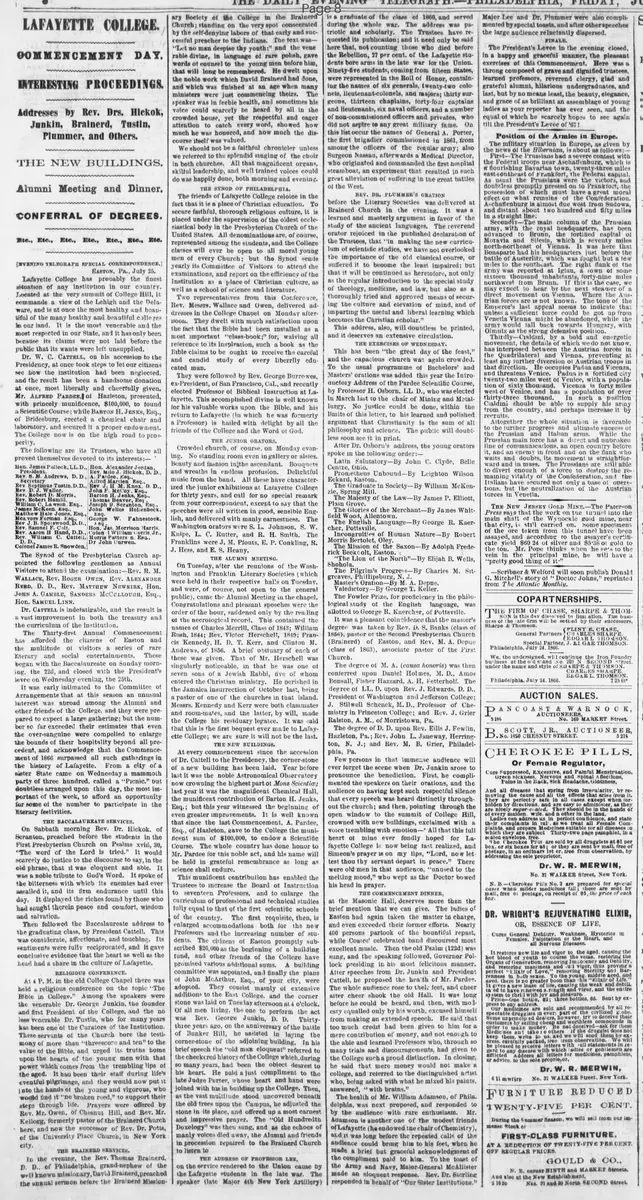
COMMENCEMENT DAY.
INTERESTING PROCEEDINGS.
Addresses by Rev. Drs. Hickok, Junkin, Brainerd, Tustin, Plummer, and Others.
THE NEW BUILDINGS.
Alumni Meeting and Dinner.
CONFERRAL OF DEGREES.
Etc., Etc., Etc.
[EVENING TELEGRAPH SPECIAL CORRESPONDENCE.]
Easton, Pa., July 25.
Lafayette College has probably the finest situation of any institution in our country. Located at the very summit of College Hill, it commands a view of the Lehigh and the Delaware, and is at once the most healthy and beautiful of the many healthy and beautiful colleges in our land. It is the most venerable and the most respected in our State, and it has only been because its claims were not laid before the public that its wants were left unsupplied.
Dr. W. C. Cattell, on his accession to the Presidency, at once took steps to let our citizens see how the institution had been neglected, and the result has been a handsome donation at once, most liberally and cheerfully given. Mr. Alfred Pardee, of Hazleton, presented, with princely munificence, $100,000, to found a Scientific Course; while Barton H. Jenks, Esq., of Bridesburg, erected a chemical chair and laboratory, and secured it a proper endowment. The College now is on the high road to prosperity.
The following are its Trustees, who have all proved themselves devoted to its interests:-
Hon. James Pollock, LL.D., President.
Hon. Alexander Jordan.
Rev. Milo J. Hickok, D. D.,
Rev. N. M. Andrews, D. D.,
A. Pardee, Esq., Secretary.
Alfred Martien, Esq.,
Rev. Septimus Tustin, D.D.
Rev. J. H. M. Knox, D. D.,
Rev. D. J. Waller.
John F. McCoy, Esq.,
Rev. Robert D. Morris,
Barton H. Jenks, Esq.,
Rev. Robert Hamill,
Thomas Beaver, Esq.
William C. Lawson, Esq.,
James McKeen, Esq.,
Joseph B. Scranton, Esq.,
John Welles Hollenbeck,
Matthew Hale Jones, Esq.,
Motors Forman, Esq.
George W. Fahnestock,
Rev. J. B. Spotswood, D.D.
Rev. Samuel F. Colt.
Hon. Jas. Morrison Harris.
Rev. Aaron H. Hand, D.D.
Col. William Corlis, Jr.,
Rev. William C. Cattell, D. D.
Morris Patterson, Esq.,
Dr. John Curwen.
Colonel James R. Snowden,
The Synod of the Presbyterian Church appointed the following gentlemen as Annual Visitors to attend the examination: - Rev. R. M. Wallace, Rev. Roger Owen, Rev. Alexander Reed, D. D., Rev. Matthew Newkirk, Hon. John A. Gamble, Sanders McCullough, Esq., Hon. Samuel Linn.
Dr. Cattell is indefatigable, and the result is a vast improvement in both the treasury and the curriculum of the institution.
The Thirty-first Annual Commencement has afforded the citizens of Easton and the multitude of visitors a series of rare literary and social entertainments. These began with the Baccalaureate on Sunday morning, the 22d, and closed with the President's levee on Wednesday evening, the 25th.
It was early intimated to the Committee of Arrangements that at this season an unusual interest was abroad among the Alumni and other friends of the College, and they were prepared to expect a large gathering; but the number so far exceeded their estimates that even the over-sanguine were compelled to enlarge the bounds of their hospitality beyond all precedent, and acknowledge that the Commencement of 1866 surpassed all such gatherings in the history of Lafayette. From a city of a sister State came on Wednesday a mammoth party of three hundred, called a "Picnic," but doubtless arranged upon this day, the most important of the week, to afford an opportunity for some of the number to participate in the literary festivities.
THE BACCALAUREATE SERVICES.
On Sabbath morning Rev. Dr. Hickok, of Scranton, preached before the students in the First Presbyterian Church on Psalms xviii, 30, "The word of the Lord is tried." It would scarcely do justice to the discourse to say, in the old phrase, that it was eloquent and able. It was a noble tribute to God's Word. It spoke of the bitterness with which its enemies had ever assailed it, and its firm endurance until this day. It displayed the riches found by those who had sought therein peace and comfort, wisdom and salvation.
Then followed the Baccalaureate address to the graduating class, by President Cattell. This was considerate, affectionate, and touching. Its sentiments were fully reciprocated, and it gave conclusive evidence that the heart as well as the head had a share in the culture of Lafayette.
RELIGIOUS CONFERENCE.
At 4 P. M. in the old College Chapel there was held a religious conference on the topic "The Bible in College." Among the speakers were the venerable Dr. George Junkin, the founder and first President of the College, and the no less venerable Dr. Tustin, who for many years has been one of the Curators of the Institution. These servants of the Church bore the testimony of more than "threescore and ten" to the value of the Bible, and urged its truths home upon the hearts of the young men with that power which comes from the trembling lips of the aged. It had been their staff during life's eventful pilgrimage, and they would now put it into the hands of the young and vigorous, who would find it "no broken reed," to support their steps through life. Prayers were offered by Rev. Mr. Owen, of Chestnut Hill, and Rev. Mr. Kellogg, formerly pastor of the Brainerd Church here, and now the successor of Rev. Dr. Potts, of the University Place Church, in New York city.
THE BRAINERD SERVICES.
In the evening, the Rev. Thomas Brainerd, D. D., of Philadelphia, grand-nephew of the well-known missionary, David Brainerd, preached the annual sermon before the Brainerd Missionary Society of the College in the Brainerd Church; standing on the very spot consecrated by the self-denying labors of that early and successful preacher to the Indians. The text was— "Let no man despise thy youth;" and the venerable divine, in language of rare polish, gave words of counsel to the young men before him, that will long be remembered. He dwelt upon the noble work which David Brainerd had done, and which was finished at an age when many ministers were just commencing theirs. The speaker was in feeble health, and sometimes his voice could scarcely be heard by all in the crowded house, yet the respectful and eager attention to catch every word, showed how much he was honored, and how much the discourse itself was valued.
We should not be a faithful chronicler unless we referred to the splendid singing of the choir in both churches. All that magnificent organs, skilful leadership, and well trained voices could do was happily done, both morning and evening.
THE SYNOD OF PHILADELPHIA.
The friends of Lafayette College rejoice in the fact that it is a place of Christian education. To secure faithful, thorough religious culture, it is placed under the supervision of the oldest ecclesiastical body in the Presbyterian Church of the United States. All denominations are, of course, represented among the students, and the College classes will ever be open to all moral young men of every Church; but the Synod sends yearly its Committee of Visitors to attend the examinations, and report on the efficiency of the Institution as a place of Christian culture, as well as a school of science and literature.
Two representatives from this Conference, Rev. Messrs. Wallace and Owen, delivered addresses in the College Chapel on Monday afternoon. They dwelt with much satisfaction upon the fact that the Bible had been installed as a most important "class-book;" for, waiving all reference to its inspiration, such a book as the Bible claims to be ought to receive the careful and candid study of every liberally educated man.
They were followed by Rev. George Burrowes, ex-President, of San Francisco, Cal., and recently elected Professor of Biblical Instruction at Lafayette. This accomplished divine is well known for his valuable works upon the Bible, and his return to Lafayette (in which he was formerly a Professor) is hailed with delight by all the friends of the College and the Word of God.
THE JUNIOR ORATORS.
Crowded church, of course, on Monday evening. No standing room even in gallery or aisles. Beauty and fashion in the ascendant. Bouquets and wreaths in endless profusion. Delightful music from the band. All these have characterized the junior exhibitions at Lafayette College for thirty years, and call for no special remark from your correspondent, except to say that the speeches were all written in good, sensible English, and delivered with manly earnestness. The Washington orators were S. L. Johnson, S. W. Knipe, L. C. Rutter, and R. H. Smith. The Franklins were J. M. Pfouts, E. P. Conkling, R. J. Hess, and E. S. Heany.
THE ALUMNI MEETING.
On Tuesday, after the reunions of the Washington and Franklin Literary Societies (which were held in their respective halls on Tuesday, and were, of course, not open to the general public), came the Alumni Meeting in the chapel. Congratulations and pleasant speeches were the order of the hour, saddened only by the reading of the necrological record. This contained the names of Charles Merrill, Class of 1843; William Rush, 1844; Rev. Victor Herschell, 1849; Francis Kennedy, H. D. T. Kerr, and Clinton M. Andrews, of 1856. A brief obituary of each of these was given. That of Mr. Herschell was singularly noticeable, in that he was one of seven sons of a Jewish Rabbi, five of whom entered the Christian ministry. He perished in the Jamaica insurrection of October last, being a pastor of one of the churches in that island. Messrs. Kennedy and Kerr were both classmates and room-mates, and the latter, by will, made the College his residuary legatee. It was said that this is the first bequest ever made to Lafayette College; we are sure it will not be the last.
THE NEW BUILDINGS.
At every commencement since the accession of Dr. Cattell to the Presidency, the corner-stone of a new building has been laid. Year before last it was the noble Astronomical Observatory now crowning the highest part of Mount Scientific; last year it was the magnificent Chemical Hall, the munificent contribution of Barton H. Jenks, Esq.; but this year witnessed the beginning of even greater improvements. It is well known that since the last Commencement, A. Pardee, Esq., of Hazleton, gave to the College the munificent sum of $100,000, to endow a Scientific Course. The whole country has done honor to Mr. Pardee for this noble act, and his name will be held in grateful remembrance as long as science shall endure.
This munificent contribution has enabled the Trustees to increase the Board of Instruction to seventeen Professors, and to enlarge the curriculum of professional and technical studies fully equal to that of the first scientific schools of the country. The first requisite, then, is enlarged accommodations both for the new Professors and the increasing number of students. The citizens of Easton promptly subscribed $20,000 as the beginning of a building fund, and other friends of the College have promised various additional sums. A building committee was appointed, and finally the plans of John McArthur, Esq., of your city, were adopted. They consist mainly of extensive additions to the East College, and the corner stone was laid on Tuesday afternoon at 4 o'clock.
Of all men living, the one to perform the act was Rev. George Junkin, D. D. Thirty-three years ago, on the anniversary of the battle of Bunker Hill, he assisted in laying the corner-stone of the adjoining building. In his brief speech the "old man eloquent" referred to the checkered history of the College which, during so many years, had been the object dearest to his heart. He paid a just compliment to the late Judge Porter, whose heart and hand were joined with his in building up the College. Then, as the vast multitude stood uncovered beneath the old trees upon the Campus, he adjusted the stone in its place, and offered up a most earnest and impressive prayer. The "Old Hundredth Doxology" was then sung, and as the echoes of manly voices died away, the Alumni and friends in procession repaired to the Brainerd Church to listen to
THE ADDRESS OF PROFESSOR LEE,
on the service rendered to the Union cause by the Lafayette students in the late war. The speaker (late Major 4th New York Artillery) is a graduate of the class of 1860, and served during the whole war. The address was patriotic and scholarly. The Trustees have requested its publication; and it need only be said here that, not counting those who died before the Rebellion, 27 per cent. of the Lafayette students bore arms in the late war for the Union. Ninety-five students, coming from fifteen States, were represented in the Roll of Honor, containing the names of six generals, twenty-two colonels, lieutenant-colonels, and majors; thirty surgeons, thirteen chaplains, forty-four captains and lieutenants, six naval officers, and a number of non-commissioned officers and privates, who did not aspire to any great military fame. On this list occur the names of General A. Porter, the first brigadier commissioned in 1861, from among the officers of the regular army; also Surgeon Nassau, afterwards a Medical Director, who originated and commanded the first hospital steamboat, an experiment that resulted in such great alleviation of suffering in the great battles of the West.
REV. DR. PLUMMER'S ORATION
before the Literary Societies was delivered at Brainerd Church in the evening. It was a learned and masterly argument in favor of the study of the ancient languages. The reverend orator rejoiced in the published declaration of the Trustees, that "in making the new curriculum of scientific studies, we have not overlooked the importance of the old classical course, or suffered it to become the least impaired; but that it will be continued as heretofore, not only as the regular introduction to the special study of theology, medicine, and law, but also as a thoroughly tried and approved means of securing the culture and elevation of mind, and of imparting the useful and liberal learning which becomes the Christian scholar."
This address, also, will doubtless be printed, and it deserves an extensive circulation.
THE EXERCISES OF WEDNESDAY.
This has been "the great day of the feast," and the capacious church was again crowded. To the usual programme of Bachelors' and Masters' orations was added this year the Introductory Address of the Pardee Scientific Course, by Professor H. Osborn, LL.D., who was elected in March last to the chair of Mining and Metallurgy. No justice could be done, within the limits of this letter, to his learned and polished argument that Christianity is the sum of all philosophy and science. The public will doubtless soon see it in print.
After Dr. Osborn's address, the young orators spoke in the following order:-
Latin Salutatory - By John C. Clyde, Belle Centre, Ohio.
Prometheus Unbound - By Leighton Wilson Eckard, Easton.
The Graduate in Society - By William McKenzie, Spring Mill.
The Majesty of the Law - By James P. Elliott, Plain Grove.
The Glories of the Merchant - By James Whitfield Wood, Allentown.
The English Language - By George R. Kaercher, Pottsville.
Incongruities of Human Nature - By Robert Morris Bertolet, Oley.
The Mission of the Saxon - By Adolph Frederick Beckcolt, Easton.
"The Lion of the North" - By Elijah B. Wells, Shohola.
The Pilgrim's Progress - By Charles M. Sitgreaves, Phillipsburg, N. J.
Master's Oration - By M. A. Depue.
Valedictory - By George T. Keller.
The Fowler Prize, for proficiency in the philological study of the English language, was allotted to George R. Kaercher, of Pottsville. It was a pleasant coincidence that the master's degree was taken by Rev. D. S. Banks (class of 1856), pastor of the Second Presbyterian Church (Brainerd) of Easton, and Rev. M. A. Depue (class of 1863), associate pastor of the First Church.
The degree of M. A. (causa honoris) was then conferred upon Daniel Holmes, M. D., Amos Bonsall, Fisher Hazzard, A. H. Fetterolf. The degree of LL. D. upon Rev. J. Edwards, D. D., President of Washington and Jefferson College; J. Stilwell Schenck, M. D., Professor of Chemistry in Princeton College; and Rev. J. Grier Ralston, A. M., of Morristown, Pa. The degree of D. D. upon Rev. Ellis J. Fewlin, Hazleton, Pa.; Rev. John L. Janeway, Herrington, N. J.; and Rev. M. B. Grier, Philadelphia, Pa.
Few persons in that immense audience will ever forget the scene when Dr. Junkin arose to pronounce the benediction. First, he complimented the speakers on their orations, and the audience on having kept such respectful silence that every speech was heard distinctly throughout the church; and then, pointing through the open window to the summit of College Hill, crowned with new buildings, exclaimed with a voice trembling with emotion - "All that this full heart of mine ever fondly hoped for Lafayette College is now being fast realized, and Simeon's prayer is on my lips, 'Lord, now lettest thou thy servant depart in peace.'" There were old men in that audience, "unused to the melting mood," who wept as the Doctor bowed his head in prayer.
THE COMMENCEMENT DINNER,
at the Masonic Hall, deserves more than the brief mention that we can give. The ladies of Easton had again taken the matter in charge, and even exceeded their former efforts. Nearly 400 persons partook of the bountiful repast, while Coates' celebrated band discoursed most excellent music. Then the old Psalm (122d) was sung, and the speaking followed, Governor Pollock presiding in his most felicitous manner. After speeches from Dr. Junkin and President Cattell, he proposed the health of Mr. Pardee. The whole audience rose to their feet, and cheer after cheer shook the old Hall. It was long before he could be heard, and then, with modesty equalled only by his worth, excused himself from making an extended speech. He said that too much credit had been given to him for a mere contribution of money, and not enough to the able and learned Professors who, through so many trials and discouragements, had given to the College such a proud distinction. In closing he said that mere money would not make a college, and referred to the distinguished artist who, being asked with what he mixed his paints, answered, "with brains."
The health of Mr. William Adamson, of Philadelphia, was next proposed, and responded to by the audience with rare enthusiasm. Mr. Adamson is another one of the modest friends of Lafayette (he endowed the chair of Chemistry), and it was long before the repeated calls of the audience could bring him to his feet, when he made a brief but graceful acknowledgment of the compliment paid to him. To the toast of the Army and Navy, Major-General McAllister made an eloquent response. Rev. Dr. Sterling responded in behalf of "Our Sister Institutions."
Major Lee and Dr. Plummer were also complimented by special toasts, and after other speeches the large audience reluctantly dispersed.
FINALE.
The President's Levee in the evening closed, in a happy and graceful manner, the pleasant exercises of this Commencement. Here was a throng composed of grave and dignified trustees, learned professors, reverend clergy, glad and grateful alumni, hilarious undergraduates, and last, but by no means least, the beauty, elegance, and grace of as brilliant an assemblage of young ladies as your reporter has ever seen, and the equal of which he scarcely hopes to see again till the President's Levee of '67!
What sub-type of article is it?
What themes does it cover?
What keywords are associated?
What entities or persons were involved?
Where did it happen?
Story Details
Key Persons
Location
Easton, Pa., Lafayette College
Event Date
July 22 25, 1866
Story Details
The 31st annual commencement at Lafayette College included baccalaureate sermons by Rev. Dr. Hickok and President Cattell, a religious conference on the Bible led by Drs. Junkin and Tustin, Brainerd Missionary Society sermon by Rev. Thomas Brainerd, alumni meeting with necrology, cornerstone laying for new scientific building by Dr. Junkin funded by Alfred Pardee's $100,000 donation, addresses on Union service and classical studies, graduating orations, degree conferrals, and a celebratory dinner with toasts to donors and institutions.