Thank you for visiting SNEWPapers!
Sign up free
Norfolk Gazette And Publick Ledger
Norfolk, Virginia
What is this article about?
The Treaty of Peace and Friendship between Portugal's Prince Regent and Algiers' Bashaw Sid Hage Ali, mediated by Britain's William A'Court, was signed in Algiers on July 14, 1813. It ensures perpetual peace, free trade and navigation, corsair restrictions, and protections for subjects and vessels.
Clipping
OCR Quality
Full Text
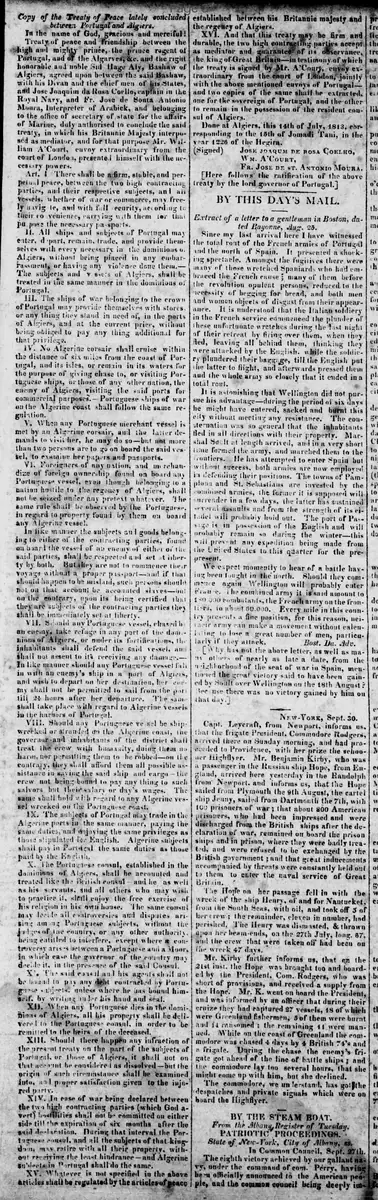
In the name of God, gracious and merciful!
Treaty of peace and friendship between the high and mighty prince, the prince regent of Portugal, and of the Algarves, &c. and the right honorable and noble Sid Hage Ali, Bashaw of Algiers, agreed upon between the said Bashaw with his Divan and the chief men of his States, and Jose Joaquim da Rosa Coello, captain in the Royal Navy, and Fr. Jose de Santa Antonio Moura, Interpreter of Arabic, and belonging to the office of secretary of state for the affairs of Marine, duly authorized to conclude the said treaty, in which his Britannic Majesty interposed as mediator, and for that purpose Mr. William A'Court, envoy extraordinary from the court of London, presented himself with the necessary powers.
Art. I. There shall be a firm, stable, and perpetual peace, between the two high contracting parties, and their respective subjects, and all vessels, whether of war or commerce, may freely navigate, and with full security, according to their convenience, carrying with them for that purpose the necessary passports.
II. All ships and subjects of Portugal may enter, depart, remain, trade, and provide themselves with every necessary in the dominions of Algiers, without being placed in any embarrassment, or having any violence done them. The subjects and vessels of Algiers, shall be treated in the same manner in the dominions of Portugal.
III. The ships of war belonging to the crown of Portugal may provide themselves with stores, or any thing they stand in need of, in the ports of Algiers, and at the current price, without being obliged to pay any thing additional for that privilege.
IV. No Algerine corsair shall cruise within the distance of six miles from the coast of Portugal, and its isles, or remain in its waters for the purpose of giving chase to, or visiting Portuguese ships, or those of any other nation, the enemy of Algiers, visiting the said ports for commercial purposes. Portuguese ships of war on the Algerine coast shall follow the same regulation.
V. When any Portuguese merchant vessel is met by an Algerine corsair, and the latter demands to visit her, he may do so—but not more than two persons are to go on board the said vessel, to examine her papers and passports.
VI. Foreigners of any nation, and merchandise of foreign ownership found on board any Portuguese vessel, even though belonging to a nation hostile to the regency of Algiers, shall not be seized under any pretext whatever. The same rule shall be observed by the Portuguese, in regard to property found by them on board any Algerine vessel.
In like manner the subjects and goods belonging to either of the contracting parties, found on board the vessel of an enemy of either of the said parties, shall be respected and set at liberty by both. But they are not to commence their voyages without a proper passport—and if that should happen to be mislaid, such persons should not on that account be accounted slaves—but on the contrary, upon its being certified that they are subjects of the contracting parties they shall be immediately set at liberty.
VII. Should any Portuguese vessel, chased by an enemy, take refuge in any port of the dominions of Algiers, or under its fortifications, the inhabitants shall defend the said vessel, and shall not assent to its receiving any damage. In like manner should any Portuguese vessel fall in with an enemy's ship in a port of Algiers, and wish to depart on her destination, her enemy shall not be permitted to sail from the port till 24 hours after her departure. The same shall take place with regard to Algerine vessels in the harbors of Portugal.
VIII. Should any Portuguese vessel be shipwrecked or stranded on the Algerine coast, the governor and inhabitants of the district shall treat the crew with humanity, doing them no harm, nor permitting them to be robbed; on the contrary, they shall afford them all possible assistance in saving the said ship and cargo—the crew not being bound to pay any thing to such salvors but their salary or day's wages. The same shall hold with regard to any Algerine vessel wrecked on the Portuguese coast.
IX. The subjects of Portugal may trade in the Algerine ports in the same manner, paying the same duties, and enjoying the same privileges as those stipulated for English. Algerine subjects shall pay in Portugal the same duties as those paid by the English.
X. The Portuguese consul, established in the dominions of Algiers, shall be accounted and treated like the British consul—and he as well as his servants, and all others who may wish to practice it, shall enjoy the free exercise of his religion in his own house. The same consul may decide all controversies and disputes arising among Portuguese subjects, without the judges of the country, or any other authority, being entitled to interfere, except where a controversy arises between a Portuguese and a Moor, in which case the governor of the country may decide it, in the presence of the said Consul.
XI. The said consul and his agents shall not be bound to pay any debt contracted by Portuguese subjects, unless where he was bound himself, by writing under his hand and seal.
XII. When any Portuguese dies in the dominions of Algiers, all his property shall be delivered to the Portuguese consul, in order to be remitted to the heirs of the deceased.
XIII. Should there happen any infraction of the present treaty on the part of the subjects of Portugal, or those of Algiers, it shall not on that account be considered as dissolved—but the origin of such circumstance shall be examined into, and proper satisfaction given to the injured party.
XIV. In case of war being declared between the two high contracting parties (which God avert) hostilities shall not be committed on either side till the expiration of six months after the said declaration. During that interval the Portuguese consul, and all the subjects of that kingdom, may retire with all their property, without receiving the least hindrance—and Algerine subjects in Portugal shall do the same.
XV. Whatever is not specified in the above articles shall be regulated by the articles of peace established between his Britannic majesty and the regency of Algiers.
XVI. And that this treaty may be firm and durable, the two high contracting parties accept as mediator and guarantee of its observance, the king of Great Britain; in testimony of which the treaty is signed by Mr. A'Court, envoy extraordinary from the court of London, jointly with the above mentioned envoys of Portugal—and two copies of the same shall be extracted, one for the sovereign of Portugal, and the other to remain in the possession of the resident consul of Algiers.
Done at Algiers, this 14th of July, 1813, corresponding to the 15th of Jomadi Tani, in the year 1226 of the Hegira.
(Signed) JOSE JOAQUIM DE ROSA COELHO,
WM. A'COURT,
Fr. JOSE DE ST. ANTONIO MOURA.
[Here follows the ratification of the above treaty by the lord governor of Portugal.]
What sub-type of article is it?
What keywords are associated?
What entities or persons were involved?
Where did it happen?
Foreign News Details
Primary Location
Algiers
Event Date
14th Of July, 1813
Key Persons
Outcome
firm, stable, and perpetual peace established, with mutual trade privileges equivalent to those with britain, restrictions on corsairs, and protections for ships, subjects, and property.
Event Details
The treaty, mediated by Britain, includes 16 articles covering perpetual peace, free navigation and trade, provisions for warships, corsair cruising limits and boarding rules, protections for neutral goods and refugees, shipwreck assistance, consular rights, dispute resolution, and a six-month grace period in case of war, with unspecified matters regulated by the Anglo-Algerine treaty.