Thank you for visiting SNEWPapers!
Sign up free
Alexandria Gazette
Alexandria, Alexandria County, District Of Columbia
What is this article about?
In the U.S. House of Representatives on the 21st and 22nd inst., Rep. Prentiss of Mississippi raised a privilege question over Rep. Alexander Duncan's letter in the Globe, calling other members liars and cowards. Debate on expulsion resolutions was heated, involving dueling law references, but the matter was laid on the table by a 117-94 vote.
Clipping
OCR Quality
Full Text
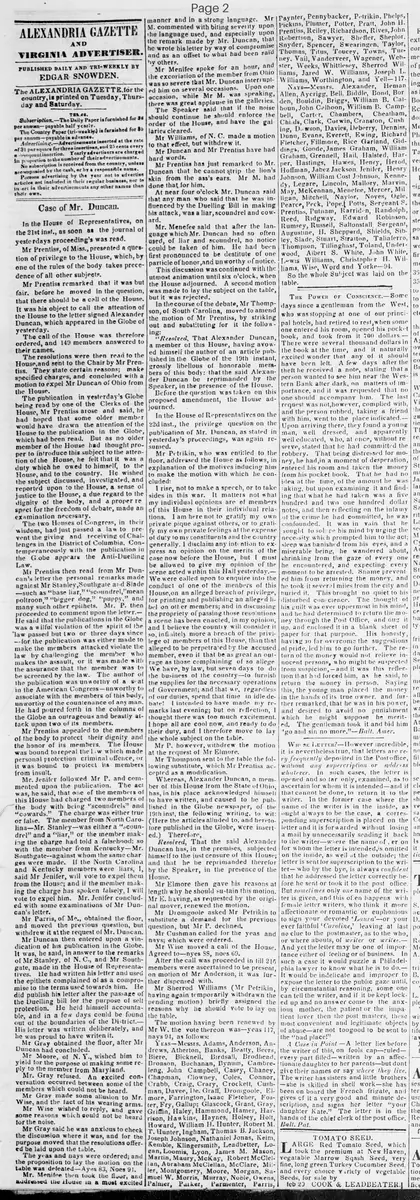
In the House of Representatives, on the 21st inst., as soon as the journal of yesterday's proceedings was read, Mr. Prentiss, of Miss., presented a question of privilege to the House, which, by one of the rules of the body takes precedence of all other subjects.
Mr. Prentiss remarked that it was but fair, before he moved in the question, that there should be a call of the House. It was his object to call the attention of the House to the letter signed Alexander Duncan, which appeared in the Globe of yesterday.
The call of the House was therefore ordered, and 149 members answered to their names.
The resolutions were then read to the House, and sent to the Chair by Mr. Prentiss. They state certain reasons; make specified charges, and concluded with a motion to expel Mr. Duncan of Ohio from the House.
The publication in yesterday's Globe being read by one of the Clerks of the House, Mr. Prentiss arose and said, he had hoped that some older member would have drawn the attention of the House to the publication in the Globe, which had been read. But as no older member of the House had thought proper to introduce this subject to the attention of the House, he felt that it was a duty which he owed to himself, to the House, and to the country. He wished the subject discussed, investigated, and reported upon to the House, a sense of justice to the House, a due regard to the dignity of the body, and a proper respect for the freedom of debate, made an examination necessary.
The two Houses of Congress, in their wisdom, had just passed a law to prevent the giving and receiving of Challenges in the District of Columbia. Contemporaneously with the publication in the Globe appears the Anti-Duelling Law.
Mr. Prentiss then read from Mr. Duncan's letter the personal remarks made against Mr. Stanley, Southgate and Slade—such as "base liar," "scoundrel," "mean poltroon" "bigger dog," "puppy," and many such other epithets. Mr. P. then proceeded to comment upon the letter.
He said that the publication in the Globe was a wilful violation of the spirit of the "law passed but two or three days since—for the publication was either made to make the members attacked violate the law by challenging the member who makes the assault, or it was made with the assurance that the member was to be screened by the law. The author of the publication was unworthy of a seat in the American Congress—unworthy to associate with the members of this body, unworthy of the countenance of any man. He had poured forth in the columns of the Globe an outrageous and beastly attack upon two of its members.
Mr. Prentiss appealed to the members of the body to protect their dignity and the honor of its members. The House was bound to repeal the law which made personal protection criminal offence, or it was bound to protect its members from insult.
Mr. Jenifer followed Mr. P. and commented upon the publication. The act was, he said, that one of the members of this House had charged two members of the body with being "scoundrels" and "cowards." The charge was either true or false. The member from North Carolina—Mr. Stanley—was either a "scoundrel" and a "liar," or the member making the charge had told a falsehood: so with the member from Kentucky—Mr. Southgate—against whom the same charges were made. If the North Carolina and Kentucky members were liars, said Mr. Jenifer, I will vote to expel them from the House; and if the member making the charge has spoken falsely, I will vote to expel him. Mr. Jenifer concluded with some examinations of Mr. Duncan's letter.
Mr. Parris, of Me., obtained the floor, and moved the previous question, but withdrew it at the request of Mr. Duncan.
Mr. Duncan then entered upon a vindication of his publication in the Globe. It was, he said, in answer to the remarks of Mr. Stanley, of N. C., and Mr. Southgate, made in the House of Representatives. He had written his letter and used the epithets complained of as a compromise to the terms used towards him. He did publish his letter after the passage of the Duelling bill for the purpose of self-protection. He held himself accountable, and in a few days could be found out of the boundaries of the District. His letter was written deliberately, and he was proud to have written it.
Mr. Gray obtained the floor, after Mr. Duncan had concluded. Mr. Moore, of N. Y., wished him to yield for the purpose of making some reply to the member from Maryland. Mr. Gray refused. An excited conversation occurred between some of the members which could not be heard. Mr. Gray made some allusion to Mr. Wise, and the fact of his wearing arms. Mr. Wise wished to reply, and gave some reasons which could not be heard for the noise. Mr. Gray said he was anxious to check the discussion where it was, and for the purpose moved that the resolutions offered be laid upon the table.
The yeas and nays were ordered; and the proposition to lay the motion on the table was defeated—Ayes 83, Noes 91.
Mr. Menifee then took the floor, and addressed the House in a most excited manner and in a strong language. Mr. M. commented with biting severity upon the language used, and especially upon the remark made by Mr. Duncan, that he wrote his letter by way of compromise and as an offset to what had been said by others. The excoriation of the member from Ohio was so severe that Mr. Duncan interrupted him on several occasions. Upon one occasion, while Mr. M. was speaking, there was great applause in the galleries. The Speaker said that if the noise should continue he should enforce the order of the House, and have the galleries cleared. Mr. Williams, of N. C. made a motion to that effect, but withdrew it.
Mr. Duncan and Mr. Prentiss have had hard words. Mr. Prentiss has just remarked to Mr. Duncan that he cannot strip the lion's skin from the ass's ears. Mr. M. had done that for him.
At near four o'clock Mr. Duncan said that any man who said that he was influenced by the Duelling Bill in making his attack, was a liar, scoundrel and coward.
Mr. Menifee said that after the language which Mr. Duncan had so often used, of liar and scoundrel, no notice could be taken of him. He had been first pronounced to be destitute of one particle of honor, and unworthy of notice.
This discussion was continued with the utmost animation until six o'clock, when the House adjourned. A second motion was made to lay the subject on the table, but it was rejected.
In the course of the debate, Mr. Thompson, of South Carolina, moved to amend the motion of Mr. Prentiss, by striking out and substituting for it the following:
"Resolved, That Alexander Duncan, a member of this House, having avowed himself the author of an article published in the Globe of the 19th instant, grossly libellous of honorable members of this body: that the said Alexander Duncan be reprimanded by the Speaker, in the presence of the House."
Before the question was taken on this proposed amendment, the House adjourned.
In the House of Representatives on the 22d inst., the privilege question on the publication of Mr. Duncan, as stated in yesterday's proceedings, was again resumed.
Mr. Petrikin, who was entitled to the floor, addressed the House as follows, in explanation of the motives inducing him to make the motion with which he concluded:
I rise, not to make a speech, or to take sides in this war. It matters not what my individual opinions are of members of this House in their individual relations. I am here not to gratify my own private pique against others, or to gratify my own private feelings at the expense of duty to my constituents and the country generally. I disclaim any intention to express an opinion on the merits of the case now before the House, but I must be allowed to give my opinion of the scene acted within this Hall yesterday.
We were called upon to enquire into the conduct of one of the members of this House, on an alleged breach of privilege, for printing and publishing an alleged libel on other members; and in discussing the propriety of passing those resolutions a scene has been enacted, in my opinion, and I believe the country will consider it so, infinitely more a breach of the privilege of members of this House, than that alleged to be perpetrated by the accused member, even if that be as great an outrage as those complaining of so allege.
We have, by law, but seven days to do the business of the country—to furnish the supplies for the necessary operations of Government; and that we, regardless of our duties, spend that time in idle debate! I intended to have made my remarks last evening; but on reflection, I thought there was too much excitement. I hope all are cool now, and ready to do their duty, and I therefore move to lay the whole subject on the table.
Mr. P. however, withdrew the motion at the request of Mr. Elmore.
Mr. Thompson sent to the table the following substitute, which Mr. Prentiss accepted as a modification.
Whereas, Alexander Duncan, a member of this House from the State of Ohio, has, in his place acknowledged himself to have written, and caused to be published in the Globe newspaper, of the 19th inst, the following writing, to wit: (Here the articles alluded to, and heretofore published in the Globe, were inserted.) Therefore,
Resolved, That the said Alexander Duncan has, in the premises, subjected himself to the just censure of this House; and that he be reprimanded therefor by the Speaker, in the presence of the House.
Mr. Elmore then gave his reasons at length why he should sustain this motion. Mr. E. having, as requested by the original mover, renewed the motion.
Mr. Dromgoole asked Mr. Petrikin to substitute a demand for the previous question, but Mr. P. declined.
Mr. Cushman called for the yeas and nays; which were ordered.
Mr. Wise moved a call of the House. Agreed to—ayes 88, noes 69.
After the call was proceeded in till 216 members were ascertained to be present, on motion of Mr. Anderson, it was further dispensed with.
Mr. Sherrod Williams (Mr. Petrikin, having again temporarily withdrawn the pending motion) briefly assigned the reasons why he should vote to lay on the table.
The motion having been renewed by Mr. W. the vote thereon was—yeas 117, nays 94, as follows:
Yeas—Messrs. Adams, Anderson, Andrews, Atherton, Banks, Beatty, Beers, Bierce, Bicknell, Birdsall, Brodhead, Bronson, Buchanan, By-num, Cambreleng, John Campbell, Casey, Chancy, Chapman, Clowney, Coles, Connor, Crabb, Craig, Crary, Crockett, Cushman, Davee, De Graff, Dromgoole, Elmore, Farrington, Isaac Fletcher, Foster, Fry, Gallup, Glascock, Grant, Gray, Griffin, Haley, Hammond, Hamer, Harrison, Hawkins, Haynes, Holsey, Holt, Howard, William H. Hunter, Robert M. T. Hunter, Ingham, Thomas B. Jackson, Joseph Johnson, Nathaniel Jones, Keim, Kemble, Klingensmith, Leadbetter, Logan, Loomis, Lyon, James M. Mason, Martin, Maury, McKay, Robert McClellan, Abraham McClellan, McClary, Miller, Montgomery, Moore, Morgan, Samuel W. Morris, Murray, Noble, Owens, Palmer, Pauker, Parmenter, Parris, Paynter, Pennybacker, Petrikin, Phelps, Pickens, Plumer, Potter, Pratt, John H. Prentiss, Reiley, Richardson, Rives, John Robertson, Sawyer, Schaffer, Sheplor, Snyder, Spencer, Swearingen, Taylor, Thomas, Titus, Toucey, Towns, Turner, Vail, Vanderveer, Wagener, Webster, Weeks, Whittlesey, Sherrod Williams, Jared W. Williams, Joseph L. Williams, Worthington, and Yell—117.
Nays—Messrs. Alexander, Heman Allen, Aycrigg, Bell, Biddle, Bond, Borden, Bouldin, Briggs, William B. Calhoun, John Calhoun, William B. Campbell, Carter, Chambers, Cheatham, Childs, Clark, Corwin, Cranston, Cushing, Dawson, Davies, Deberry, Denniss, Dunn, Evans, Everett, Ewing, Richard Fletcher, Fillmore, Rice Garland, Giddings, Goode, James Graham, William Graham, Grennell, Hall, Halsted, Harper, Hastings, Hawes, Henry, Herod, Hoffman, Jabez Jackson, Jenifer, Henry Johnson, William Cost Johnson, Kennedy, Legare, Lincoln, Mallory, Marvin, May, McKennan, Menefee, Mercer, Milligan, Mitchell, Naylor, Noyes, Ogle, Pearce, Peck, Pope, Potts, Sergeant S. Prentiss, Putnam, Rariden, Randolph, Reed, Ridgway, Edward Robinson, Rumsey, Russell, Saltonstall, Sergeant Augustine, H. Shepperd, Shields, Sibley, Slade, Stuart, Stratton, Taliaferro, Thompson, Tillinghast, Toland, Underwood, Albert S. White, John White, Lewis Williams, Christopher H. Williams, Wise, Wood and Yorke—94.
So the whole subject was laid on the table.
What sub-type of article is it?
What keywords are associated?
What entities or persons were involved?
Where did it happen?
Domestic News Details
Primary Location
House Of Representatives
Event Date
21st Inst. And 22d Inst.
Key Persons
Outcome
the subject was laid on the table by a vote of 117 yeas to 94 nays; no expulsion or reprimand occurred.
Event Details
Rep. Prentiss raised a privilege question over Rep. Duncan's letter in the Globe accusing members of lying and cowardice, violating the spirit of the new anti-dueling law. Debate included calls for expulsion, defenses by Duncan, amendments for reprimand, interruptions, and gallery applause; continued over two days until tabled.