Thank you for visiting SNEWPapers!
Sign up free
Arkansas Intelligencer
Van Buren, Crawford County, Arkansas
What is this article about?
Opinion piece arguing for U.S. annexation of Texas, claiming it was included in the 1803 Louisiana Purchase and part of the Union until the 1819 Spanish treaty, which was unconstitutional. Cites Jefferson, Monroe, Adams, and Clay; dismisses Northern opposition and Whig inconsistency.
Clipping
OCR Quality
Full Text
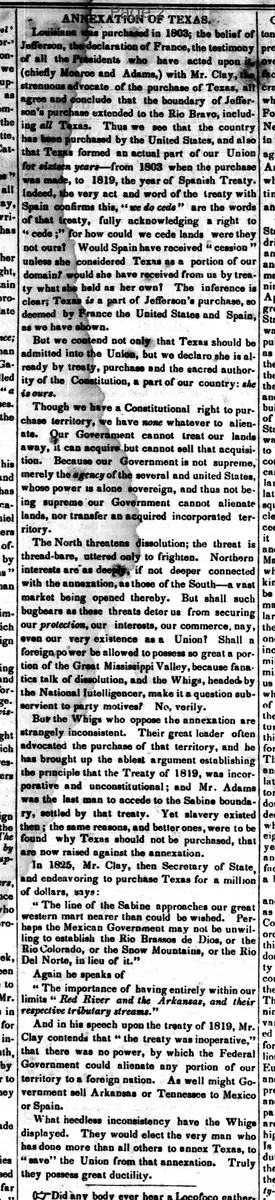
Louisiana was purchased in 1803; the belief of Jefferson, the declaration of France, the testimony of all the Presidents who have acted upon it (chiefly Monroe and Adams,) with Mr. Clay, the strenuous advocate of the purchase of Texas, all agree and conclude that the boundary of Jefferson's purchase extended to the Rio Bravo, including all Texas. Thus we see that the country has been purchased by the United States, and also that Texas formed an actual part of our Union for sixteen years—from 1803 when the purchase was made, to 1819, the year of Spanish Treaty.
Indeed, the very act and word of the treaty with Spain confirms this, "ace do cede" are the words of that treaty, fully acknowledging a right to "cede;" for how could we cede lands were they not ours? Would Spain have received "cession" unless she considered Texas as a portion of our domain? would she have received from us by treaty what she held as her own? The inference is clear; Texas is a part of Jefferson's purchase, so deemed by France the United States and Spain, as we have shown.
But we contend not only that Texas should be admitted into the Union, but we declare she is already by treaty, purchase and the sacred authority of the Constitution, a part of our country: she is ours.
Though we have a Constitutional right to purchase territory, we have none whatever to alienate. Our Government cannot treat our lands away, it can acquire but cannot sell that acquisition. Because our Government is not supreme, merely the agency of the several and united States, whose power is alone sovereign, and thus not being supreme our Government cannot alienate lands, nor transfer an acquired incorporated territory.
The North threatens dissolution; the threat is thread-bare, uttered only to frighten. Northern interests are as deeply, if not deeper connected with the annexation, as those of the South—a vast market being opened thereby. But shall such bugbears as these threats deter us from securing our protection, our interests, our commerce, nay, even our very existence as a Union? Shall a foreign power be allowed to possess so great a portion of the Great Mississippi Valley, because fanatics talk of dissolution, and the Whigs, headed by the National Intelligencer, make it a question subservient to party motives? No, verily.
But the Whigs who oppose the annexation are strangely inconsistent. Their great leader often advocated the purchase of that territory, and he has brought up the ablest argument establishing the principle that the Treaty of 1819, was incorporative and unconstitutional; and Mr. Adams was the last man to accede to the Sabine boundary, settled by that treaty. Yet slavery existed then; the same reasons, and better ones, were to be found why Texas should not be purchased, that are now raised against the annexation.
In 1825, Mr. Clay, then Secretary of State and endeavoring to purchase Texas for a million of dollars, says:
"The line of the Sabine approaches our great western mart nearer than could be wished. Perhaps the Mexican Government may not be unwilling to establish the Rio Brazos de Dios, or the Rio Colorado, or the Snow Mountains, or the Rio Del Norte, in lieu of it."
Again he speaks of
"The importance of having entirely within our limits "Red River and the Arkansas, and their respective tributary streams."
And in his speech upon the treaty of 1819, Mr. Clay contends that "the treaty was inoperative," that there was no power, by which the Federal Government could alienate any portion of our territory to a foreign nation. As well might Government sell Arkansas or Tennessee to Mexico or Spain.
What needless inconsistency have the Whigs displayed. They would elect the very man who has done more than all others to annex Texas, to "save" the Union from that annexation. Truly they possess great ductility.
What sub-type of article is it?
What keywords are associated?
What entities or persons were involved?
Where did it happen?
Foreign News Details
Primary Location
Texas
Key Persons
Outcome
texas claimed as already part of the u.s. by purchase and treaty; 1819 spanish treaty deemed unconstitutional and inoperative.
Event Details
Argument that Texas was included in the 1803 Louisiana Purchase extending to Rio Bravo, part of U.S. until 1819 Spanish treaty ceding it away unconstitutionally. U.S. government lacks power to alienate territory. Northern threats of dissolution dismissed; Whig opposition inconsistent given Clay's past advocacy for purchase.