Thank you for visiting SNEWPapers!
Sign up free
Letter to Editor
July 18, 1851
The Liberator
Boston, Suffolk County, Massachusetts
What is this article about?
Letter to Mr. Garrison critiques Maine churches, especially Congregationalists, for avoiding anti-slavery discussions, supporting colonization, and electing pro-slavery delegates, exposing their hypocrisy on slavery and temperance compared to English churches.
Clipping
OCR Quality
98%
Excellent
Full Text
MR. GARRISON:
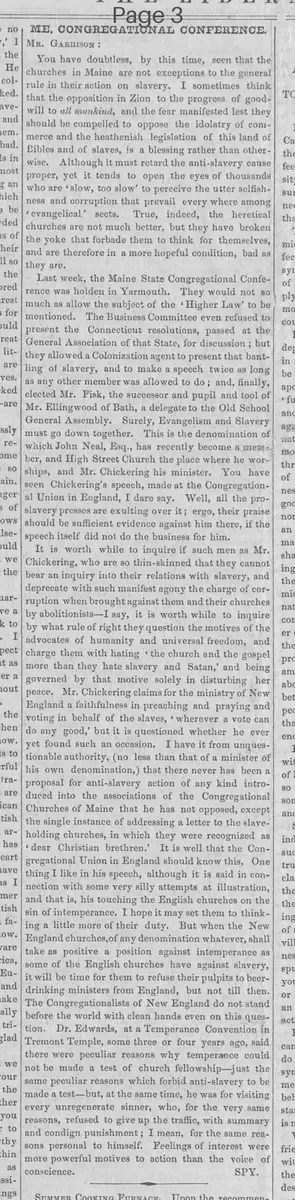
You have doubtless, by this time, seen that the churches in Maine are not exceptions to the general rule in their action on slavery. I sometimes think that the opposition in Zion to the progress of good-will to all mankind, and the fear manifested lest they should be compelled to oppose the idolatry of commerce and the heathenish legislation of this land of Bibles and of slaves, is a blessing rather than otherwise. Although it must retard the anti-slavery cause proper, yet it tends to open the eyes of thousands who are 'slow, too slow' to perceive the utter selfishness and corruption that prevail everywhere among 'evangelical' sects. True, indeed, the heretical churches are not much better, but they have broken the yoke that forbade them to think for themselves, and are therefore in a more hopeful condition, bad as they are. Last week, the Maine State Congregational Conference was holden in Yarmouth. They would not so much as allow the subject of the 'Higher Law' to be mentioned. The Business Committee even refused to present the Connecticut resolutions, passed at the General Association of that State, for discussion; but they allowed a Colonization agent to present that bantling of slavery, and to make a speech twice as long as any other member was allowed to do; and, finally, elected Mr. Fisk, the successor and pupil and tool of Mr. Ellingwood of Bath, a delegate to the Old School General Assembly. Surely, Evangelism and Slavery must go down together. This is the denomination of which John Neal, Esq., has recently become a member, and High Street Church the place where he worships, and Mr. Chickering his minister. You have seen Chickering's speech, made at the Congregational Union in England, I dare say. Well, all the pro-slavery presses are exulting over it; ergo, their praise should be sufficient evidence against him there, if the speech itself did not do the business for him. It is worth while to inquire if such men as Mr. Chickering, who are so thin-skinned that they cannot bear an inquiry into their relations with slavery, and deprecate with such manifest agony the charge of corruption when brought against them and their churches by abolitionists—I say, it is worth while to inquire by what rule of right they question the motives of the advocates of humanity and universal freedom, and charge them with hating 'the church and the gospel more than they hate slavery and Satan,' and being governed by that motive solely in disturbing her peace. Mr. Chickering claims for the ministry of New England a faithfulness in preaching and praying and voting in behalf of the slaves, 'wherever a vote can do any good,' but it is questioned whether he ever yet found such an occasion. I have it from unquestionable authority, (no less than that of a minister of his own denomination,) that there never has been a proposal for anti-slavery action of any kind introduced into the associations of the Congregational Churches of Maine that he has not opposed, except the single instance of addressing a letter to the slave-holding churches, in which they were recognized as dear Christian brethren.' It is well that the Congregational Union in England should know this. One thing I like in his speech, although it is said in connection with some very silly attempts at illustration, and that is, his touching the English churches on the sin of intemperance. I hope it may set them to thinking a little more of their duty. But when the New England churches, of any denomination whatever, shall take as positive a position against intemperance as some of the English churches have against slavery, it will be time for them to refuse their pulpits to beer-drinking ministers from England, but not till then. The Congregationalists of New England do not stand before the world with clean hands even on this question. Dr. Edwards, at a Temperance Convention in Tremont Temple, some three or four years ago, said there were peculiar reasons why temperance could not be made a test of church fellowship—just the same peculiar reasons which forbid anti-slavery to be made a test—but, at the same time, he was for visiting every unregenerate sinner, who, for the very same reasons, refused to give up the traffic, with summary and condign punishment; I mean, for the same reasons personal to himself. Feelings of interest were more powerful motives to action than the voice of conscience.
SPY.
You have doubtless, by this time, seen that the churches in Maine are not exceptions to the general rule in their action on slavery. I sometimes think that the opposition in Zion to the progress of good-will to all mankind, and the fear manifested lest they should be compelled to oppose the idolatry of commerce and the heathenish legislation of this land of Bibles and of slaves, is a blessing rather than otherwise. Although it must retard the anti-slavery cause proper, yet it tends to open the eyes of thousands who are 'slow, too slow' to perceive the utter selfishness and corruption that prevail everywhere among 'evangelical' sects. True, indeed, the heretical churches are not much better, but they have broken the yoke that forbade them to think for themselves, and are therefore in a more hopeful condition, bad as they are. Last week, the Maine State Congregational Conference was holden in Yarmouth. They would not so much as allow the subject of the 'Higher Law' to be mentioned. The Business Committee even refused to present the Connecticut resolutions, passed at the General Association of that State, for discussion; but they allowed a Colonization agent to present that bantling of slavery, and to make a speech twice as long as any other member was allowed to do; and, finally, elected Mr. Fisk, the successor and pupil and tool of Mr. Ellingwood of Bath, a delegate to the Old School General Assembly. Surely, Evangelism and Slavery must go down together. This is the denomination of which John Neal, Esq., has recently become a member, and High Street Church the place where he worships, and Mr. Chickering his minister. You have seen Chickering's speech, made at the Congregational Union in England, I dare say. Well, all the pro-slavery presses are exulting over it; ergo, their praise should be sufficient evidence against him there, if the speech itself did not do the business for him. It is worth while to inquire if such men as Mr. Chickering, who are so thin-skinned that they cannot bear an inquiry into their relations with slavery, and deprecate with such manifest agony the charge of corruption when brought against them and their churches by abolitionists—I say, it is worth while to inquire by what rule of right they question the motives of the advocates of humanity and universal freedom, and charge them with hating 'the church and the gospel more than they hate slavery and Satan,' and being governed by that motive solely in disturbing her peace. Mr. Chickering claims for the ministry of New England a faithfulness in preaching and praying and voting in behalf of the slaves, 'wherever a vote can do any good,' but it is questioned whether he ever yet found such an occasion. I have it from unquestionable authority, (no less than that of a minister of his own denomination,) that there never has been a proposal for anti-slavery action of any kind introduced into the associations of the Congregational Churches of Maine that he has not opposed, except the single instance of addressing a letter to the slave-holding churches, in which they were recognized as dear Christian brethren.' It is well that the Congregational Union in England should know this. One thing I like in his speech, although it is said in connection with some very silly attempts at illustration, and that is, his touching the English churches on the sin of intemperance. I hope it may set them to thinking a little more of their duty. But when the New England churches, of any denomination whatever, shall take as positive a position against intemperance as some of the English churches have against slavery, it will be time for them to refuse their pulpits to beer-drinking ministers from England, but not till then. The Congregationalists of New England do not stand before the world with clean hands even on this question. Dr. Edwards, at a Temperance Convention in Tremont Temple, some three or four years ago, said there were peculiar reasons why temperance could not be made a test of church fellowship—just the same peculiar reasons which forbid anti-slavery to be made a test—but, at the same time, he was for visiting every unregenerate sinner, who, for the very same reasons, refused to give up the traffic, with summary and condign punishment; I mean, for the same reasons personal to himself. Feelings of interest were more powerful motives to action than the voice of conscience.
SPY.
What sub-type of article is it?
Persuasive
Investigative
Provocative
What themes does it cover?
Slavery Abolition
Religion
Morality
What keywords are associated?
Slavery
Churches
Congregational
Maine
Anti Slavery
Higher Law
Colonization
Temperance
Hypocrisy
What entities or persons were involved?
Spy.
Mr. Garrison
Letter to Editor Details
Author
Spy.
Recipient
Mr. Garrison
Main Argument
maine churches, particularly congregationalists, hypocritically avoid anti-slavery discussions while supporting pro-slavery elements, revealing corruption in evangelical sects that hinders the abolition cause and mirrors their stance on temperance.
Notable Details
Maine State Congregational Conference In Yarmouth Refused To Discuss 'Higher Law' Or Connecticut Resolutions
Allowed Colonization Agent To Speak Extensively
Elected Mr. Fisk As Delegate To Old School General Assembly
Criticism Of Mr. Chickering's Speech At Congregational Union In England
Opposition To Anti Slavery Proposals In Maine Congregational Associations
Comparison To English Churches' Stance On Slavery And Intemperance
Dr. Edwards' Remarks At Temperance Convention In Tremont Temple