Thank you for visiting SNEWPapers!
Sign up free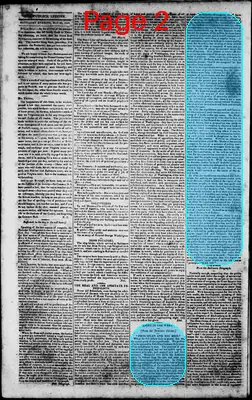
Editorial
May 25, 1816
Norfolk Gazette And Publick Ledger
Norfolk, Virginia
What is this article about?
An 1816 Republican editorial from the Tennessee Clarion criticizes President Madison and the current administration for abandoning 1798 principles, including opposition to standing armies, direct taxes, national banks, and unjust treaties, accusing them of hypocrisy, corruption, and constitutional violations.
Clipping
OCR Quality
95%
Excellent
Full Text
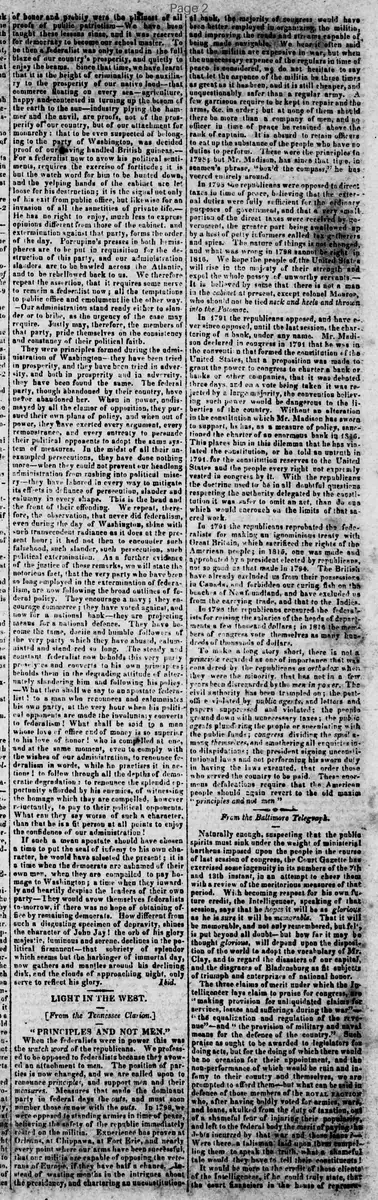
LIGHT IN THE WEST.
[From the Tennessee Clarion.]
"PRINCIPLES AND NOT MEN."
When the federalists were in power this was the watch word of the republicans. We professed to be opposed to federalists because they avowed an attachment to men. The position of parties is now changed, and we are called upon to renounce principles, and support men and their measures. Measures that made the dominant party in federal days the outs, and must soon number those in now with the outs. In 1798 we were opposed to standing armies in time of peace believing the safety of the republic immediately rooted on the militia. Experience has proven at New Orleans, at Chippawa, at Fort Erie, and nearly every point where our arms have been successful, that our militia are capable of opposing the veterans of Europe, if they have half a chance. Instead of wasting months in the intrigues about the presidency, and chartering an unconstitutional bank, the majority of congress would have been better employed in organizing the militia, and improving the roads and streams capable of being made navigable. We hear it often said that the militia are expensive in war, but when the unnecessary expense of the regulars in time of peace is considered, we do not hesitate to say that let the expense of the militia be three times as great as it has been, and it is still cheaper, and unquestionably safer than a regular army. A few garrisons require to be kept in repair and the arms, &c. in order; but at none of them should there be more than a company of men, and no officer in time of peace be retained above the rank of captain. It is absurd to retain officers to eat up the substance of the people who have no duties to perform. These were the principles in 1798: but Mr. Madison, has since that time, in seamen's phrase, "box'd the compass," he has veered entirely around.
In 1798 the republicans were opposed to direct taxes in time of peace, believing that the external duties were fully sufficient for the ordinary purposes of government, and that a very small portion of the direct taxes were received by government, the greater part being swallowed up by a host of petty informers called tax gatherers and spies. The nature of things is not changed, and what was wrong in 1798 cannot be right in 1816. We hope the people of the United States will rise in the majesty of their strength and expel the whole posse of unworthy servants. It is believed by some that there is not a man in the cabinet at present, except colonel Monroe, who should not be tied neck and heels and thrown into the Potomac.
In 1798 the republicans opposed, and have ever since opposed, until the last session, the chartering of a bank, under any name. Mr. Madison declared in congress in 1791 that he was in the convention that formed the constitution of the United States, that a proposition was made to grant the power to congress to charter a bank or banks or other companies, that it was debated three days, and on a vote being taken it was rejected by a large majority, the convention believing such power would be dangerous to the liberties of the country. Without an alteration in the constitution which Mr. Madison has sworn to support, he has, as a measure of policy, sanctioned the charter of an enormous bank in 1816. This places him in this dilemma that he has violated the constitution, or he told an untruth in 1791. For the constitution reserves to the United States and the people every right not expressly vested in congress by it. With the republicans the doctrine used to be in all doubtful questions respecting the authority delegated by the constitution it was safer to omit an act, than do one which would encroach on the limits of that sacred work.
In 1801 the republicans reprobated the federalists for making an ignominious treaty with Great Britain, which sacrificed the rights of the American people; in 1816, one was made and approved by a president elected by republicans, not so good as that made in 1794. The British have already excluded us from their possessions in Canada, and forbidden our curing fish on the beaches of Newfoundland, and have excluded us from the carrying trade, and that to the Indies.
In 1798 the republicans censured the federalists for raising the salaries of the heads of departments a few thousand dollars; in 1816 the members of congress vote themselves as many hundreds of thousands of dollars.
To make a long story short, there is not a principle regarded as one of importance that was considered by the republicans as orthodox when they were the minority, that has not in a few years been disregarded by the men in power. The civil authority has been trampled on; the post-office violated by public agents, and letters and papers suppressed and violated; the people ground down with unnecessary taxes; the public agents plundering the people or speculating with the public funds; congress dividing the spoil among themselves, and smothering all enquiries into dilapidations; the president signing unconstitutional laws and not performing his sworn duty in having the laws executed, that order those who served the country to be paid. These enormous defalcations require that the American people should again revert to the old maxim "principles and not men."
[From the Tennessee Clarion.]
"PRINCIPLES AND NOT MEN."
When the federalists were in power this was the watch word of the republicans. We professed to be opposed to federalists because they avowed an attachment to men. The position of parties is now changed, and we are called upon to renounce principles, and support men and their measures. Measures that made the dominant party in federal days the outs, and must soon number those in now with the outs. In 1798 we were opposed to standing armies in time of peace believing the safety of the republic immediately rooted on the militia. Experience has proven at New Orleans, at Chippawa, at Fort Erie, and nearly every point where our arms have been successful, that our militia are capable of opposing the veterans of Europe, if they have half a chance. Instead of wasting months in the intrigues about the presidency, and chartering an unconstitutional bank, the majority of congress would have been better employed in organizing the militia, and improving the roads and streams capable of being made navigable. We hear it often said that the militia are expensive in war, but when the unnecessary expense of the regulars in time of peace is considered, we do not hesitate to say that let the expense of the militia be three times as great as it has been, and it is still cheaper, and unquestionably safer than a regular army. A few garrisons require to be kept in repair and the arms, &c. in order; but at none of them should there be more than a company of men, and no officer in time of peace be retained above the rank of captain. It is absurd to retain officers to eat up the substance of the people who have no duties to perform. These were the principles in 1798: but Mr. Madison, has since that time, in seamen's phrase, "box'd the compass," he has veered entirely around.
In 1798 the republicans were opposed to direct taxes in time of peace, believing that the external duties were fully sufficient for the ordinary purposes of government, and that a very small portion of the direct taxes were received by government, the greater part being swallowed up by a host of petty informers called tax gatherers and spies. The nature of things is not changed, and what was wrong in 1798 cannot be right in 1816. We hope the people of the United States will rise in the majesty of their strength and expel the whole posse of unworthy servants. It is believed by some that there is not a man in the cabinet at present, except colonel Monroe, who should not be tied neck and heels and thrown into the Potomac.
In 1798 the republicans opposed, and have ever since opposed, until the last session, the chartering of a bank, under any name. Mr. Madison declared in congress in 1791 that he was in the convention that formed the constitution of the United States, that a proposition was made to grant the power to congress to charter a bank or banks or other companies, that it was debated three days, and on a vote being taken it was rejected by a large majority, the convention believing such power would be dangerous to the liberties of the country. Without an alteration in the constitution which Mr. Madison has sworn to support, he has, as a measure of policy, sanctioned the charter of an enormous bank in 1816. This places him in this dilemma that he has violated the constitution, or he told an untruth in 1791. For the constitution reserves to the United States and the people every right not expressly vested in congress by it. With the republicans the doctrine used to be in all doubtful questions respecting the authority delegated by the constitution it was safer to omit an act, than do one which would encroach on the limits of that sacred work.
In 1801 the republicans reprobated the federalists for making an ignominious treaty with Great Britain, which sacrificed the rights of the American people; in 1816, one was made and approved by a president elected by republicans, not so good as that made in 1794. The British have already excluded us from their possessions in Canada, and forbidden our curing fish on the beaches of Newfoundland, and have excluded us from the carrying trade, and that to the Indies.
In 1798 the republicans censured the federalists for raising the salaries of the heads of departments a few thousand dollars; in 1816 the members of congress vote themselves as many hundreds of thousands of dollars.
To make a long story short, there is not a principle regarded as one of importance that was considered by the republicans as orthodox when they were the minority, that has not in a few years been disregarded by the men in power. The civil authority has been trampled on; the post-office violated by public agents, and letters and papers suppressed and violated; the people ground down with unnecessary taxes; the public agents plundering the people or speculating with the public funds; congress dividing the spoil among themselves, and smothering all enquiries into dilapidations; the president signing unconstitutional laws and not performing his sworn duty in having the laws executed, that order those who served the country to be paid. These enormous defalcations require that the American people should again revert to the old maxim "principles and not men."
What sub-type of article is it?
Partisan Politics
Constitutional
Economic Policy
What keywords are associated?
Principles Not Men
Standing Army
Direct Taxes
National Bank
Constitutional Violation
Madison Hypocrisy
Militia Reform
Unjust Treaty
What entities or persons were involved?
Mr. Madison
Republicans
Federalists
Colonel Monroe
Congress
Editorial Details
Primary Topic
Republican Abandonment Of 1798 Principles Under Madison
Stance / Tone
Strongly Critical Of Hypocrisy And Corruption
Key Figures
Mr. Madison
Republicans
Federalists
Colonel Monroe
Congress
Key Arguments
Opposition To Standing Armies In Peacetime; Militia Is Sufficient And Cheaper
Direct Taxes Unnecessary; External Duties Suffice
National Bank Unconstitutional; Rejected In Constitutional Convention
Current Treaty With Britain Worse Than 1794; Sacrifices American Rights
Congressional Self Enrichment And Suppression Of Inquiries
Call To Revert To 'Principles Not Men'