Thank you for visiting SNEWPapers!
Sign up free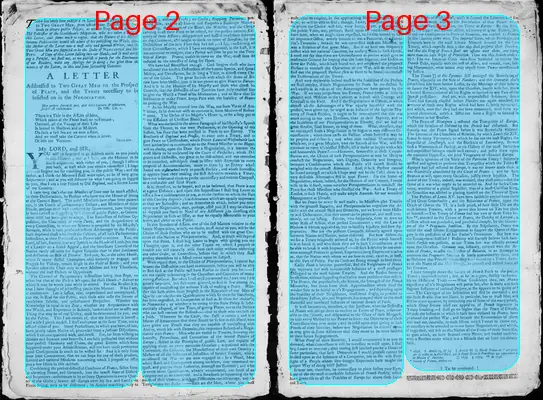
The New Hampshire Gazette
Portsmouth, Rockingham County, New Hampshire
What is this article about?
This editorial publishes a letter addressed to the Duke of Newcastle and Mr. Pitt, offering advice on negotiating peace with a distressed France. It stresses selecting capable plenipotentiaries, demands proofs of French sincerity due to historical perfidy, and cites violations of treaties like Westphalia, Pyrenees, and Utrecht to ensure lasting peace.
Merged-components note: This is a single continuous opinion piece consisting of a letter addressed to two great men on the prospect of peace and negotiation terms, spanning pages 2 and 3. The content is political commentary and analysis, better classified as editorial rather than literary.
Clippings
1 of 2
OCR Quality
Full Text
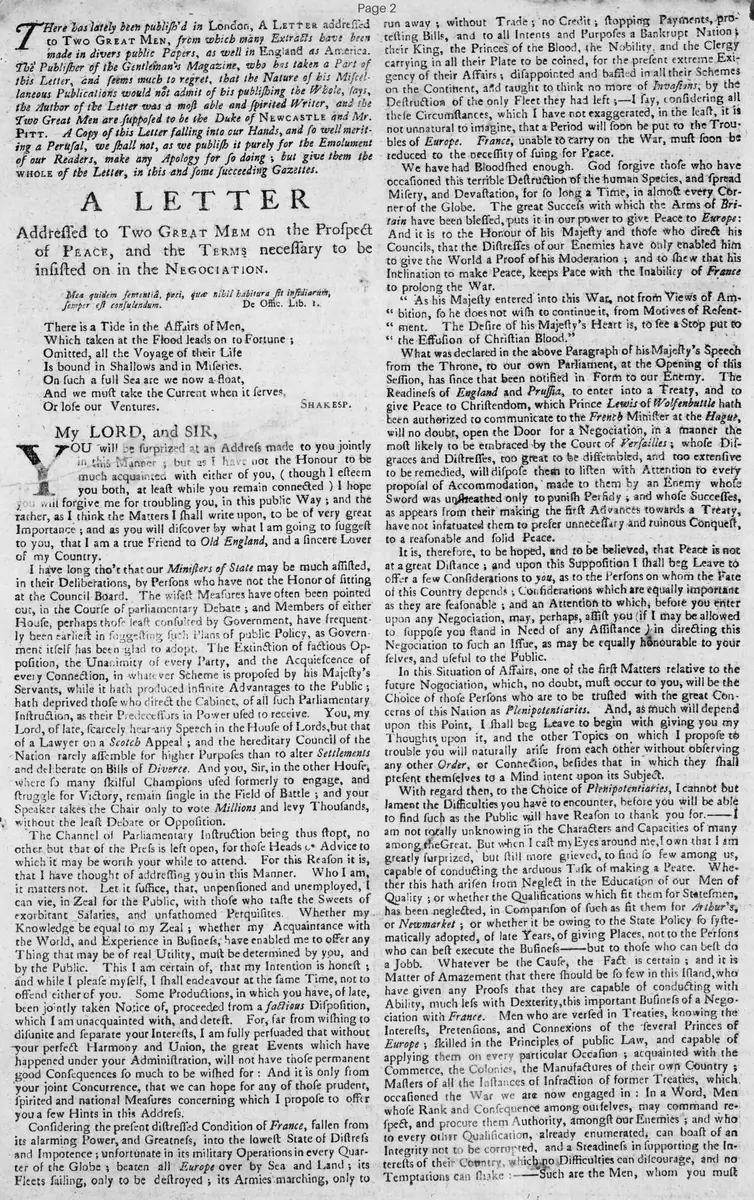
A LETTER
Addressed to Two Great Men on the Prospect
of Peace, and the Terms necessary to be
insisted on in the Negotiation.
Mea quidem sententiâ, paci, quæ nihil habitura est insidiarum,
semper et consulendum.
De Ofic. Lib. I.
There is a Tide in the Affairs of Men.
Which taken at the Flood leads on to Fortune ;
Omitted, all the Voyage of their Life
Is bound in Shallows and in Miseries.
On such a full Sea are we now a-float,
And we must take the Current when it serves,
Or lose our Ventures.
SHAKESP.
My LORD, and SIR,
You will be surprised at an Address made to you jointly in this Manner : but as I have not the Honour to be much acquainted with either of you, ( though I esteem you both, at least while you remain connected ) I hope you will forgive me for troubling you. in this public Way ; and the rather, as I think the Matters I shall write upon, to be of very great Importance ; and as you will discover by what I am going to suggest to you, that I am a true Friend to Old England, and a sincere Lover of my Country.
I have long thought that our Ministers of State may be much assisted, in their Deliberations. by Persons who have not the Honor of sitting at the Council Board. The wisest Measures have often been pointed out, in the Course of parliamentary Debate ; and Members of either House, perhaps those least consulted by Government, have frequently been earliest in suggesting such Plans of public Policy, as Government itself has been glad to adopt. The Extinction of factious Opposition, the Unanimity of every Party, and the Acquiescence of every Connection, in whatever Scheme is proposed by his Majesty's Servants, while it hath produced infinite Advantages to the Public ; hath deprived those who direct the Cabinet. of all such Parliamentary Instruction, as their Predecessors in Power used to receive. You, my Lord, of late, scarcely hear any Speech in the House of Lords, but that of a Lawyer on a Scotch Appeal ; and the hereditary Council of the Nation rarely assembles for higher Purposes than to alter Settlements and deliberate on Bills of Divorce. And you, Sir, in the other House, where so many skilful Champions used formerly to engage, and struggle for Victory, remain single in the Field of Battle ; and your Speaker takes the Chair only to vote Millions and levy Thousands, without the least Debate or Opposition.
The Channel of Parliamentary Instruction being thus stopped, no other but that of the Press is left open, for those Heads of Advice to which it may be worth your while to attend. For this Reason it is, that I have thought of addressing you in this Manner. Who I am, it matters not. Let it suffice, that, unpensioned and unemployed, I can vie, in Zeal for the Public, with those who taste the Sweets of exorbitant Salaries. and unfathomed Perquisites. Whether my Knowledge be equal to my Zeal ; whether my Acquaintance with the World, and Experience in Business, have enabled me to offer any Thing that may be of real Utility, must be determined by you, and by the Public. This I am certain of. that my Intention is honest : and while I please myself, I shall endeavour at the same Time, not to offend either of you. Some Productions, in which you have, of late, been jointly taken Notice of, proceeded from a factious Disposition, which I am unacquainted with, and detest. For, far from wishing to disunite and separate your Interests, I am fully persuaded that without your perfect Harmony and Union, the great Events which have happened under your Administration, will not have those permanent good Consequences so much to be wished for : And it is only from your joint Concurrence, that we can hope for any of those prudent, spirited and national Measures concerning which I propose to offer you a few Hints in this Address.
Considering the present distressed Condition of France. fallen from its alarming Power, and Greatness, into the lowest State of Distress and Impotence ; unfortunate in its military Operations in every Quarter of the Globe ; beaten all Europe over by Sea and Land; its Fleets sailing, only to be destroyed ; its Armies marching, only to run away ; without Trade ; no Credit : stopping Payments, protesting Bills, and to all Intents and Purposes a Bankrupt Nation ; their King, the Princes of the Blood. the Nobility. and the Clergy carrying in all their Plate to be coined, for the present extreme Exigency of their Affairs ; disappointed and baffled in all their Schemes on the Continent, and taught to think no more of Invasions; by the Destruction of the only Fleet they had left ;--I say, considering all these Circumstances, which I have not exaggerated, in the least, it is not unnatural to imagine, that a Period will soon be put to the Troubles of Europe. France, unable to carry on the War, must soon be reduced to the necessity of suing for Peace.
We have had Bloodshed enough. God forgive those who have occasioned this terrible Destruction of the human Species, and spread Misery, and Devastation, for so long a Time, in almost every Corner of the Globe. The great Success with which the Arms of Britain have been blessed, puts it in our power to give Peace to Europe: And it is to the Honour of his Majesty and those who direct his Councils, that the Distresses of our Enemies have Only enabled him to give the World a Proof of his Moderation ; and to shew that his Inclination to make Peace, keeps Pace with the Inability of France to prolong the War.
" As his Majesty entered into this War. not from Views of Ambition. so he does not wish to continue it. from Motives of Resentment. The Desire of his Majesty's Heart is, to see a Stop put to the Effusion of Christian Blood."
What was declared in the above Paragraph of his Majesty's Speech from the Throne, to Our own Parliament, at the Opening of this Session. has since that been notified in Form to our Enemy. The Readiness of England and Prussia, to enter into a Treaty, and to give Peace to Christendom, which Prince Lewis of Wolfenbuttle hath been authorized to communicate to the French Minister at the Hague. will no doubt, open the Door for a Negotiation, in a manner the most likely to be embraced by the Court of Versailles : whose Disgraces and Distresses, too great to be dissembled, and too extensive to be remedied, will dispose them to listen with Attention to every proposal of Accommodation, 'made to them by an Enemy whose Sword was unsheathed only to punish Perfidy ; and whose Successes. as appears from their making the first Advances towards a Treaty, have not infatuated them to prefer unnecessary and ruinous Conquest, to a reasonable and solid Peace.
It is, therefore, to be hoped, and to be believed, that Peace is not at a great Distance ; and upon this Supposition I shall beg Leave to offer a few Considerations to you, as to the Persons on whom the Fate of this Country depends ; Considerations which are equally important as they are reasonable ; and an Attention to which, before you enter upon any Negotiation, may, perhaps, assist you (if I may be allowed to suppose you stand in Need of any Assistance ) in directing this Negotiation to such an Issue, as may be equally honourable to your selves, and useful to the Public.
In this. Situation of Affairs, one of the first Matters relative to the future Negotiation, which, no doubt, must occur to you, will be the Choice of those Persons who are to be trusted with the great Concerns of this Nation as Plenipotentiaries.' And, as much will depend upon this Point, I shall beg Leave to begin with giving you my Thoughts upon it, and the other Topics on which I propose to trouble you will naturally arise from each other without observing any other Order, or Connection, besides that in which they shall present themselves to a Mind intent upon its Subject.
With regard then. to the Choice of Plenipotentiaries. I cannot but lament the Difficulties you have to encounter, before you will be able to find such as the Public will have Reason to thank you for.---I am not totally unknowing in the Characters and Capacities of many among the Great. But when I cast my Eyes around me, I own that I am greatly surprised, but still more grieved, to find so few among us, capable of conducting the arduous Task of making a Peace. Whether this hath arisen from Neglect in the Education of our Men of Quality ; or whether the Qualifications which fit them for Statesmen, has been neglected, in Comparison of such as fit them for Arthur's. or Newmarket : or whether it be owing to the State Policy so systematically adopted, of late Years, of giving Places, not to the Persons who can best execute the Business-r--but to those who can best do a Jobb. Whatever be the Cause, the Fact is certain ; and it is Matter of Amazement that there should be so few in this Island, who have given any Proofs that they are capable of conducting with Ability, much less with Dexterity, this important Business of a Negotiation with France. Men who are versed in Treaties, knowing the Interests, Pretensions, and Connexions of the several Princes of Europe ; skilled in the Principles of public Law, and capable of applying them on every particular Occasion ; acquainted with the Commerce, the Colonies, the Manufactures of their own Country ; Masters of all the Instances of Infraction of former Treaties, which occasioned the War we are now engaged in : In a Word, Men whose Rank and Consequence among ourselves, may command respect, and procure them Authority, amongst our Enemies ; and who to every other Qualification, already enumerated, can boast of an Integrity not to be corrupted, and a Steadiness in supporting the Interests of their Country, which no Difficulties can discourage, and no Temptations can Shake :-Such are the Men, whom you must
endeavour to employ, in the approaching Negotiation, and such, I hope, ye will be able to find; though, I own, I am puzzled to guess on whom the Choice will fall, - none being, as yet, pointed out by the public Voice, nor, perhaps, fixed upon by yourselves. Times have been, when we might have expected, to see One named to such an important Office, merely because he was a Favourite, or a Favourite's Favourite; because he was connected with this Minister, or was a Relation of that great Man. But if we have too frequently trifled with our national Concerns, by trusting them in such Hands, I need not say that there are Circumstances at present which give us reasonable Ground for hoping that the same Sagacity, and Desire to Serve the Public, which hath found out, and employed the properest Persons to conduct the Operations of the War, will be exerted to find out the properest Persons (few as there are to be found) to conduct the Deliberations of the Treaty.
And very deplorable indeed must be the Inabilities of the Persons we shall employ, if their Negotiations for Peace be conducted so awkwardly as to rob us of the Advantages we have gained by the War. If we may judge from late Events, France seems as little to abound with Wisdom in the Cabinet, as it doth with Courage and Conduct in the Field. And if the Negotiations at Utrecht, in which almost all the Advantages of a War equally successful with the present, were given up, be urged as an Instance of the superior Dexterity of French Politics, it ought to be remembered that this was more owing to our own Divisions, than to their Sagacity, and to the Inabilities of our Plenipotentiaries at Utrecht, tho' we had no great Reason, God knows, to brag of them. What, therefore, may we not expect from a Negotiation to be begun in very different Circumstances; when there exists no Faction whose Interest it may be to perplex and defeat it; and when that national Unanimity to which we, in a great Measure, owe the Success of the War, will still continue to exert its blessed Effects, till it make us happy with a safe and honourable Peace? -However, favourable as these Circumstances are, the Choice of such Plenipotentiaries as may be likely to conduct the Negotiation, with Dignity, Dexterity and Integrity, becomes a Consideration which the Public will expect should be weighed with the utmost Attention. - And, if such Persons cannot be found amongst us (which I hope may not be the Case) there is a very desirable Alternative still in your Power. Fix the Scene of Negotiation, where, indeed, for the Honour of our Country, I could wish to see it fixed. Name no other Plenipotentiaries to conduct the Peace but those Ministers who directed the War: And a Treaty of London, in such Hands, will make ample Amends for our wretched Management at Utrecht.
- But let Peace be never so well made; let Ministers plan Treaties with the greatest Sagacity, and Plenipotentiaries negotiate the Articles with the utmost Skill and Dexterity, yet we know from History and Observation, that they never can be perpetual, and most commonly, are not lasting. Princes too frequently, seem to own no other Rule of Action, than present Convenience; and the Law of Nations is seldom appealed to, but to sanctify Injustice, and save Appearances. Nor are the positive Compacts solemnly agreed upon between Nation and Nation, better observed: For how seldom do we see a Treaty religiously adhered to, by the Parties whose Interest it is to break it, and who think they are in such Circumstances as to be able to break it with Impunity? -If such Infidelity be too common amongst Princes in general, Experience, long Experience teaches us, that the Nation with whom we are soon to treat, excel us, at least, in this Part of Policy. For no Cords are strong enough to bind them. Gallic Faith is become proverbial, and the Neighbours of France can reproach her with innumerable Instances of a most profligate Disregard to the most solemn Treaties. And the Reason seems to be obvious, without supposing that Nation more perfidious than others. The Power, the populousness, the Extent, the Strength of the French Monarchy, free them from those Apprehensions which bind the weaker Side to be faithful to its Engagements; and depending upon the Inability of their Neighbours, considered singly, to procure to themselves Justice, this, too frequently, has tempted them to the most shameful and barefaced Instances of national Breach of Faith.
It well becomes us, therefore, at this Juncture, when the Distresses of France will oblige them to consent to Terms of Peace, unfavourable to their Interests, and disgraceful to the Glory of their Monarch, to take every Method in our Power to secure the Observance of those Concessions they may make; and to insist upon their giving us such Proofs of their Sincerity, before any Negotiation be entered upon, as may give us some Assurance that they mean to be more faithful to their future Engagements.
What Proof of their Sincerity, I would recommend it to you to demand, what Concessions it will be necessary to insist upon, I shall beg Leave to mention: after having first satisfied you by a Detail of some particulars, that such Demands as I would propose cannot be looked upon as the Insolence of a Conqueror, but as the wise Foresight of a People whom dear-bought Experience hath taught the proper Way of doing itself Justice.
It may not, therefore, be unnecessary to place before your Eyes, some of the most remarkable Instances of French Perfidy, which have given rise to all the Troubles of Europe for above these hundred Years.
The Peace of Westphalia* -while it secured the Liberties and Religion of Germany, also laid the Foundation of that Power which hath made France, ever since, the Terror of Europe By this Treaty, the Upper and Lower Alsace, a Country of great Extent, and of infinite Consequence in Point of Situation, was ceded to France. In this Country there were Ten Imperial Cities, whose Privileges and Liberties were in the most solemn Manner secured by the same Treaty, which expressly says, "that they shall preserve their Freedom, and that the King of France shall not assume over them, any Thing more than the bare Right of Protection." How was this Article observed? The ten Imperial Cities were soon humbled to receive the French Yoke, equally with the rest of Alsace, and remain, now, lasting Monuments, what others may expect from Power unrestrained by Justice.
The Treaty [] of the Pyrenees still enlarged the Boundaries of France, especially on the Side of Flanders; and the Spaniards thought themselves safe from farther Loss, by the Marriage of their Infanta to Lewis the XIV, who, upon that Occasion, jointly with her, made a formal Renunciation of all her Rights to succeed to any Part of the Spanish Possessions. And yet, with unparallelled Insolence, seven Years had scarcely elapsed before Flanders was again attacked, on pretence of those very Rights which had been so lately renounced, and which, even tho' they had not been renounced, must have appeared chimerical, unless a Sister can have a Right to succeed in Preference to her Brother.
The Peace of Nimeguen ↓ restored the Tranquility of Europe, which the Invasion of Holland by the French had disturbed. But scarcely was the Peace signed before it was shamefully violated. The Decrees of the Chambers of Reunion, by which Lewis the XIV. seized so many Territories, to which he has not the least Right; the Surprisal of Strasburg, and the Blockade of Luxemburg, shewed such a Wantonness of Perfidy, as no History of the most barbarous and unpolished Savages could well exceed; and justly drew upon the common Oppressor, the joint Vengeance of offended Europe.
Who is ignorant of the Story of the Partition Treaty? Solemnly ratified and agreed to preserve that Tranquility which the Treaty of Ryswick had just restored to Europe, it was no sooner made than it was shamefully abandoned by the Court of France; and for such Reasons as will, upon every Occasion, justify every Injustice. The Letter of the Treaty, indeed, was violated, they must own; --but the Spirit of it was what ought to be attended to. And by such a Comment, worthier of a pitiful Sophister, than of a most Christian King, his Grandson was assisted in placing himself on the Throne of Spain.
The Politics of Lewis XV. have been faithfully copied from those of his Great-Grandfather: and the Behaviour of France, upon the Death of Charles the VI. is a fresh proof, of how little Use are the most solemn Treaties, with a power that knows no Ties but those of Interest. --The Treaty of Vienna had but two or three Years before **, annexed to the Crown of France, the Dutchy of Lorrain; a Cession which was purchased, and purchased cheaply, by the Guarantee of the * Pragmatic Sanction. By this Stipulation, France was under the most solemn Engagements to support the Queen of Hungary in the possession of all her Father's Dominions. But how was the Engagement fulfilled? Posterity will scarcely believe such barefaced Perfidy was possible, as our Times saw was actually avowed upon that Occasion. Germany was, instantly, covered with the Armies of France, to assist the Elector of Bavaria, in an Attempt to overturn the Pragmatic Sanction so lately guaranteed by them, and to dethrone that Princess whom they were bound by a Treaty, sworn to in the Name of the Holy Trinity, to protect and defend from all her Enemies.
I have brought down the Sketch of French Faith to the present Times; imperfect indeed: but, as far as it goes, strictly conformable to Historical Truth, --- What Confidence then, can France expect any of its Neighbours will put in her, after so many and such flagrant Instances of national Perjury, as she appears to be guilty of? --The Catalogue of her Infidelities will still be encreased; and the little Reason that Our Island, in particular, has to trust Her, will still be more apparent, by reminding you of some of the many proofs, which Great Britain itself can appeal to, of French Ingenuity in Treaty breaking. --I shall go no higher than the Peace of Utrecht, because the Instances in which it hath been violated by France, have produced the present War: and because the Enumeration of them will lead me, naturally, to those Hints which I mean to throw out, as necessary to be attended to in our future Negotiations; and which, if neglected, will lose to this Nation all the Fruits of those Successes, to gain which, we have strained every Nerve; and loaded ourselves with a Burthen under which it is a Miracle that we have not already sunk.
1648. + Article 73, & Seq. Article 88 Le Roi de France ne S'arrogera sur les villes de la Préfecture, que le simple Droit de Protection, qui appartient à la Maison d' Autriche,
[] 1659 1679. **. In 1738.
* Treaty of Vienna, Article 10.
[ To be continued. ]
What sub-type of article is it?
What keywords are associated?
What entities or persons were involved?
Editorial Details
Primary Topic
Advice On Peace Negotiations With France And Ensuring Treaty Observance
Stance / Tone
Urging Cautious And Firm Negotiation Due To French Historical Unreliability
Key Figures
Key Arguments