Thank you for visiting SNEWPapers!
Sign up free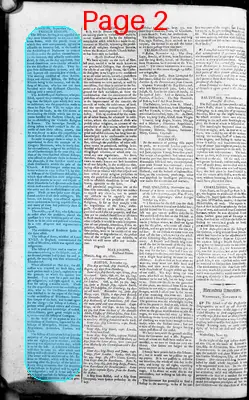
Alexandria Advertiser And Commercial Intelligencer
Alexandria, Virginia
What is this article about?
French bishops in exile in London met on September 19, 1814, to discuss Pope Pius VII's proposal to resign their sees to end the schism in the Gallican Church. Debates divided them, with majority likely opposing resignation.
Clipping

OCR Quality
Full Text
FRENCH BISHOPS.
The Bishops, having been apprised that they were immediately to receive a Brief from Rome, with the precise tenor of which they were unacquainted, agreed to assemble on Saturday last, at the house of the Archbishop of Narbonne to concert measures under the present circumstances. In the interval, they actually received the Brief, so that, on the day appointed, they found themselves conveniently assembled for the discussion of the plan. They began their deliberations at noon, and did not separate till towards five o'clock.
The meeting consisted of three Archbishops and thirteen Bishops, the Bishop of Rhodes being in the country, and the Bishop of Moulins, who has not yet been invested with the Episcopal Character, taking only a nominal part.
The Archbishop of Narbonne, who presided, opened the proceedings by announcing that the subject upon which they were to deliberate, was the proposition made to them by Pope Pius VII. to resign their Sees into his hands, as the sole means of terminating the schism which has for ten years harassed the Gallican Church, and for re-establishing the Catholic Religion in France. The Sovereign Pontiff, in doing justice to their conduct in the exercise of their Holy Offices, avows, that he was forced to make this proposition to them from the cruel necessity of the times. In order to engage them to adopt it, he represented to them the example of St. Gregory Nazianzen, who, in nearly similar circumstances, resigned his archbishopric of Constantinople in the year 381, and that of the three hundred African Bishops, who offered to abdicate theirs in favour of the Donatists, if that sacrifice could recall those schismatics within the pale of the Church. A still stronger reason was the letter written in 1791 to Pius VI. by thirty Bishops of the Constituent Assembly, in which they offered him their resignation, with full powers to accept and dispose of their Dioceses in such a manner as he should think most conducive to the preservation of the unity and the re-establishment of religion. These 30 men spoke upon the presumed consent of all their colleagues. The latter, not having remonstrated against it, were considered as having acquiesced in it, and many of them had positively done so in private letters.
The archbishop of Aix, who spoke next in order after the president, placed the question in a very luminous point of view, both as to its civil and political relations, in a very eloquent and argumentative speech.
The archbishop of Bordeaux spoke to the same effect.
The bishop of Arras, minister of Louis XVIII. in England, communicated the wish of Monsieur, which was against their resignation.
The bishop of Uzes read a number of documents relating to the subject; and, after several prelates had spoken for and against, the meeting was then adjourned to Monday last.
When assembled on that day, the discussion was renewed on both sides, and each prelate made a speech, explanatory of the grounds on which his opinion was founded. Four were for a pure and simple resignation, and eight against it, and four for taking a middle course. Those for the acquiescence were the archbishop of Aix, who in the Constituent Assembly, was elected to be the organ of the clergy—the archbishop of Bordeaux, heretofore keeper of the seals, and former agent for the clergy—the bishop of Langers, a prelate whose pastoral talents and virtues, as well as profound knowledge of ecclesiastical science, gave great weight to his opinion—and the bishop of Comminges.
At the head of its opponents was the archbishop of Narbonne, supported by the bishops of Montpellier, Mayenne, Nantes, Angouleme, Avranches, Lonbez, and Uzes.
The bishop of Leon promised to join the majority of the general body of Bishops, who are eighty-two in number; and the meeting was adjourned to this day, which is to be the last. A definitive resolution will then be come to, after which each bishop will individually write to the Pope. The letter will be transmitted to Mr. Erskine on Monday, which will be the 10th morning after the receipt of the brief.
Every thing announces that the majority of the bishops in England will be against the resignation; and it is not easy to see what line of conduct the bishops who took refuge in other countries will think proper.
What sub-type of article is it?
What keywords are associated?
What entities or persons were involved?
Where did it happen?
Foreign News Details
Primary Location
London
Event Date
September 19
Key Persons
Outcome
majority of bishops likely against resignation; definitive resolution pending on september 19, followed by individual letters to the pope.
Event Details
French bishops in exile assembled in London to discuss Pope Pius VII's brief proposing they resign their sees to end the ten-year schism in the Gallican Church and restore Catholicism in France. Meeting included three archbishops and thirteen bishops; debates featured speeches for and against, with four favoring resignation, eight opposing, and four for a middle course. Adjourned to September 19 for final decision.