Thank you for visiting SNEWPapers!
Sign up free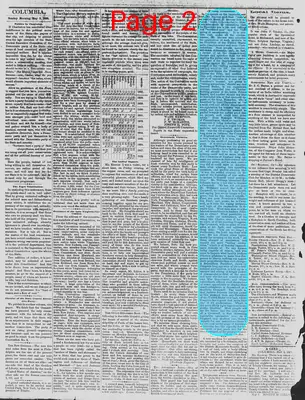
Editorial
May 3, 1868
The Daily Phoenix
Columbia, Richland County, South Carolina
What is this article about?
The Baltimore Sun editorial defends President Andrew Johnson against impeachment charges, dismissing them as 'railing accusations' by critics like Mr. Stevens and Manager Williams, who compare him to Charles I and Cromwell. It argues Johnson holds less power than predecessors, while Congress usurps authority.
Clipping

OCR Quality
98%
Excellent
Full Text
"Railing Accusations."
In his speech on the impeachment trial, Mr. Stevens said that "railing accusation would ill become this occasion," which he proceeded to illustrate afterwards by intimating that the President was a liar, and calling him "wretched man" and the "offspring of assassination." It is possible that, under all the circumstances, Mr. Stevens may consider the application of such epithets to the President of the United States quite complimentary and even Chesterfieldian. Most people, however, will think differently, and, in fact, a review of all the impeachment charges and speeches thus far will impress the public with the conviction that if the impeachment proceedings against Mr. Johnson were purged of the "railing accusations," nothing would be left. One of the impeachers likens the President to Charles the First, and another to Cromwell, almost as curious a combination of opposites as if one of the President's counsel, not given to "railing accusations," should say that General Butler, in his impetuous courage, reminded him of Charles' dashing general of the horse, Prince Rupert, and another should say that he reminded him of that eminent opposer of the king, Hampden, who is described by Lord Clarendon as "of a most civil and affable deportment: his reputation for honesty was universal, and his affections seemed so guided towards the public good that no private ends could lead them astray." Even Manager Williams, of Pennsylvania, whom no one before suspected of being historical or poetical, or of dealing in aught but the material and substantial, said that this "was the old struggle which had long gone on between the Commons of England and the Crown," which is very strange if it is true, and not much to the credit of American progress. If it were not that the speech of Manager Williams was too ponderous a production to be lightly spoken of, we should have to say that nothing could well be more chaffy.
The Commons of England long ago came out victors in their contest with arbitrary power, and no such contest ever did or could exist in America. Still, after uttering this appalling nonsense, and gravely alleging that "it was the settled purpose on the part of the Executive of this nation to assume to himself royal prerogatives," Mr. Williams intimated that Johnson was in a fair way to become a Cromwell. "He has not yet (says Mr. Williams) played the role of Cromwell, by coming in here boldly and saying 'you are no longer a Congress,' but he has done it outside."
First, the poor President is Charles the First; and, presto, he is Cromwell, as it suits the zigzag purposes and logic of the impeachers to describe him. What sane man sees the faintest resemblance in Andrew Johnson to either? What possibility exists, under our institutions, of his being like Charles, even if he were an idiot, or of his entering Congress, like Cromwell, with an army of ironsides at his back, and addressing them thus: "You are no longer a Parliament: the Lord has done with you; He has chosen other instruments for carrying on his work." All these charges of usurpation and royalty, are mere "railing accusations," which is all that the impeachment consists of. To any human being capable of reason, and who cares to inquire what faculty Andrew Johnson possesses to make him dangerous to liberty, nothing can appear more preposterous than such charges.
A Republican President, shorn by Congress long ago even of his constitutional prerogatives, is held up as a usurper and aiming at kingly power! A commander-in-chief of the army and navy who has not control of his own War Department, and whose subordinate officers avail themselves of every opportunity to display their insubordinations, is denounced as a would-be Cromwell. The truth is, that Andrew Johnson has less power at this moment than any President of the United States ever had, whilst Congress has a great deal more than any of its predecessors. Which is the more likely to be injurious to the public liberties? Most people will say the latter; and the only danger of a Cromwell, is that increasing legislative usurpation here, as in England, may produce one, though happily for our institutions there is no one now on the stage of American affairs who has the capacity for Government or war, much less for the two combined, of the great protector.
Baltimore Sun.
In his speech on the impeachment trial, Mr. Stevens said that "railing accusation would ill become this occasion," which he proceeded to illustrate afterwards by intimating that the President was a liar, and calling him "wretched man" and the "offspring of assassination." It is possible that, under all the circumstances, Mr. Stevens may consider the application of such epithets to the President of the United States quite complimentary and even Chesterfieldian. Most people, however, will think differently, and, in fact, a review of all the impeachment charges and speeches thus far will impress the public with the conviction that if the impeachment proceedings against Mr. Johnson were purged of the "railing accusations," nothing would be left. One of the impeachers likens the President to Charles the First, and another to Cromwell, almost as curious a combination of opposites as if one of the President's counsel, not given to "railing accusations," should say that General Butler, in his impetuous courage, reminded him of Charles' dashing general of the horse, Prince Rupert, and another should say that he reminded him of that eminent opposer of the king, Hampden, who is described by Lord Clarendon as "of a most civil and affable deportment: his reputation for honesty was universal, and his affections seemed so guided towards the public good that no private ends could lead them astray." Even Manager Williams, of Pennsylvania, whom no one before suspected of being historical or poetical, or of dealing in aught but the material and substantial, said that this "was the old struggle which had long gone on between the Commons of England and the Crown," which is very strange if it is true, and not much to the credit of American progress. If it were not that the speech of Manager Williams was too ponderous a production to be lightly spoken of, we should have to say that nothing could well be more chaffy.
The Commons of England long ago came out victors in their contest with arbitrary power, and no such contest ever did or could exist in America. Still, after uttering this appalling nonsense, and gravely alleging that "it was the settled purpose on the part of the Executive of this nation to assume to himself royal prerogatives," Mr. Williams intimated that Johnson was in a fair way to become a Cromwell. "He has not yet (says Mr. Williams) played the role of Cromwell, by coming in here boldly and saying 'you are no longer a Congress,' but he has done it outside."
First, the poor President is Charles the First; and, presto, he is Cromwell, as it suits the zigzag purposes and logic of the impeachers to describe him. What sane man sees the faintest resemblance in Andrew Johnson to either? What possibility exists, under our institutions, of his being like Charles, even if he were an idiot, or of his entering Congress, like Cromwell, with an army of ironsides at his back, and addressing them thus: "You are no longer a Parliament: the Lord has done with you; He has chosen other instruments for carrying on his work." All these charges of usurpation and royalty, are mere "railing accusations," which is all that the impeachment consists of. To any human being capable of reason, and who cares to inquire what faculty Andrew Johnson possesses to make him dangerous to liberty, nothing can appear more preposterous than such charges.
A Republican President, shorn by Congress long ago even of his constitutional prerogatives, is held up as a usurper and aiming at kingly power! A commander-in-chief of the army and navy who has not control of his own War Department, and whose subordinate officers avail themselves of every opportunity to display their insubordinations, is denounced as a would-be Cromwell. The truth is, that Andrew Johnson has less power at this moment than any President of the United States ever had, whilst Congress has a great deal more than any of its predecessors. Which is the more likely to be injurious to the public liberties? Most people will say the latter; and the only danger of a Cromwell, is that increasing legislative usurpation here, as in England, may produce one, though happily for our institutions there is no one now on the stage of American affairs who has the capacity for Government or war, much less for the two combined, of the great protector.
Baltimore Sun.
What sub-type of article is it?
Partisan Politics
Constitutional
What keywords are associated?
Impeachment Trial
Andrew Johnson
Railing Accusations
Partisan Politics
Constitutional Prerogatives
Congressional Usurpation
What entities or persons were involved?
Andrew Johnson
Mr. Stevens
Manager Williams
Charles The First
Cromwell
Congress
Editorial Details
Primary Topic
Defense Against Impeachment Accusations Of President Johnson
Stance / Tone
Strongly Supportive Of Johnson, Critical Of Impeachers
Key Figures
Andrew Johnson
Mr. Stevens
Manager Williams
Charles The First
Cromwell
Congress
Key Arguments
Impeachment Charges Are Mere Railing Accusations Without Substance
Comparisons Of Johnson To Charles I And Cromwell Are Illogical And Inapplicable
Johnson Has Less Power Than Any Previous President Due To Congressional Actions
Congress Holds Excessive Power And Risks Usurpation
No Resemblance Between Johnson And Historical Tyrants Under American Institutions