Thank you for visiting SNEWPapers!
Sign up free
Editorial
March 19, 1870
The Sun
New York, New York County, New York
What is this article about?
Editorial criticizes President Grant's personal visit to the Senate lobby to push ratification of the corrupt Dominican annexation treaty, warning of dangerous precedents for executive overreach and drawing parallels to Charles I's interference in Parliament, predicting political fallout for Grant.
Clipping
OCR Quality
95%
Excellent
Full Text
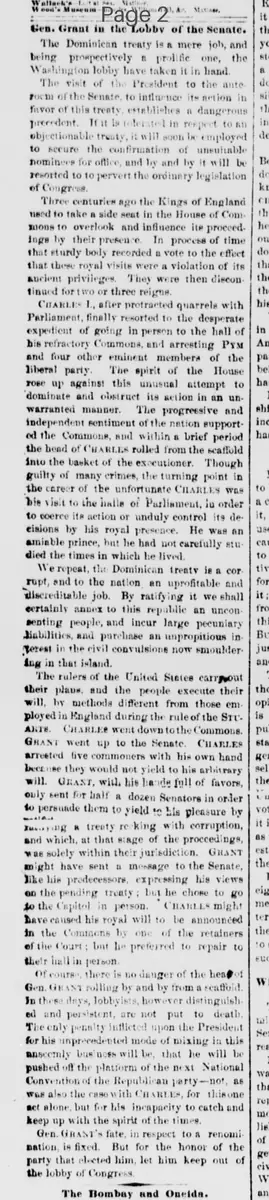
Gen. Grant in the Lobby of the Senate.
The Dominican treaty is a mere job, and being prospectively a prolific one, the Washington lobby have taken it in hand. The visit of the President to the ante-room of the Senate, to influence its action in favor of this treaty, establishes a dangerous precedent. If it is resorted to in respect to all objectionable treaty, it will soon be employed to secure the confirmation of unsuitable nominees for office, and by and by it will be resorted to to pervert the ordinary legislation of Congress.
Three centuries ago the Kings of England used to take a side seat in the House of Commons to overlook and influence its proceedings by their presence. In process of time that sturdy body recorded a vote to the effect that these royal visits were a violation of its ancient privileges. They were then discontinued for two or three reigns.
CHARLES I., after protracted quarrels with Parliament, finally resorted to the desperate expedient of going in person to the hall of his refractory Commons, and arresting PYM and four other eminent members of the liberal party. The spirit of the House rose up against this unusual attempt to dominate and obstruct its action in an unwarranted manner. The progressive and independent sentiment of the nation supported the Commons, and within a brief period the head of CHARLES rolled from the scaffold into the basket of the executioner. Though guilty of many crimes, the turning point in the career of the unfortunate CHARLES was his visit to the halls of Parliament, in order to coerce its action or unduly control its decisions by his royal presence. He was an amiable prince, but he had not carefully studied the times in which he lived.
We repeat, the Dominican treaty is a corrupt, and to the nation an unprofitable and discreditable job. By ratifying it we shall certainly annex to this republic an unconsenting people, and incur large pecuniary liabilities, and purchase an unpropitious interest in the civil convulsions now smoldering in that island.
The rulers of the United States carry out their plans, and the people execute their will, by methods different from those employed in England during the rule of the STUARTS. CHARLES went down to the Commons. GRANT went up to the Senate. CHARLES arrested five commoners with his own hand because they would not yield to his arbitrary will. GRANT, with his hands full of favors, only sent for half a dozen Senators in order to persuade them to yield to his pleasure by ratifying a treaty reeking with corruption, and which, at that stage of the proceedings, was solely within their jurisdiction. GRANT might have sent a message to the Senate, like his predecessors, expressing his views on the pending treaty; but he chose to go to the Capitol in person. CHARLES might have caused his royal will to be announced in the Commons by one of the retainers of the Court; but he preferred to repair to their hall in person.
Of course there is no danger of the head of Gen. GRANT rolling by and by from a scaffold. In these days, lobbyists, however distinguished and persistent, are not put to death. The only penalty inflicted upon the President for his unprecedented mode of mixing in this assembly business will be, that he will be pushed off the platform of the next National Convention of the Republican party—not, as was also the case with CHARLES, for this one act alone, but for his incapacity to catch and keep up with the spirit of the times.
Gen. GRANT's fate, in respect to a renomination, is fixed. But for the honor of the party that elected him, let him keep out of the lobby of Congress.
The Dominican treaty is a mere job, and being prospectively a prolific one, the Washington lobby have taken it in hand. The visit of the President to the ante-room of the Senate, to influence its action in favor of this treaty, establishes a dangerous precedent. If it is resorted to in respect to all objectionable treaty, it will soon be employed to secure the confirmation of unsuitable nominees for office, and by and by it will be resorted to to pervert the ordinary legislation of Congress.
Three centuries ago the Kings of England used to take a side seat in the House of Commons to overlook and influence its proceedings by their presence. In process of time that sturdy body recorded a vote to the effect that these royal visits were a violation of its ancient privileges. They were then discontinued for two or three reigns.
CHARLES I., after protracted quarrels with Parliament, finally resorted to the desperate expedient of going in person to the hall of his refractory Commons, and arresting PYM and four other eminent members of the liberal party. The spirit of the House rose up against this unusual attempt to dominate and obstruct its action in an unwarranted manner. The progressive and independent sentiment of the nation supported the Commons, and within a brief period the head of CHARLES rolled from the scaffold into the basket of the executioner. Though guilty of many crimes, the turning point in the career of the unfortunate CHARLES was his visit to the halls of Parliament, in order to coerce its action or unduly control its decisions by his royal presence. He was an amiable prince, but he had not carefully studied the times in which he lived.
We repeat, the Dominican treaty is a corrupt, and to the nation an unprofitable and discreditable job. By ratifying it we shall certainly annex to this republic an unconsenting people, and incur large pecuniary liabilities, and purchase an unpropitious interest in the civil convulsions now smoldering in that island.
The rulers of the United States carry out their plans, and the people execute their will, by methods different from those employed in England during the rule of the STUARTS. CHARLES went down to the Commons. GRANT went up to the Senate. CHARLES arrested five commoners with his own hand because they would not yield to his arbitrary will. GRANT, with his hands full of favors, only sent for half a dozen Senators in order to persuade them to yield to his pleasure by ratifying a treaty reeking with corruption, and which, at that stage of the proceedings, was solely within their jurisdiction. GRANT might have sent a message to the Senate, like his predecessors, expressing his views on the pending treaty; but he chose to go to the Capitol in person. CHARLES might have caused his royal will to be announced in the Commons by one of the retainers of the Court; but he preferred to repair to their hall in person.
Of course there is no danger of the head of Gen. GRANT rolling by and by from a scaffold. In these days, lobbyists, however distinguished and persistent, are not put to death. The only penalty inflicted upon the President for his unprecedented mode of mixing in this assembly business will be, that he will be pushed off the platform of the next National Convention of the Republican party—not, as was also the case with CHARLES, for this one act alone, but for his incapacity to catch and keep up with the spirit of the times.
Gen. GRANT's fate, in respect to a renomination, is fixed. But for the honor of the party that elected him, let him keep out of the lobby of Congress.
What sub-type of article is it?
Constitutional
Foreign Affairs
Imperialism
What keywords are associated?
Dominican Treaty
Grant Senate Visit
Executive Interference
Constitutional Precedent
Imperialism
Republican Renomination
Charles I Parallel
What entities or persons were involved?
Gen. Grant
Charles I
Senate
Republican Party
Pym
Editorial Details
Primary Topic
Criticism Of President Grant's Personal Intervention In Senate Regarding Dominican Treaty Ratification
Stance / Tone
Strongly Critical And Cautionary, Drawing Historical Parallels To Warn Against Executive Overreach
Key Figures
Gen. Grant
Charles I
Senate
Republican Party
Pym
Key Arguments
The Dominican Treaty Is A Corrupt Job Involving Washington Lobbyists
President Grant's Visit To The Senate Ante Room Sets A Dangerous Precedent For Influencing Legislation And Nominations
Historical Parallel: English Kings' Interference In Parliament Led To Backlash, Culminating In Charles I's Execution
Ratifying The Treaty Would Annex An Unconsenting People, Incur Liabilities, And Involve The Us In Dominican Civil Unrest
Grant's Actions Mirror Charles I's Coercive Tactics, Though Without Violence, And Risk His Political Future
Grant's Renomination Is Doomed Due To Failure To Align With The Times