Thank you for visiting SNEWPapers!
Sign up free
The Abbeville Press And Banner
Abbeville, Abbeville County, South Carolina
What is this article about?
Historical article on Mount Vernon, George Washington's estate in Virginia, detailing visitor access via new electric railway from Alexandria, the site's Revolutionary history, Washington's extensive farming operations, family legacy, and the estate's decline and partial revival after his 1799 death.
Clipping
OCR Quality
Full Text
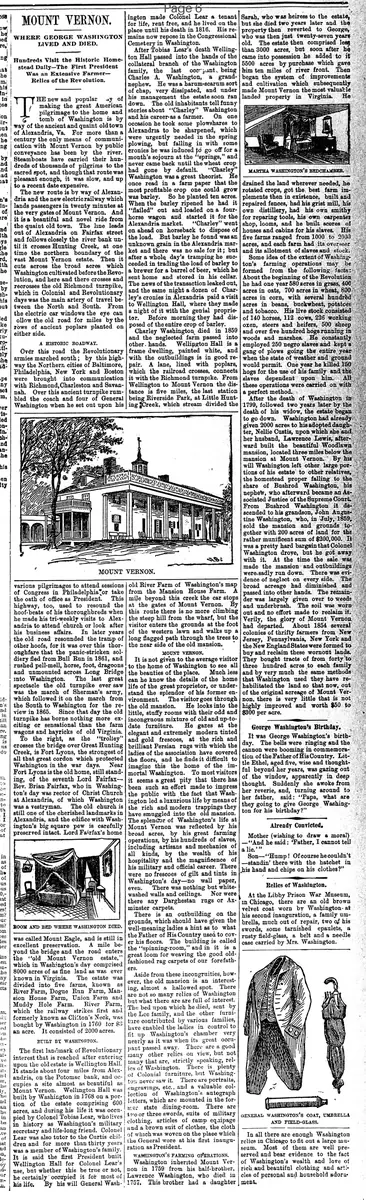
WHERE GEORGE WASHINGTON
LIVED AND DIED.
Hundreds Visit the Historic Homestead Daily—The First President Was an Extensive Farmer—
Relics of the Revolution,
A new and popular way of making the great American pilgrimage to the home and tomb of Washington is by way of the ancient and quaint old town of Alexandria, Va. For more than a century the only means of communication with Mount Vernon by public conveyance has been by the river. Steamboats have carried their hundreds of thousands of pilgrims to the sacred spot, and though that route was pleasant enough, it was slow, and up to a recent date expensive.
The new route is by way of Alexandria and the new electric railway which lands passengers in twenty minutes at the very gates of Mount Vernon. And it is a beautiful and novel ride from the quaint old town. The line leads out of Alexandria on Fairfax street and follows closely the river bank until it crosses Hunting Creek, at one time the northern boundary of the vast Mount Vernon estate. Then it cuts across the broad acres which Washington cultivated before the Revolution, and here and there crosses and recrosses the old Richmond turnpike, which in Colonial and Revolutionary days was the main artery of travel between the North and South. From the electric car windows the eye can follow the old road for miles by the rows of ancient poplars planted on either side.
A HISTORIC ROADWAY.
Over this road the Revolutionary armies marched south; by this highway the Northern cities of Baltimore, Philadelphia, New York and Boston were brought into communication with Richmond, Charleston and Savannah. Over this ancient turnpike rumbled the coach and four of General Washington when he set out upon his various pilgrimages to attend sessions of Congress in Philadelphia or take the oath of office as President. This highway, too, used to resound the hoof-beats of his thoroughbreds when he made his tri-weekly visits to Alexandria to attend church or look after his business affairs. In later years the old road resounded the tramp of other hoofs, for it was over this thoroughfare that the panic-stricken soldiery fled from Bull Run in 1861, and rushed pell-mell, horse, foot, dragoons and unmounted across Long Bridge into Washington. The last great spectacle the old turnpike ever saw was the march of Sherman's army, which followed it on the march from the South to Washington for the review in 1865. Since that day the old turnpike has borne nothing more exciting or sensational than the farm wagons and hayricks of old Virginia.
To the right, as the "trolley" crosses the bridge over Great Hunting Creek, is Fort Lyons, the strongest of all that great cordon which protected Washington in the war days. Near Fort Lyons is the old home, still standing, of the seventh Lord Fairfax—Rev. Brian Fairfax, who in Washington's day was rector of Christ Church at Alexandria, of which Washington was a vestryman. The old church is still one of the cherished landmarks in Alexandria, and the edifice with Washington's big square pew is carefully preserved intact. Lord Fairfax's home was called Mount Eagle, and is still in excellent preservation. A mile beyond the bridge and the road enters the "old Mount Vernon estate," which in Washington's day comprised 8000 acres of as fine land as was ever known in Virginia. The estate was divided into five farms, known as River Farm, Dogue Run Farm, Mansion House Farm, Union Farm and Muddy Hole Farm. River Farm, which the railway strikes first and formerly known as Clinton's Neck, was bought by Washington in 1760 for $5 an acre. It consisted of 2000 acres.
BUILT BY WASHINGTON.
The first landmark of Revolutionary interest that is reached after entering upon the old estate is Wellington Hall. It stands about four miles from Alexandria, on the Potomac bank, and occupies a site almost as beautiful as Mount Vernon. Wellington Hall was built by Washington in 1768 on a portion of the estate comprising 600 acres, and during his life it was occupied by Colonel Tobias Lear, who lives in history as Washington's military secretary and life-long friend. Colonel Lear was also tutor to the Curtis children and for more than thirty years was a member of Washington's family. It is said the first President built Wellington Hall for Colonel Lear's use, but whether this be true or not, he certainly occupied it for most of his life. By his will General Washington made Colonel Lear a tenant for life, rent free, and he lived on the place until his death in 1816. His remains now repose in the Congressional Cemetery in Washington.
After Tobias Lear's death Wellington Hall passed into the hands of the collateral branch of the Washington family, the last occupant being Charles A. Washington, a grand-nephew. He was a harum-scarum sort of chap, very dissipated, and under his management the estate soon ran down. The old inhabitants tell funny stories about "Charley" Washington and his career as a farmer. On one occasion he took some plowshares to Alexandria to be sharpened, which were urgently needed in the spring plowing, but falling in with some cronies he was induced to go off for a month's sojourn at the "springs," and never came back until the wheat crop had gone by default. "Charley" Washington was a great theorist. He once read in a farm paper that the most profitable crop one could grow was barley. So he planted ten acres. When the barley ripened he had it "flailed" out and loaded on a four-horse wagon and started it for the Alexandria market. "Charley" went on ahead on horseback to dispose of the load. But barley he found was an unknown grain in the Alexandria market and there was no sale for it; but after a whole day's tramping he succeeded in trading the load of barley to a brewer for a barrel of beer, which he sent home and stored in his cellar. The news of the transaction leaked out, and the same night a dozen of Charley's cronies in Alexandria paid a visit to Wellington Hall, where they made a night of it with the genial proprietor. Before morning they had disposed of the entire crop of barley.
Charley Washington died in 1859 and the neglected farm passed into other hands. Wellington Hall is a frame dwelling, painted white, and with the outbuildings is in good repair. A lane, lined with poplars, which the railroad crosses, connects it with the Richmond turnpike. From Wellington to Mount Vernon the distance is five miles, the last station being Riverside Park, at Little Hunting Creek, which stream divided the old River Farm of Washington's map from the Mansion House Farm. A mile beyond this creek the car stops at the gates of Mount Vernon. By this route there is no more climbing the steep hill from the wharf, but the visitor enters the grounds at the foot of the western lawn and walks up a long flagged path through the trees to the near side of the old mansion.
MOUNT VERNON.
It is not given to the average visitor to the home of Washington to see all the beauties of the place. Much less can he know the details of the home life of the great proprietor, or understand the splendor of his former environment. The visitor goes through the old mansion. He looks into the little, stuffy rooms with their odd and incongruous mixture of old and up-to-date furniture. He gazes at the elegant and extremely modern tinted and gold frescoes, at the rich and brilliant Persian rugs with which the ladies of the association have covered the floors, and he finds it difficult to imagine this the home of the immortal Washington. To most visitors it seems a great pity that there has been such an effort made to impress the public with the fact that Washington led a luxurious life by means of the rich and modern trappings they have smuggled into the old mansion.
The splendor of Washington's life at Mount Vernon was reflected by his broad acres, by his great farming operations, by his hundreds of slaves, including artisans and mechanics of all kinds, by the wealth of his hospitality and the magnificence of his military and official career. There were no frescoes of gilt and tints in Washington's day—no wall paper, even. There was nothing but white-washed walls and ceilings. Nor were there any Daghestan rugs or Axminster carpets.
There is an outbuilding on the grounds, which should have given the well-meaning ladies a hint as to what the Father of His Country used to cover his floors. The building is called the "spinning-room," and in it is a great loom for weaving the good old-fashioned rag carpets of our forefathers.
Aside from these incongruities, however, the old mansion is an interesting, almost a hallowed spot. There are not so many relics of Washington but what there are are full of interest. The bed upon which he died, sent by the Lee family, and the other furniture contributed by various families, have enabled the ladies in control to fit up Washington's chamber very nearly as it was when its great occupant passed away. There are a good many other relics on view, but not many that are, strictly speaking, relics of Washington. There is plenty of Colonial furniture, but Washington never saw it. There are portraits, engravings, etc., and a valuable collection of Washington's autograph letters, which are mounted in the former state dining-room. There are three or four swords, suits of military clothing, articles of camp equipage and a brown suit of clothes, the cloth of which was woven on the place which the General wore at his first inauguration as President.
WASHINGTON'S FARMING OPERATIONS.
Washington inherited Mount Vernon in 1759 from his half-brother, Lawrence Washington, who died in 1757. This brother had a daughter Sarah, who was heiress to the estate, but she died two years later and the property then reverted to George, who was then just twenty-seven years old. The estate then comprised less than 3000 acres, but soon after he came into possession he added to it 5500 acres by purchase which gave him ten miles of river front. Then began the system of improvements and cultivation which subsequently made Mount Vernon the most valuable landed property in Virginia. He drained the land wherever needed, he rotated crops, got the best farm implements then in existence, built and repaired fences, had his grist mill, his own distillery, had his own smithy for repairing tools, his own carpenter shop, looms, and he built scores of houses and cabins for his slaves. His five farms ranged from 1000 to 2000 acres, and each farm had its overseer and its allotment of slaves and stock.
Some idea of the extent of Washington's farming operations may be formed from the following facts: About the beginning of the Revolution he had one year 580 acres in grass, 400 acres in oats, 700 acres in wheat, 800 acres in corn, with several hundred acres in beans, buckwheat, potatoes and tobacco. His live stock consisted of 140 horses, 112 cows, 226 working oxen, steers and heifers, 500 sheep and over five hundred hogs running in woods and marshes. He constantly employed 250 negro slaves and kept a gang of plows going the entire year when the state of weather and ground would permit. One year he killed 150 hogs for the use of his family and the slaves dependent upon him. All these operations were carried on with a perfect method.
After the death of Washington in 1799, followed two years later by the death of his widow, the estate began to go down. Washington had already given 2000 acres to his adopted daughter, Nellie Custis, upon which she and her husband, Lawrence Lewis, afterward built the beautiful Woodlawn mansion, located three miles below the mansion at Mount Vernon. By his will Washington left other large portions of his estate to other relatives, the homestead proper falling to the share of Bushrod Washington, his nephew, who afterward became an Associate Justice of the Supreme Court. From Bushrod Washington it descended to his grandson, John Augustine Washington, who, in July, 1858, sold the mansion and grounds together with 200 acres of land for the rather munificent sum of $200,000. It was a pretty hard bargain that Colonel Washington drove, but he got away with it. At the time the sale was made the mansion and outbuildings were sadly run down. There was evidence of neglect on every side. The broad acreage had diminished and passed into other hands. The remainder was largely given over to weeds and underbrush. The soil was worn out and no effort made to reclaim it. Verily, the glory of Mount Vernon had departed. About 1858 several colonies of thrifty farmers from New Jersey, Pennsylvania, New York and the New England States were formed to buy and reclaim these worn-out lands. They bought tracts of from forty to three hundred acres to each family and by very much the same methods that Washington used they have rehabilitated the land so that now, out of the original acreage of Mount Vernon, there is very little that is not highly improved and worth $50 to $300 per acre.
MARTHA WASHINGTON'S BEDCHAMBER.
What sub-type of article is it?
What themes does it cover?
What keywords are associated?
What entities or persons were involved?
Where did it happen?
Story Details
Key Persons
Location
Mount Vernon, Virginia
Event Date
1759 1799
Story Details
Description of Mount Vernon estate, Washington's inheritance and expansion to 8000 acres with advanced farming practices employing 250 slaves; historical route via electric railway from Alexandria; anecdotes of occupants like Tobias Lear and dissipated Charles A. Washington; decline after 1799 death and sale in 1858; relics and modern visitor experience critiqued.