Thank you for visiting SNEWPapers!
Sign up free
Literary
February 9, 1877
The Somerset Press
Somerset, Perry County, Ohio
What is this article about?
This essay explains the daily delay in tides due to the moon's eastward orbit of about 13 degrees every 24 hours, requiring Earth to rotate an extra ~50 minutes to align. It discusses lunar-solar tide interactions causing spring tides at new and full moons, and notes tides are mainly superficial.
Clipping
OCR Quality
95%
Excellent
Full Text
Why the Tides Occur Later Each Day.
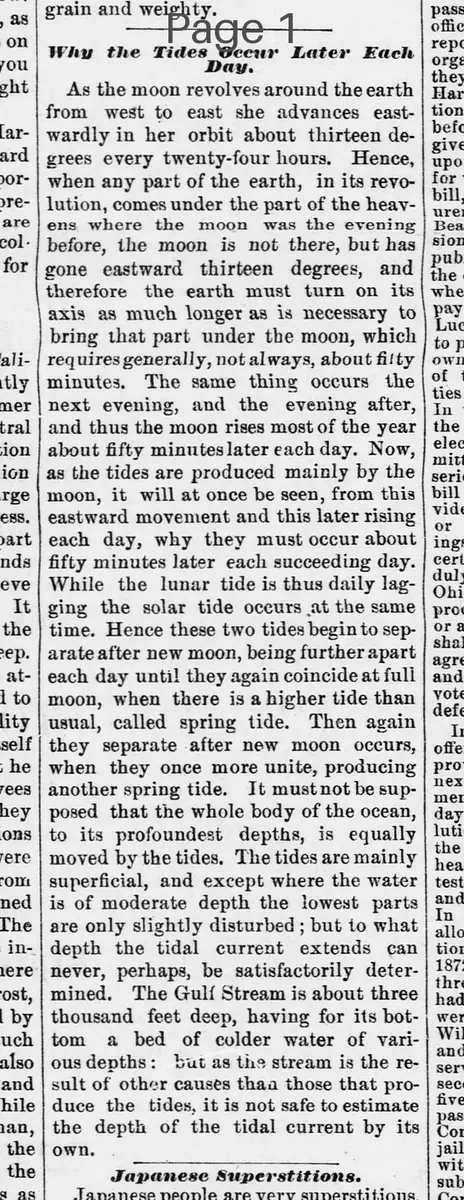
As the moon revolves around the earth from west to east she advances eastwardly in her orbit about thirteen degrees every twenty-four hours. Hence, when any part of the earth, in its revolution, comes under the part of the heavens where the moon was the evening before, the moon is not there, but has gone eastward thirteen degrees, and therefore the earth must turn on its axis as much longer as is necessary to bring that part under the moon, which requires generally, not always, about fifty minutes. The same thing occurs the next evening, and the evening after, and thus the moon rises most of the year about fifty minutes later each day. Now, as the tides are produced mainly by the moon, it will at once be seen, from this eastward movement and this later rising each day, why they must occur about fifty minutes later each succeeding day.
While the lunar tide is thus daily lagging the solar tide occurs at the same time. Hence these two tides begin to separate after new moon, being further apart each day until they again coincide at full moon, when there is a higher tide than usual, called spring tide. Then again they separate after new moon occurs, when they once more unite, producing another spring tide. It must not be supposed that the whole body of the ocean, to its profoundest depths, is equally moved by the tides. The tides are mainly superficial, and except where the water is of moderate depth the lowest parts are only slightly disturbed; but to what depth the tidal current extends can never, perhaps, be satisfactorily determined. The Gulf Stream is about three thousand feet deep, having for its bottom a bed of colder water of various depths: but as the stream is the result of other causes than those that produce the tides, it is not safe to estimate the depth of the tidal current by its own.
As the moon revolves around the earth from west to east she advances eastwardly in her orbit about thirteen degrees every twenty-four hours. Hence, when any part of the earth, in its revolution, comes under the part of the heavens where the moon was the evening before, the moon is not there, but has gone eastward thirteen degrees, and therefore the earth must turn on its axis as much longer as is necessary to bring that part under the moon, which requires generally, not always, about fifty minutes. The same thing occurs the next evening, and the evening after, and thus the moon rises most of the year about fifty minutes later each day. Now, as the tides are produced mainly by the moon, it will at once be seen, from this eastward movement and this later rising each day, why they must occur about fifty minutes later each succeeding day.
While the lunar tide is thus daily lagging the solar tide occurs at the same time. Hence these two tides begin to separate after new moon, being further apart each day until they again coincide at full moon, when there is a higher tide than usual, called spring tide. Then again they separate after new moon occurs, when they once more unite, producing another spring tide. It must not be supposed that the whole body of the ocean, to its profoundest depths, is equally moved by the tides. The tides are mainly superficial, and except where the water is of moderate depth the lowest parts are only slightly disturbed; but to what depth the tidal current extends can never, perhaps, be satisfactorily determined. The Gulf Stream is about three thousand feet deep, having for its bottom a bed of colder water of various depths: but as the stream is the result of other causes than those that produce the tides, it is not safe to estimate the depth of the tidal current by its own.
What sub-type of article is it?
Essay
What themes does it cover?
Nature
What keywords are associated?
Tides
Moon Revolution
Lunar Tide
Solar Tide
Spring Tide
Gulf Stream
Literary Details
Title
Why The Tides Occur Later Each Day.
Form / Style
Prose Explanation Of Astronomical And Tidal Phenomena
Key Lines
As The Moon Revolves Around The Earth From West To East She Advances Eastwardly In Her Orbit About Thirteen Degrees Every Twenty Four Hours.
Now, As The Tides Are Produced Mainly By The Moon, It Will At Once Be Seen, From This Eastward Movement And This Later Rising Each Day, Why They Must Occur About Fifty Minutes Later Each Succeeding Day.
Hence These Two Tides Begin To Separate After New Moon, Being Further Apart Each Day Until They Again Coincide At Full Moon, When There Is A Higher Tide Than Usual, Called Spring Tide.