Thank you for visiting SNEWPapers!
Sign up free
The New Hampshire Gazette
Portsmouth, Rockingham County, New Hampshire
What is this article about?
Excerpt from the Gentleman's Magazine for September, outlining England's defense in the dispute with Holland over Dutch claims to neutral trade with France and its American settlements during wartime, citing historical practices, laws of nations, and treaties from 1668 and 1675.
Clipping
OCR Quality
Full Text
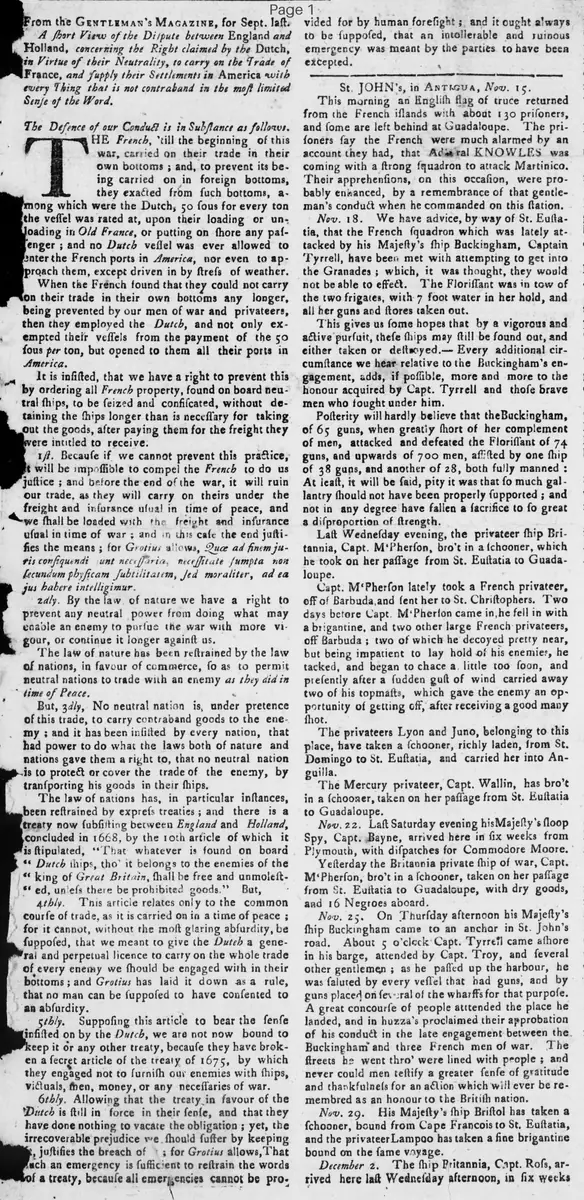
A short View of the Dispute between England and Holland, concerning the Right claimed by the Dutch, in Virtue of their Neutrality, to carry on the Trade of France, and supply their Settlements in America with every Thing that is not contraband in the most limited Sense of the Word.
The Defence of our Conduct is in Substance as follows.
The French, till the beginning of this war, carried on their trade in their own bottoms; and, to prevent its being carried on in foreign bottoms, they exacted from such bottoms, among which were the Dutch, 50 sous for every ton the vessel was rated at, upon their loading or unloading in Old France, or putting on shore any passenger; and no Dutch vessel was ever allowed to enter the French ports in America, nor even to approach them, except driven in by stress of weather.
When the French found that they could not carry on their trade in their own bottoms any longer, being prevented by our men of war and privateers, then they employed the Dutch, and not only exempted their vessels from the payment of the 50 sous per ton, but opened to them all their ports in America.
It is insisted, that we have a right to prevent this by ordering all French property, found on board neutral ships, to be seized and confiscated, without detaining the ships longer than is necessary for taking out the goods, after paying them for the freight they were entitled to receive.
1st. Because if we cannot prevent this practice, it will be impossible to compel the French to do us justice; and before the end of the war, it will ruin our trade, as they will carry on theirs under the freight and insurance usual in time of peace, and we shall be loaded with the freight and insurance usual in time of war: and in this case the end justifies the means; for Grotius allows, Quæ ad finem justi confisquendi sunt necessaria, necessitate sumpta non secundum physicam subtilitatem, sed moraliter, ad ea jus habere intelligimur.
2dly. By the law of nature we have a right to prevent any neutral power from doing what may enable an enemy to pursue the war with more vigour, or continue it longer against us.
The law of nature has been restrained by the law of nations, in favour of commerce, so as to permit neutral nations to trade with an enemy as they did in time of Peace.
But, 3dly. No neutral nation is, under pretence of this trade, to carry contraband goods to the enemy; and it has been insisted by every nation, that had power to do what the laws both of nature and nations gave them a right to, that no neutral nation is to protect or cover the trade of the enemy, by transporting his goods in their ships.
The law of nations has, in particular instances, been restrained by express treaties; and there is a treaty now subsisting between England and Holland, concluded in 1668, by the 10th article of which it is stipulated, "That whatever is found on board Dutch ships, tho' it belongs to the enemies of the king of Great Britain, shall be free and unmolested, unless there be prohibited goods." But,
4thly. This article relates only to the common course of trade, as it is carried on in a time of peace; for it cannot, without the most glaring absurdity, be supposed, that we meant to give the Dutch a general and perpetual licence to carry on the whole trade of every enemy we should be engaged with in their bottoms; and Grotius has laid it down as a rule, that no man can be supposed to have consented to an absurdity.
5thly. Supposing this article to bear the sense insisted on by the Dutch, we are not now bound to keep it or any other treaty, because they have broken a secret article of the treaty of 1675, by which they engaged not to furnish our enemies with ships, victuals, men, money, or any necessaries of war.
6thly. Allowing that the treaty in favour of the Dutch is still in force in their sense, and that they have done nothing to vacate the obligation; yet, the irreparable prejudice we should suffer by keeping it, justifies the breach of it: for Grotius allows, That such an emergency is sufficient to restrain the words of a treaty, because all emergencies cannot be provided for by human foresight; and it ought always to be supposed, that an intolerable and ruinous emergency was meant by the parties to have been excepted.
What sub-type of article is it?
What keywords are associated?
Where did it happen?
Foreign News Details
Primary Location
Holland
Outcome
england defends right to seize french property on dutch ships; cites treaties of 1668 and 1675 as potentially void or inapplicable due to wartime emergency and dutch violations.
Event Details
England argues against Dutch neutral trade carrying French goods to America during war, detailing pre-war French restrictions on foreign vessels, wartime shifts favoring Dutch ships, and legal justifications from natural law, nations' law, and treaties to seize enemy property without detaining neutral ships unduly.