Thank you for visiting SNEWPapers!
Sign up free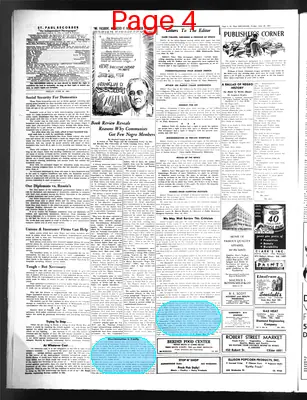
Editorial
June 29, 1951
St. Paul Recorder
Saint Paul, Ramsey County, Minnesota
What is this article about?
The editorial highlights the monetary and social costs of racial discrimination against Negroes, including slum-related expenses, lost talent, and damage to America's democratic image abroad, citing examples like Ralph Bunche and George Washington Carver. From N.Y. Times, May 28, 1951.
Clipping
OCR Quality
100%
Excellent
Full Text
Discrimination Is Costly
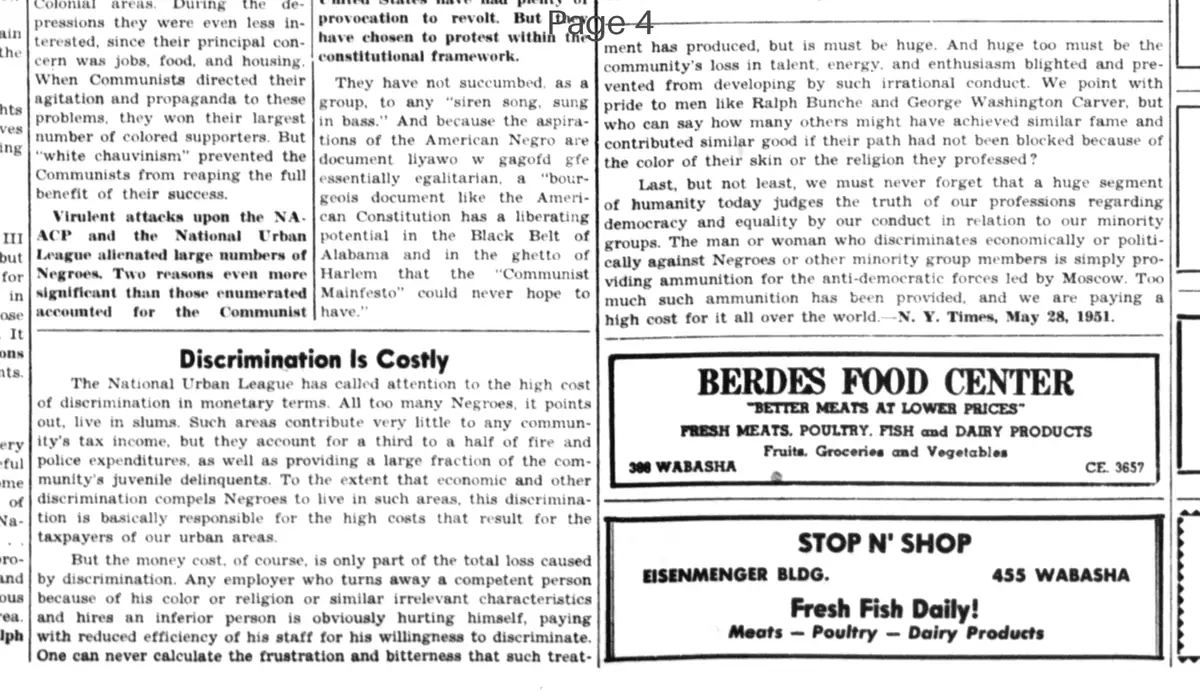
The National Urban League has called attention to the high cost of discrimination in monetary terms. All too many Negroes, it points out, live in slums. Such areas contribute very little to any community's tax income, but they account for a third to a half of fire and police expenditures, as well as providing a large fraction of the community's juvenile delinquents. To the extent that economic and other discrimination compels Negroes to live in such areas, this discrimination is basically responsible for the high costs that result for the taxpayers of our urban areas.
But the money cost, of course, is only part of the total loss caused by discrimination. Any employer who turns away a competent person because of his color or religion or similar irrelevant characteristics and hires an inferior person is obviously hurting himself, paying with reduced efficiency of his staff for his willingness to discriminate.
One can never calculate the frustration and bitterness that such treatment engenders in the rejected applicant. Nor can one compute the loss to the community when talent is wasted because of irrational prejudice. The number of such instances must be huge. And huge too must be the community's loss in talent, energy, and enthusiasm blighted and prevented from developing by such irrational conduct. We point with pride to men like Ralph Bunche and George Washington Carver, but who can say how many others might have achieved similar fame and contributed similar good if their path had not been blocked because of the color of their skin or the religion they professed?
Last, but not least, we must never forget that a huge segment of humanity today judges the truth of our professions regarding democracy and equality by our conduct in relation to our minority groups. The man or woman who discriminates economically or politically against Negroes or other minority group members is simply providing ammunition for the anti-democratic forces led by Moscow. Too much such ammunition has been provided, and we are paying a high cost for it all over the world.
—N. Y. Times, May 28, 1951.
The National Urban League has called attention to the high cost of discrimination in monetary terms. All too many Negroes, it points out, live in slums. Such areas contribute very little to any community's tax income, but they account for a third to a half of fire and police expenditures, as well as providing a large fraction of the community's juvenile delinquents. To the extent that economic and other discrimination compels Negroes to live in such areas, this discrimination is basically responsible for the high costs that result for the taxpayers of our urban areas.
But the money cost, of course, is only part of the total loss caused by discrimination. Any employer who turns away a competent person because of his color or religion or similar irrelevant characteristics and hires an inferior person is obviously hurting himself, paying with reduced efficiency of his staff for his willingness to discriminate.
One can never calculate the frustration and bitterness that such treatment engenders in the rejected applicant. Nor can one compute the loss to the community when talent is wasted because of irrational prejudice. The number of such instances must be huge. And huge too must be the community's loss in talent, energy, and enthusiasm blighted and prevented from developing by such irrational conduct. We point with pride to men like Ralph Bunche and George Washington Carver, but who can say how many others might have achieved similar fame and contributed similar good if their path had not been blocked because of the color of their skin or the religion they professed?
Last, but not least, we must never forget that a huge segment of humanity today judges the truth of our professions regarding democracy and equality by our conduct in relation to our minority groups. The man or woman who discriminates economically or politically against Negroes or other minority group members is simply providing ammunition for the anti-democratic forces led by Moscow. Too much such ammunition has been provided, and we are paying a high cost for it all over the world.
—N. Y. Times, May 28, 1951.
What sub-type of article is it?
Social Reform
Moral Or Religious
Foreign Affairs
What keywords are associated?
Racial Discrimination
Economic Costs
Social Loss
Wasted Talent
Democracy Image
Minority Groups
What entities or persons were involved?
National Urban League
Ralph Bunche
George Washington Carver
Moscow
Editorial Details
Primary Topic
Costs Of Racial Discrimination
Stance / Tone
Criticism Of Discrimination And Call For Equality
Key Figures
National Urban League
Ralph Bunche
George Washington Carver
Moscow
Key Arguments
Discrimination Leads To High Monetary Costs For Taxpayers Through Slums And Increased Public Services.
Employers Suffer Reduced Efficiency By Hiring Inferior Workers Due To Prejudice.
Rejected Individuals Experience Frustration And Bitterness, Wasting Community Talent.
Many Potential Contributors Like Bunche And Carver Are Blocked By Prejudice.
Discrimination Undermines America's Democratic Image, Aiding Anti Democratic Forces Abroad.