Thank you for visiting SNEWPapers!
Sign up free
Story
January 31, 1863
Sioux City Register
Sioux City, Woodbury County, Iowa
What is this article about?
A baffling epidemic in Plymouth, Ind., identified as cerebro-spinal meningitis, causes rapid death with symptoms like chills, stupor, rigidity, and black spots. Dr. J. Adams Allen recommends stimulants and nutriment, which are proving effective. The disease has historical precedents in the US.
Clipping
OCR Quality
95%
Excellent
Full Text
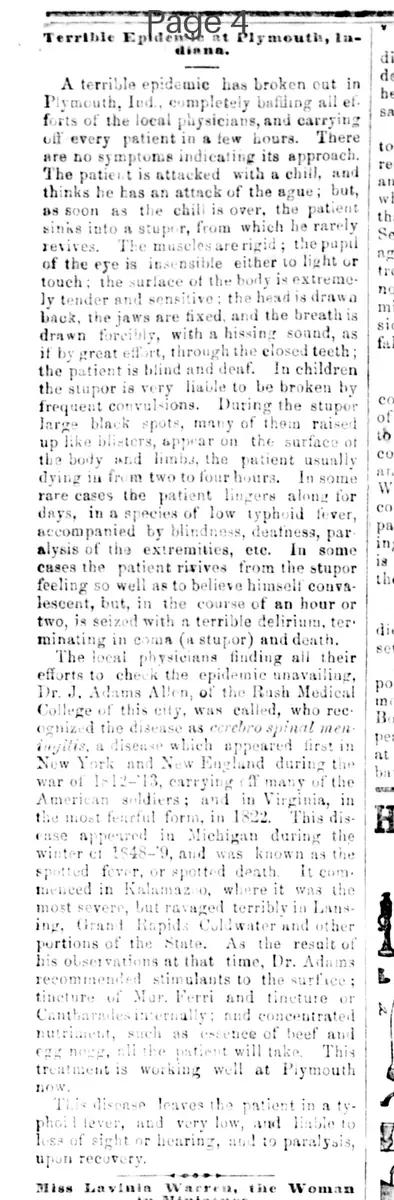
A terrible epidemic has broken out in Plymouth, Ind., completely baffling all efforts of the local physicians, and carrying off every patient in a few hours.
There are no symptoms indicating its approach. The patient is attacked with a chill, and thinks he has an attack of the ague; but, as soon as the chill is over, the patient sinks into a stupor, from which he rarely revives. The muscles are rigid; the pupil of the eye is insensible either to light or touch: the surface of the body is extremely tender and sensitive: the head is drawn back, the jaws are fixed, and the breath is drawn forcibly, with a hissing sound, as if by great effort, through the closed teeth: the patient is blind and deaf. In children the stupor is very liable to be broken by frequent convulsions. During the stupor large black spots, many of them raised up like blisters, appear on the surface of the body and limbs, the patient usually dying in from two to four hours.
In some rare cases the patient lingers along for days, in a species of low typhoid fever, accompanied by blindness, deafness, paralysis of the extremities, etc. In some cases the patient revives from the stupor feeling so well as to believe himself convalescent, but, in the course of an hour or two, is seized with a terrible delirium, terminating in coma (a stupor) and death.
The local physicians finding all their efforts to check the epidemic unavailing, Dr. J. Adams Allen, of the Rush Medical College of this city, was called, who recognized the disease as cerebro-spinal meningitis, a disease which appeared first in New York and New England during the war of 1812-13, carrying off many of the American soldiers: and in Virginia, in the most fearful form, in 1822. This disease appeared in Michigan during the winter of 1858-9, and was known as the spotted fever, or spotted death. It commenced in Kalamazoo, where it was the most severe, but ravaged terribly in Lansing, Grand Rapids, Coldwater and other portions of the State.
As the result of his observations at that time, Dr. Adams recommended stimulants to the surface: tincture of Mur. Ferri and tincture of Cantharides internally: and concentrated nutriment, such as essence of beef and egg nog, all the patient will take. This treatment is working well at Plymouth now. This disease leaves the patient in a typhoid fever, and very low, and liable to loss of sight or hearing, and to paralysis, upon recovery.
There are no symptoms indicating its approach. The patient is attacked with a chill, and thinks he has an attack of the ague; but, as soon as the chill is over, the patient sinks into a stupor, from which he rarely revives. The muscles are rigid; the pupil of the eye is insensible either to light or touch: the surface of the body is extremely tender and sensitive: the head is drawn back, the jaws are fixed, and the breath is drawn forcibly, with a hissing sound, as if by great effort, through the closed teeth: the patient is blind and deaf. In children the stupor is very liable to be broken by frequent convulsions. During the stupor large black spots, many of them raised up like blisters, appear on the surface of the body and limbs, the patient usually dying in from two to four hours.
In some rare cases the patient lingers along for days, in a species of low typhoid fever, accompanied by blindness, deafness, paralysis of the extremities, etc. In some cases the patient revives from the stupor feeling so well as to believe himself convalescent, but, in the course of an hour or two, is seized with a terrible delirium, terminating in coma (a stupor) and death.
The local physicians finding all their efforts to check the epidemic unavailing, Dr. J. Adams Allen, of the Rush Medical College of this city, was called, who recognized the disease as cerebro-spinal meningitis, a disease which appeared first in New York and New England during the war of 1812-13, carrying off many of the American soldiers: and in Virginia, in the most fearful form, in 1822. This disease appeared in Michigan during the winter of 1858-9, and was known as the spotted fever, or spotted death. It commenced in Kalamazoo, where it was the most severe, but ravaged terribly in Lansing, Grand Rapids, Coldwater and other portions of the State.
As the result of his observations at that time, Dr. Adams recommended stimulants to the surface: tincture of Mur. Ferri and tincture of Cantharides internally: and concentrated nutriment, such as essence of beef and egg nog, all the patient will take. This treatment is working well at Plymouth now. This disease leaves the patient in a typhoid fever, and very low, and liable to loss of sight or hearing, and to paralysis, upon recovery.
What sub-type of article is it?
Medical Curiosity
Disaster
Historical Event
What themes does it cover?
Catastrophe
Misfortune
Recovery
What keywords are associated?
Epidemic
Cerebro Spinal Meningitis
Plymouth Ind
Spotted Fever
Medical Treatment
What entities or persons were involved?
Dr. J. Adams Allen
Where did it happen?
Plymouth, Ind.
Story Details
Key Persons
Dr. J. Adams Allen
Location
Plymouth, Ind.
Story Details
Epidemic of cerebro-spinal meningitis baffles local doctors in Plymouth, Ind., killing patients rapidly with chills, stupor, rigidity, black spots, and convulsions. Dr. J. Adams Allen diagnoses it, recalls past outbreaks, and recommends stimulants and nutriment, which succeed.