Thank you for visiting SNEWPapers!
Sign up free
Story
March 4, 1911
Democratic Messenger
Snow Hill, Worcester County, Maryland
What is this article about?
Observational piece comparing an Arab plowman to biblical Elisha, highlighting the slight enduring impact of Roman civilization on North African people, visible only in minor details like month names in Kabyle dialect and labor hiring customs in the Tell.
Clipping
OCR Quality
98%
Excellent
Full Text
The Arab Plowman.
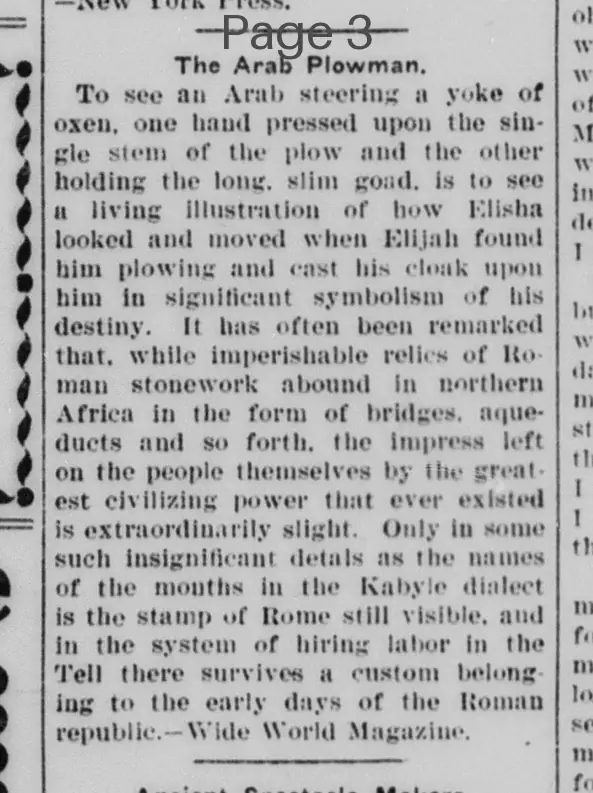
To see an Arab steering a yoke of oxen, one hand pressed upon the single stem of the plow and the other holding the long, slim goad, is to see a living illustration of how Elisha looked and moved when Elijah found him plowing and cast his cloak upon him in significant symbolism of his destiny. It has often been remarked that, while imperishable relics of Roman stonework abound in northern Africa in the form of bridges, aqueducts and so forth, the impress left on the people themselves by the greatest civilizing power that ever existed is extraordinarily slight. Only in some such insignificant details as the names of the months in the Kabyle dialect is the stamp of Rome still visible, and in the system of hiring labor in the Tell there survives a custom belonging to the early days of the Roman republic.
-Wide World Magazine.
To see an Arab steering a yoke of oxen, one hand pressed upon the single stem of the plow and the other holding the long, slim goad, is to see a living illustration of how Elisha looked and moved when Elijah found him plowing and cast his cloak upon him in significant symbolism of his destiny. It has often been remarked that, while imperishable relics of Roman stonework abound in northern Africa in the form of bridges, aqueducts and so forth, the impress left on the people themselves by the greatest civilizing power that ever existed is extraordinarily slight. Only in some such insignificant details as the names of the months in the Kabyle dialect is the stamp of Rome still visible, and in the system of hiring labor in the Tell there survives a custom belonging to the early days of the Roman republic.
-Wide World Magazine.
What sub-type of article is it?
Curiosity
Historical Event
What themes does it cover?
Social Manners
What keywords are associated?
Arab Plowman
Roman Influence
North Africa
Kabyle Dialect
Tell Labor
Biblical Elisha
What entities or persons were involved?
Elisha
Elijah
Where did it happen?
Northern Africa
Story Details
Key Persons
Elisha
Elijah
Location
Northern Africa
Story Details
An Arab plowman illustrates the biblical scene of Elisha plowing when called by Elijah; Roman influence on North African people is minimal, seen only in Kabyle month names and Tell labor hiring customs from early Roman republic.