Thank you for visiting SNEWPapers!
Sign up free
Lewiston Teller
Lewiston, Nez Perce County, Idaho
What is this article about?
J.C. Ainsworth, President of the Oregon Steam Navigation Company, discusses plans for narrow-gauge railroads connecting to Dr. Baker's line, improvements to reduce freight costs, and the importance of agriculture for steamboat trade in the Snake and Columbia River regions.
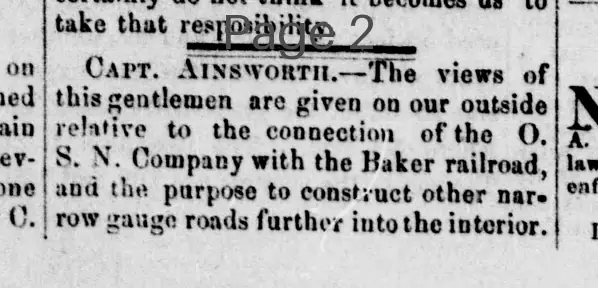
Merged-components note: Merged the short introduction on page 2 with the full interview on page 4 (referred to as 'outside').
Clippings
1 of 2
OCR Quality
Full Text
The editor of the Inland Empire gives the following:
Being in Portland some days ago, we chanced to get in conversation with J. C. Ainsworth, President of the Oregon Steam Navigation Company, upon that subject, and, in reply to our query if a few questions may be considered impertinent, that gentleman replied:
"Soon you know all about it as any one else. The road has not been purchased, nor will it be, by this company. A company has been formed here to build a system of narrow-gauge roads through that eastern country, communicative and harmonious with the road inaugurated by Dr. Baker and his associates. That road represents a certain amount of stock in the new corporation, but its present existence does not terminate till the first of January next. The Doctor in the meantime, is making some important changes in the character of the roadbed by which dangerous trestles are to be avoided and easier grades reached, thus enabling the present completed road to carry heavier loaded trains, at decreased risk and lessen wear of material. You must certainly see, that the prosperity of the past two years to the farmers of that section, affords no fair criterion of the future; for the figures realized for the grain of 1876 and 1877 are purely exceptional prices, based upon the chances of a general war in Europe. Remove the probabilities of such a war and those prices must decline, thus greatly decreasing the profits of agriculture. A farmer's expenses are as great during dull years as in those that are prosperous; and that fact must be borne in mind by those engaged in carrying trade. For, whenever agriculture affords no profit to the farmers, he will abandon it and go to stock raising; and that makes no trade for steamboats. Agriculture is the only avocation that justifies heavy outlay in this business, and I would call your attention to the facts that our company has laid out over four hundred thousand dollars during the past two years in tonnage for the upper Columbia trade, including new wharf-boats, of course. All the materials used in their construction had to be carried over our lines as "fast freights," to the exclusion often of other freights on which men stood ready to pay us the ready cash. But the trade demands it and you must obey the trade. When you pilot a steamer, you must obey the current; and the currents of business are more imperious than those of the water itself.
Now those people up Snake river, live so far from navigable water that their least wagon-haul to any of our landings is above fifteen miles, over roads that are none of the best; and a man cannot haul grain to the landings on his wagon for less than eight to ten dollars per ton. This cuts off a great deal of profit on agriculture and jeopardizes the success of our steamboating. They must be given cheaper or they will abandon agriculture. You will recollect that in the Nez Perce mining day, we charged seventy dollars per ton to Lewiston. That was because the trade was a risky one, based on no permanent employment for the people. Had those mines proven to be worthless, the first year, our boats would have been dead property the second Summer, not worth ten per cent. of their cost. But with farming the case is different; you can make some different calculations." Here we ventured a question as to whether the new system would lead to a reduced freight tariff on the rivers. "Most assuredly it will," replied the Captain. "It is with a view of meeting the imperative demands for reduced tariff that we are increasing our transportation facilities and widening our connections. We made reduction upon farming machinery of nearly twenty-five per cent., just to increase the acreage of crops in that section and develop our trade. These reductions must be made in proportion to the increase of our operative tonnage. For instance, when you first went up the river, ten years ago, we had small boats; fifty and one hundred tons of down freight were a big load. Now we have boats capable of carrying twice that much at a less draft of water, with the same consumption of fuel, and a mere nominal increase of labor to unload the grain. By blowing out the rocks in the rapids at Five Mile, Fish Hook, Pine Tree, give us better channels in Snake river, Palouse and Texas, and we will be able to go to Lewiston with the same loads we now carry to Wallula. Whenever we can do that, we can reduce five dollars per ton to Wallula and ten dollars to Lewiston, with a proportional decrease on way freight. I have no doubt but if the money appropriated for those improvements was entrusted to us to expend, we would have the work done more cheaply and practically under the supervision of our pilots than under the Government engineers; but it would be idle folly to ask for such concession. It would be regarded as a concession to a company and not the people, though the people would be most directly benefited by it. Commerce is peremptory and creates corporations to meet its requirements. Hence companies must obey the demands of trade. I will tell you what this thing means, after this year. It means cheaper transportation for their grain from the threshing machine to tide-water. It means no more storage of seven or eight months in warehouses for those Snake river crops, awaiting a rise in the river; it means no paying interest on money to live upon while crops are stored to await shipment; it means less insurance and less loss by rats and other nuisances: and it also means--if men will only take advantage of these increased facilities offered to the primary producers--fewer poor men in the country. Now I've told you all there is in this new arrangement you can judge for yourself whether there is anything worth concealing. We don't go around telling everybody our business, but when a man comes in for information, we like to keep him correctly posted."
What sub-type of article is it?
What themes does it cover?
What keywords are associated?
What entities or persons were involved?
Where did it happen?
Story Details
Key Persons
Location
Portland; Snake River; Columbia River; Lewiston; Wallula
Event Date
1876 1877
Story Details
J.C. Ainsworth explains the O.S.N. Company's non-purchase of Baker's railroad but formation of a new corporation for narrow-gauge roads into the interior, improvements to reduce risks and costs, emphasis on sustaining agriculture for steamboat trade, and plans for freight reductions through better facilities and river improvements.