Thank you for visiting SNEWPapers!
Sign up free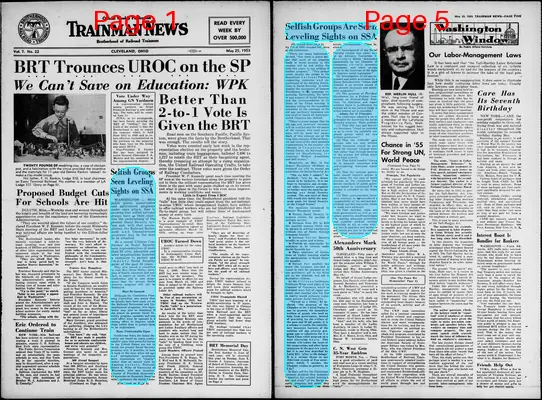
Trainman News
Indianapolis, Marion County, Indiana
What is this article about?
In Washington, a Citizens Conference on Social Security launched a campaign to protect and improve the system amid fears of attacks by groups like the Chamber of Commerce. Professor Edwin E. Witte warned of threats to progress, while Sen. Hubert Humphrey introduced bills on May 18 to extend and enhance benefits.
Merged-components note: Merged continuation of the article on threats to Social Security from page 1 to page 5. Changed label from story on page 5 to domestic_news to match the overall labor policy topic.
Clippings
1 of 2
OCR Quality
Full Text
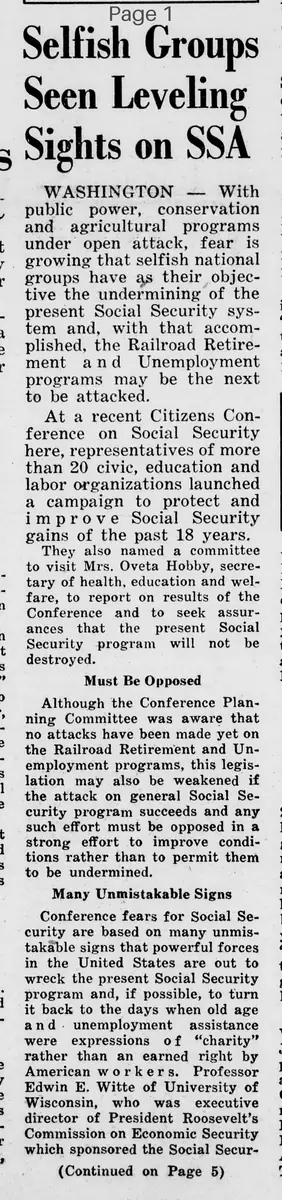
WASHINGTON - With public power, conservation and agricultural programs under open attack, fear is growing that selfish national groups have as their objective the undermining of the present Social Security system and, with that accomplished, the Railroad Retirement and Unemployment programs may be the next to be attacked.
At a recent Citizens Conference on Social Security here, representatives of more than 20 civic, education and labor organizations launched a campaign to protect and improve Social Security gains of the past 18 years.
They also named a committee to visit Mrs. Oveta Hobby, secretary of health, education and welfare, to report on results of the Conference and to seek assurances that the present Social Security program will not be destroyed.
Must Be Opposed
Although the Conference Planning Committee was aware that no attacks have been made yet on the Railroad Retirement and Unemployment programs, this legislation may also be weakened if the attack on general Social Security program succeeds and any such effort must be opposed in a strong effort to improve conditions rather than to permit them to be undermined.
Many Unmistakable Signs
Conference fears for Social Security are based on many unmistakable signs that powerful forces in the United States are out to wreck the present Social Security program and, if possible, to turn it back to the days when old age and unemployment assistance were expressions of "charity" rather than an earned right by American workers. Professor Edwin E. Witte of University of Wisconsin, who was executive director of President Roosevelt's Commission on Economic Security which sponsored the Social Security (Continued on Page 5)
Selfish Groups Are Seen Leveling Sights on SSA
(Continued from Page 1)
ity Act of 1935, sounded the alarm at the Conference.
"There are many indications," he said, "that there is grave danger that much of the progress made in social security in this country will be lost within the next two years, to say nothing of further progress."
"This danger exists despite the pledge in the Republican National Platform supporting extension and improvement of the existing institutions in Social Security. It exists despite the statements of General Eisenhower in the campaign expressing forthrightly his belief in and support of Social Security, and the recommendation in his State of the Union message in January asking for the immediate extension of the coverage of the old age survivors' insurance system to all or nearly all Americans, which Congress has shelved."
"There is grave danger that the old age and survivors' insurance will be scuttled and the old people of the country who need assistance will be made less secure.
Back of this attempt are all the long time enemies of Social Security and some of the most powerful organizations in the country—the Chamber of Commerce of the United States, the National Association of Manufacturers, the American Medical Association, and still others."
Meanwhile, on May 18 Sen. Hubert Humphrey (D-Minn) introduced six bills to amend and modernize the Social Security Act.
"The six bills I submit," he declared, "are by no means meant to be inclusive. It is my hope to introduce and co-sponsor other legislative proposals to further meet the need for improving our Social Security system. The sum total of these bills would only define the minimum goals for Social Security in the United States."
The measures introduced by Senator Humphrey would:
Extend Social Security insurance credits for periods of military service.
Increase from $75 to $100 the monthly amount which may be earned in covered employment without loss of Social Security insurance benefits.
Increase Social Security benefits to wives and widows.
• Provide an opportunity for ministers to be covered under Social Security law.
• Make employees of institutions of higher learning eligible for participation in Social Security benefits.
Extend for another two years the increases provided to states in 1952 for payment to old age assistance, aid to the blind, aid to the disabled, and aid to dependent children.
At the Citizens Conference, Professor Witte cited plans of the Chamber of Commerce which he indicated were full of vague proposals that sounded nice but that in reality would seriously undermine present Social Security.
"Viewed as a whole," he declared, "the program of the Chamber of the United States is one to promote the immediate welfare of people who need no help from government, instead of providing for the welfare of the poor and ill old people. It is a scheme to scuttle the contributory insurance features of the existing old age security program and to substitute for it a Santa Claus relief program on a near starvation basis. This scheme will reduce the taxes of the corporations and other large taxpayers in the next few years, but it is one best described by Louis XIV, 'after us the deluge.'
It is a serious threat to our American system of free enterprise, which, I assume, the Chamber wishes to preserve, as I do."
In their call for the Conference, sponsors declared they welcomed "objective, fair-minded investigation and study" of the Social Security program, but added they were "apprehensive" over three recent developments. These included:
(1) Investigation of the Social Security system now under way by an Advisory Committee to Secretary Hobby "dominated numerically by the Chamber of Commerce, certain insurance companies, and other groups never in the forefront of the fight to improve social legislation."
(2) Investigation of old-age insurance and public assistance by a House Subcommittee "whose staff director is an avowed enemy of the present insurance and assistance programs."
(3) The proposal of President Eisenhower for a Federal Commission on Federal-State Relations "to determine and report whether there is justification for federal aid in the various fields in which federal aid is extended."
Adopts Set of Principles
The conference adopted a set of principles for improving the Social Security program. These provide:
(1) That Old Age and Survivors Insurance "should be extended so as to cover the gainfully employed groups which are now without protection."
(2) That the 4,500,000 aged persons who are now without OASI insurance should be provided for through national taxation rather than through invasion of the present $18 billion OASI trust fund reserve.
(3) That OASI benefits "should be in amounts consistent with self-respecting American standards."
(4) That the national government should improve grants to the states for the care of needy persons on the contention that decent standards of public assistance cannot be maintained if the burden is unloaded on the states alone.
(5) That unemployment insurance continue to be considered a responsibility of the national government and that payments should be made more adequate.
(6) That national, state and local governments as well as voluntary agencies should participate "in making adequate preventive and curative medical services accessible to all, at costs which are fair in amounts and incidence and which are just to the medical and allied professions and hospitals."
What sub-type of article is it?
What keywords are associated?
What entities or persons were involved?
Where did it happen?
Domestic News Details
Primary Location
Washington
Event Date
Recent (Conference); May 18 (Humphrey Bills)
Key Persons
Outcome
launched campaign to protect social security; named committee to meet with secretary; introduced six bills to amend act; adopted principles for improvement; warnings of potential undermining by groups like chamber of commerce.
Event Details
At a recent Citizens Conference on Social Security in Washington, over 20 organizations launched a campaign to protect and improve the system amid fears of attacks by powerful groups aiming to undermine it and revert to charity-based assistance. Professor Witte warned of grave dangers despite Republican pledges. Sen. Humphrey introduced bills to extend coverage, increase benefits, and modernize the Act. Conference adopted principles for expansion and adequacy of benefits.