Thank you for visiting SNEWPapers!
Sign up free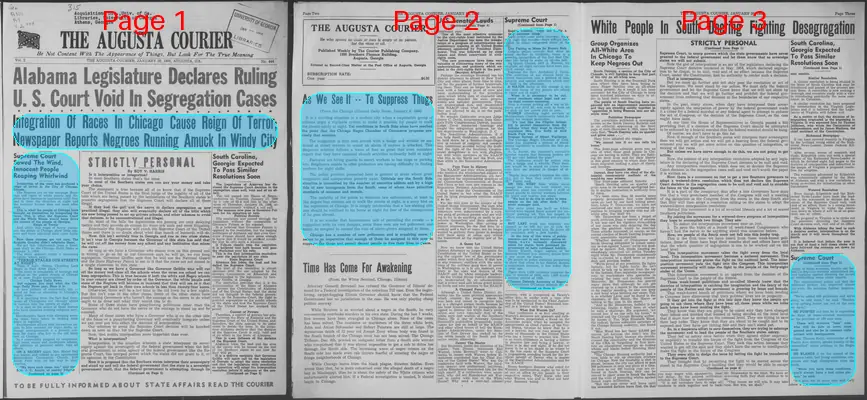
The Augusta Courier
Augusta, Richmond County, Georgia
What is this article about?
A 1956 article claims racial integration in Chicago has caused a 'reign of terror' with beatings, rapes, and fear in Negro areas, leading to closed churches and stores at night. Quotes Chicago Daily News on community fears, police challenges, and proposals for street vigilantes amid narcotics and immigration issues.
Merged-components note: This is a continued story across pages about the reign of terror due to integration in Chicago, quoting the Chicago Daily News; the page 2 part was mislabeled as editorial but is part of the narrative report.
Clippings
1 of 3
OCR Quality
Full Text
Supreme Court Sowed the Wind,
Innocent People Reaping Whirlwind
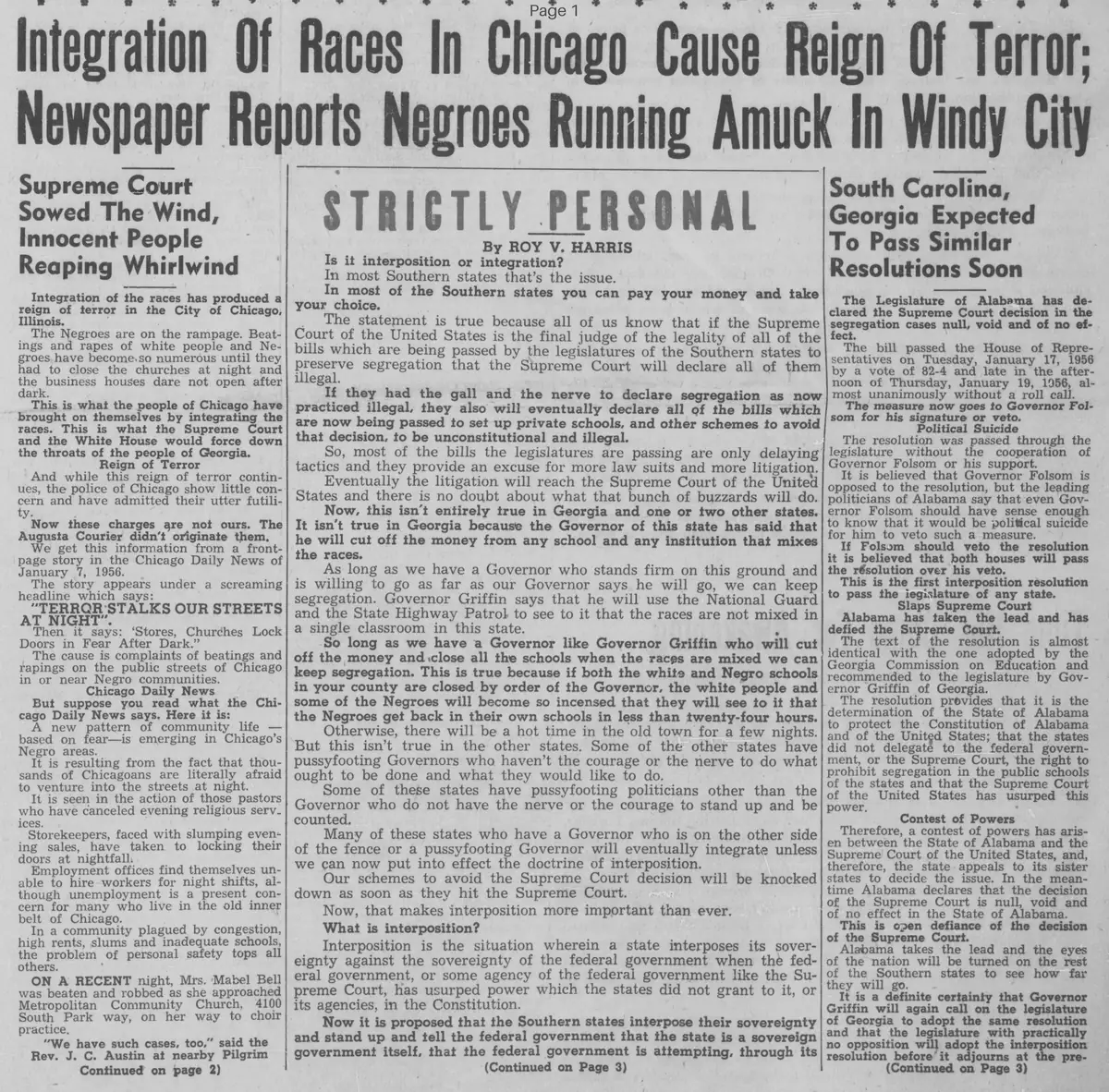
Integration of the races has produced a reign of terror in the City of Chicago, Illinois.
The Negroes are on the rampage. Beat-
ings and rapes of white people and Ne-
groes have become so numerous until they had to close the churches at night and the business houses dare not open after dark.
This is what the people of Chicago have brought on themselves by integrating the races. This is what the Supreme Court and the White House would force down the throats of the people of Georgia.
Reign of Terror
And while this reign of terror contin-
ues, the police of Chicago show little con-
cern and have admitted their utter futili-
ty.
Now these charges are not ours. The Augusta Courier didn't originate them. We get this information from a front-
page story in the Chicago Daily News of January 7, 1956.
The story appears under a screaming headline which says:
"TERROR STALKS OUR STREETS AT NIGHT".
Then it says: "Stores, Churches Lock Doors in Fear After Dark."
The cause is complaints of beatings and rapings on the public streets of Chicago in or near Negro communities.
Chicago Daily News
But suppose you read what the Chi-
cago Daily News says. Here it is:
A new pattern of community life based on fear--is emerging in Chicago's Negro areas.
It is resulting from the fact that thou-
sands of Chicagoans are literally afraid to venture into the streets at night.
It is seen in the action of those pastors who have canceled evening religious serv-
ices.
Storekeepers, faced with slumping even-
ing sales, have taken to locking their doors at nightfall.
Employment offices find themselves un-
able to hire workers for night shifts, al-
though unemployment is a present con-
cern for many who live in the old inner belt of Chicago.
In a community plagued by congestion, high rents, slums and inadequate schools, the problem of personal safety tops all others.
ON A RECENT night, Mrs. Mabel Bell was beaten and robbed as she approached Metropolitan Community Church, 4100 South Park way, on her way to choir practice.
"We have such cases, too," said the Rev. J. C. Austin at nearby Pilgrim
Continued on page 2
As We See It -- To Suppress Thugs
(From the Chicago (Illinois) Daily News, January 9, 1956)
It is a startling situation in a modern city when a responsible group of citizens urges a vigilante system to make it possible for people to walk the streets safely at night. Yet conditions in South Side areas have reached the point that the Chicago Negro Chamber of Commerce proposes precisely that solution.
The suggestion is that men armed with a badge and whistle be stationed at street corners to sound an alarm if anyone is attacked. This desperate solution follows a wave of fear so great that even ministers report that they have canceled church activities ordinarily held at night.
Factories are hiring guards to escort workers to bus stops or parking lots. Employers unable to offer protection are having difficulty in finding workers for night shifts.
The police problem presented here is general in areas where great congestion and comparative poverty exist. Officials say the South Side situation is intensified by the number of narcotics addicts and by a high tide of new immigrants from the South, some of whom have primitive standards of manners and morals.
The inability of the police to maintain law enforcement, at least to the degree that citizens are to walk the streets at night, is a sorry blot on the reputation of Chicago. It is simply intolerable that a law-abiding citizen should be confined to his home at night for fear of the consequences if he goes abroad.
It is no wonder that businessmen talk of patrolling the streets — a suggestion with its own dangers, since these men are not policemen and might be tempted to exceed the role of alarm-givers assigned to them.
Chicago has a number of new policemen and is acquiring more. It seems to us imperative that enough of them be assigned to this area to suppress the thugs and permit decent people to live their lives in peace.
Baptist Church. "They are really a very common thing."
Such crime and petty thievery, burglary, rape and murder—have always been higher in older, congested areas of the city.
City Failing to Make Its Streets Safe
Despite police records that show an actual decline in incidents, there is a growing recognition of the fact that Chicago has failed to make its streets safe.
At Quinn Chapel, 2401 S. Wabash, for example, all night services have been canceled except one.
Explains the Rev. Archibald J. Carey, "The activities of our church have resolved themselves into a pattern of teas, concerts and special activities which may be held in the afternoon.
A MAJOR factor in this change is the fact that many of our people are afraid to come out at night."
When it is necessary to be out, many residents adopt legal and extra-legal counter-measures.
Thus a woman getting off a bus at Indiana and 33rd St. was seen to tuck an ice pick up her sleeve just in case.
WOMEN attending night services at Metropolitan Church customarily band together for mutual protection.
"It's just like the Pilgrim fathers did to protect themselves from the Indians when they went to church," explained Mrs. Eva Scott of 4510 South Parkway.
Propose System of Street Vigilantes
The Chicago Negro Chamber of Commerce has proposed a system of street-corner vigilantes to reinforce the thin police lines.
A. L. Foster, the chamber's executive director reports that business leaders are "100 per cent behind the plan."
The vigilantes would be armed only with a badge and a whistle. Their function would be to sound an alarm whenever they see anyone in danger of attack.
"Maybe they couldn't capture the criminal, but at least they could scare him off," Foster said.
ON THE WEST Side, where social change has been the most violent, one industrial plant has recruited a staff of armed guards to convoy workers between the plant and nearby bus stops.
"We had to do this in order to keep people on the job after dark," the plant manager said.
The same plant has built an 8-foot, barbed-wire-topped fence around the employees' parking lot. This has helped to reduce complaints of pilfered and stripped cars.
BUT LAST week one employee was jumped as he left his car to lock the parking lot gate behind him. He drove off his assailants with a jack handle.
In the face of this wave of public concern—not to say terror—police officials have variously disavowed cause for alarm, have promised improvement or have confessed futility.
Kinzie Blueitt, Negro captain of the teeming Wabash Ave. district, denies there is any cause for alarm.
He points to police statistics purporting to show that crime in his district, despite a population increase, is less today than a year ago.
There were 1,638 incidents reported the first 11 months of 1954; only 1,602 during a similar period of 1955.
O'Connor Defends Accuracy of Reports
Commissioner O'Connor defends the accuracy of the reports.
(Continued on Page 3)
Supreme Court
(Continued from Page 2)
accuracy of these statistics, despite the fact that his deputies recently admonished district captains against cheating the record by withholding some crime reports.
The commissioner, points out that the statistical picture has improved almost city-wide. He promises further improvement.
"We've added 600 policemen and we're going to add more," he said. "Besides, we're getting better use out of the men we have."
HE POINTED out that he is expanding the force of three-wheeled motorcycles by the purchase of 100 new ones.
These will motorize "beat" men, who will be able to cover more ground and also be in constant radio contact with headquarters.
Capt. Thomas Kelly, commander of the Prairie Ave. district, speaks frankly of the 'intensified" crime problem in the Negro areas.
HE BLAMES it on the spread of the narcotics habit, bad living conditions, congestion and high immigration from the South.
"When you have these conditions, you'll always have a bad crime picture," he said.
"But give me 50 more men and we'll show a big improvement."
What sub-type of article is it?
What themes does it cover?
What keywords are associated?
What entities or persons were involved?
Where did it happen?
Story Details
Key Persons
Location
Chicago, Illinois, South Side Negro Areas
Event Date
January 7, 1956
Story Details
Racial integration in Chicago leads to widespread fear of nighttime crime including beatings and rapes in Negro communities, resulting in canceled evening church services, locked stores, hiring difficulties for night shifts, and proposals for street vigilantes by the Negro Chamber of Commerce. Police cite narcotics, immigration, and congestion as factors, promising more officers despite declining statistics.