Thank you for visiting SNEWPapers!
Sign up free
Portland Gazette, And Maine Advertiser
Portland, Cumberland County, Maine
What is this article about?
The Massachusetts House of Representatives responds to the Governor's speech on June 15, 1810, expressing support for his principles and discussing topics like religion, education, agriculture, commerce, judiciary, and militia. The session proceeds with debates and passage of bills on constitutional amendments, bank regulations, elections, and infrastructure until adjournment on June 20.
Merged-components note: Merged adjacent components with sequential reading order and overlapping text content that form a single coherent report on the Massachusetts Legislature proceedings.
Clipping
OCR Quality
Full Text
HOUSE OF REPRESENTATIVES,
THURSDAY, JUNE 15.
ANSWER OF THE HOUSE TO THE GOVERNOR'S SPEECH.
MAY IT PLEASE YOUR EXCELLENCY:
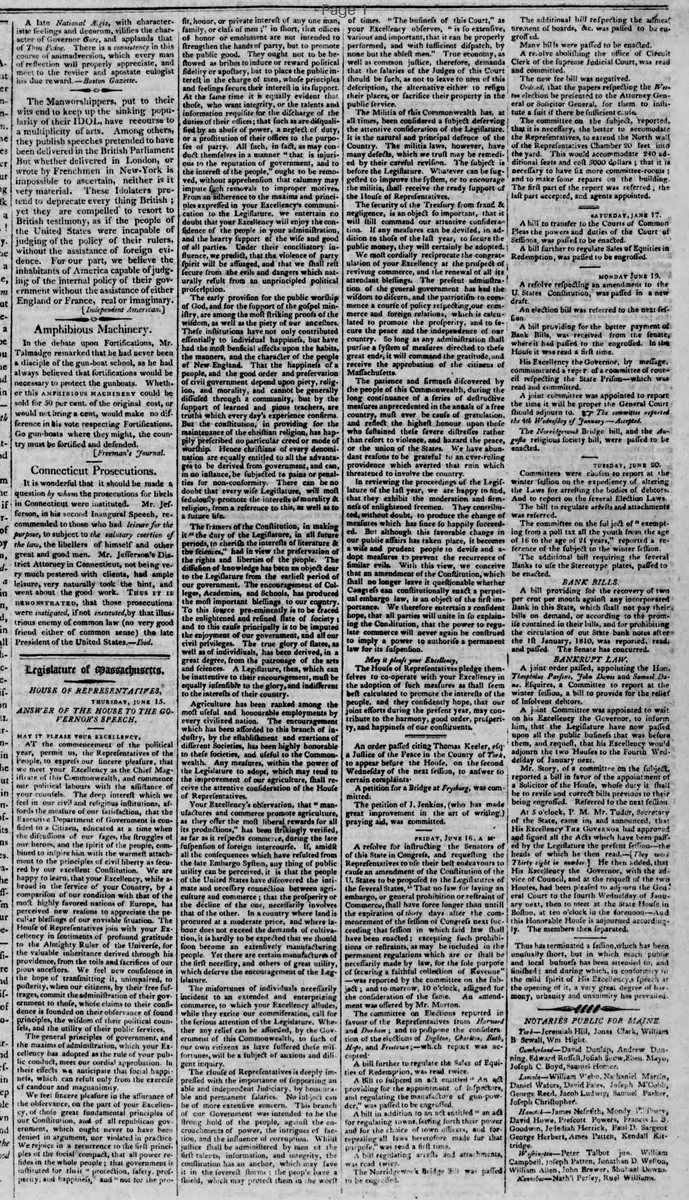
At the commencement of the political year, permit us, the Representatives of the People, to express our sincere pleasure, that we meet your Excellency as the Chief Magistrate of this Commonwealth, and commence our political labours with the assistance of your counsels. The deep interest which we feel in our civil and religious institutions, affords the measure of our satisfaction, that the Executive Department of Government is confided to a Citizen, educated at a time when the delusions of our sages, the struggles of our heroes, and the spirit of the people, combined to inspire him with the warmest attachment to the principles of civil liberty as secured by our excellent Constitution. We are happy to learn, that your Excellency, while abroad in the service of your Country, by a comparison of our condition with that of the most highly favored nations of Europe, has perceived new reasons to appreciate the peculiar blessings of our enviable situation. The House of Representatives join with your Excellency in sentiments of profound gratitude to the Almighty Ruler of the Universe, for the valuable inheritance derived through his providence, from the toils and sacrifices of our pious ancestors. We feel new confidence in the hope of transmitting it, unimpaired, to posterity, when our citizens, by their free suffrages, commit the administration of their government to those, whose claims to their confidence is founded on their observance of sound principles, the wisdom of their political counsels, and the utility of their public services.
The general principles of government, and the maxims of administration, which your Excellency has adopted as the rule of your public conduct, meet our cordial approbation. In their effects we anticipate that social happiness, which can result only from the exercise of candour and magnanimity.
We feel sincere pleasure in the assurance of the observance, on the part of your Excellency, of those great fundamental principles of our Constitution, and of all republican government, which ought never to have been denied in argument, nor violated in practice. We rejoice in a recurrence to the first principles of the social compact, that all power resides in the whole people; that government is instituted for their "protection, safety, prosperity, and happiness" and "not for the profit, honor, or private interest of any one man, family, or class of men;" in short, that offices of honor or emolument are not intended to strengthen the hands of party, but to promote the public good. They ought not to be bestowed as bribes to induce or reward political fidelity or apostasy, but to place the public interest in the charge of men, whose principles and feelings secure their interest in its support. At the same time it is equally evident that those, who want integrity, or the talents and information requisite for the discharge of the duties of their offices; that such as are disqualified by an abuse of power, a neglect of duty, or a prostitution of their offices to the purposes of party. All such, in fact, as may conduct themselves in a manner "that is injurious to the reputation of government, and to the interest of the people," ought to be removed, without apprehension that calumny may impute such removals to improper motives.
From an adherence to the maxims and principles expressed in your Excellency's communication to the Legislature, we entertain no doubt that your Excellency will enjoy the confidence of the people in your administration, and the hearty support of the wise and good of all parties. Under their conciliatory influence, we predict, that the violence of party spirit will be assuaged, and that we shall rest secure from the evils and dangers which naturally result from an unprincipled political proscription.
The early provision for the public worship of God, and for the support of the gospel ministry, are among the most striking proofs of the wisdom, as well as the piety of our ancestors. These institutions have not only contributed essentially to individual happiness, but have had the most beneficial effects upon the habits, the manners, and the character of the people of New-England. That the happiness of a people, and the good order and preservation of civil government depend upon piety, religion, and morality, and cannot be generally diffused through a community, but by the support of learned and pious teachers, are truths which every day's experience confirms. But the constitution, in providing for the maintenance of the christian religion, has happily prescribed no particular creed or mode of worship. Hence christians of every denomination are equally entitled to all the advantages to be derived from government, and can, in no instance, be subjected to pains or penalties for non-conformity. There can be no doubt that every wise Legislature, will most sedulously promote the interests of morality & religion, from a reference to this, as well as to a future life.
The framers of the Constitution, in making it "the duty of the Legislature, in all future periods, to cherish the interests of literature & the sciences," had in view the preservation of the rights and liberties of the people. The diffusion of knowledge has been an object dear to the Legislature from the earliest period of our government. The encouragement of Colleges, Academies, and Schools, has produced the most important blessings to our country. To this source pre-eminently is to be traced the enlightened and refined state of society and to this cause principally is to be imputed the enjoyment of our government, and all our civil privileges. The true glory of states, as well as of individuals, has been derived, in a great degree, from the patronage of the arts and sciences. A Legislature, then, which can be inattentive to their encouragement, must be equally insensible to the glory, and indifferent to the interests of their country.
Agriculture has been ranked among the most useful and honourable employments by every civilized nation. The encouragement which has been afforded to this branch of industry, by the establishment and exertions of different Societies, has been highly honorable to these societies, and useful to the Commonwealth. Any measures, within the power of the Legislature to adopt, which may tend to the improvement of our agriculture, shall receive the attentive consideration of the House of Representatives.
Your Excellency's observation, that "manufactures and commerce promote agriculture, as they offer the most liberal rewards for all its productions," has been strikingly verified, as far as it respects commerce, during the late suspension of foreign intercourse. If, amidst all the consequences which have resulted from the late Embargo System, any thing of public utility can be perceived, it is that the people of the United States have discovered the intimate and necessary connection between agriculture and commerce; that the prosperity or the decline of the one, necessarily involves that of the other. In a country where land is procured at a moderate price, and where labour does not exceed the demands of cultivation, it is hardly to be expected that we should soon become an extensively manufacturing people. Yet there are certain manufactures of the first necessity, and others of great utility, which deserve the encouragement of the Legislature.
The misfortunes of individuals necessarily incident to an extended and enterprizing commerce, to which your Excellency alludes, while they excite our commiseration, call for the serious attention of the Legislature. Whether any relief can be afforded, by the Government of this Commonwealth, to such of our own citizens as have suffered these misfortunes, will be a subject of anxious and diligent inquiry.
The House of Representatives is deeply impressed with the importance of supporting an able and independent Judiciary, by honourable and permanent salaries. No subject can be of more extensive concern. This branch of our Government was intended to be the strong hold of the people, against the encroachments of power, the intrigues of faction, and the influence of corruption. Whilst justice shall be administered by men of the first talents, information, and integrity, the constitution has an anchor, which may save it in the severest storms; the people have a shield, which may protect them in the worst of times.
"The business of this Court," as your Excellency observes, "is so extensive, various and important, that it can be properly performed, and with sufficient dispatch, by none but the ablest men." True economy, as well as common justice, therefore, demands that the salaries of the Judges of this Court should be such, as not to leave to men of this description, the alternative either to resign their places, or sacrifice their property in the public service.
The Militia of this Commonwealth has, at all times, been considered a subject deserving the attentive consideration of the Legislature. It is the natural and principal defence of the Country. The militia laws, however, have many defects, which we trust may be remedied by their careful revision. The subject is before the Legislature. Whatever can be suggested to improve the system, or to encourage the militia, shall receive the ready support of the House of Representatives.
The security of the Treasury from fraud & negligence, is an object so important, that it will still command our attentive consideration. If any measures can be devised, in addition to those of the last year, to secure the public money, they will certainly be adopted.
We most cordially reciprocate the congratulation of your Excellency at the prospect of reviving commerce, and the renewal of all its attendant blessings. The present administration of the general government has had the wisdom to discern, and the patriotism to commence a course of policy respecting our commerce and foreign relations, which is calculated to promote the prosperity, and to secure the peace and the independence of our country. So long as any administration shall pursue a system of measures directed to these great ends, it will command the gratitude, and receive the approbation of the citizens of Massachusetts.
The patience and firmness discovered by the people of this Commonwealth, during the long continuance of a series of destructive measures unprecedented in the annals of a free country, must ever be cause of gratulation, and reflect the highest honour upon those who sustained these severe distresses rather than resort to violence, and hazard the peace, or the union of the States. We have abundant reasons to be grateful to an over-ruling providence which averted that ruin which threatened to involve the country.
In reviewing the proceedings of the Legislature of the last year, we are happy to find, that they exhibit the moderation and firmness of enlightened freemen. They contributed, without doubt, to produce the change of measures which has since so happily succeeded. But although this favorable change in our public affairs has taken place, it becomes a wise and prudent people to devise and adopt measures to prevent the recurrence of similar evils. With this view, we conceive that an amendment of the Constitution, which shall no longer leave it questionable whether Congress can constitutionally enact a perpetual embargo law, is an object of the first importance. We therefore entertain a confident hope, that all parties will unite in so explaining the Constitution, that the power to regulate commerce will never again be construed to imply a power to authorize a permanent law for its suspension.
May it please your Excellency,
The House of Representatives pledge themselves to co-operate with your Excellency in the adoption of such measures as shall seem best calculated to promote the interests of the people, and they confidently hope, that our joint efforts during the present year, may contribute to the harmony, good order, prosperity, and happiness of our constituents.
FRIDAY, JUNE 16, A.M.
A resolve for instructing the Senators of this State in Congress, and requesting the Representatives to use their best endeavours to cause an amendment of the Constitution of the U. States to be proposed to the Legislatures of the several States, "That no law for laying an embargo, or general prohibition or restraint of Commerce, shall have force longer than until the expiration of thirty days after the commencement of the session of Congress next succeeding that session in which said law shall have been enacted; excepting such prohibitions or restraints, as may be included in the permanent regulations which are or shall be necessarily made by law, for the sole purpose of securing a faithful collection of Revenue"—was reported by the committee on the subject; and to-morrow, 10 o'clock, assigned for the consideration of the same. An amendment was offered by Mr. Morton.
The committee on Elections reported in favour of the Representatives from Harvard and Durham; and to postpone the consideration of the elections of Dighton, Charlestown, Bath, Hope, and Freetown;—which report was accepted.
A bill further to regulate the Sales of Equities of Redemption, was read twice.
A Bill to suspend an act entitled "An act providing for the appointment of Inspectors, and regulating the manufacture of gun-powder," was passed to be engrossed.
A bill in addition to an act entitled "an act for regulating towns, setting forth their powers and for the choice of town officers, and for repealing all laws heretofore made for that purpose," was read a first time.
A bill regulating arrests and attachments, was read twice.
The Norridgewock Bridge Bill was passed to be engrossed.
The additional bill respecting the admeasurement of boards, &c. was passed to be engrossed.
Many bills were passed to be enacted.
A resolve abolishing the office of Circuit Clerk of the Supreme Judicial Court, was read and committed.
The new fee bill was negatived.
Ordered, that the papers respecting the Weston election be presented to the Attorney General or Solicitor General, for them to institute a suit if there be sufficient cause.
The committee on the subject, reported, that it is necessary, the better to accommodate the Representatives, to extend the North wall of the Representatives Chamber 20 feet into the yard. This would accommodate 240 additional seats and cost 5000 dollars; that it is necessary to have six more committee-rooms; and to make some repairs on the building. The first part of the report was referred; the last part accepted, and agents appointed.
MONDAY JUNE 19.
A resolve respecting an amendment to the U. States Constitution, was passed in a new draft.
An election bill was referred to the next session.
A bill providing for the better payment of Bank Bills, was received from the senate, wherein it had passed to the engrossed. In the House it was read a first time.
His Excellency the Governor, by message, communicated a report of a committee of council respecting the State Prison—which was read and committed.
A joint committee was appointed to report the time it will be proper the General Court should adjourn to. The committee reported the 4th Wednesday of January.—Accepted.
The Norridgewock Bridge bill, and the Augusta religious society bill, were passed to be enacted.
TUESDAY, JUNE 20.
Committees were chosen to report at the winter session on the expediency of altering the Laws for arresting the bodies of debtors. And to report on the several Election Laws.
The bill to regulate arrests and attachments was referred.
The committee on the subject of "exempting from a poll tax all the youth from the age of 16 to the age of 21 years," reported a reference of the subject to the winter session.
The additional bill requiring the several Banks to use the Stereotype plates, passed to be enacted.
BANK BILLS.
A bill providing for the recovery of two per cent per month against any incorporated Bank in this State, which shall not pay their bills on demand, or according to the promise contained in their bills, and for prohibiting the circulation of out State bank notes after the 1st January, 1810, was reported, read; and passed. The Senate has concurred.
BANKRUPT LAW.
A joint order passed, appointing the Hon. Theophilus Parsons, John Davis and Samuel Dana, Esquires, a Committee to report at the winter session, a bill to provide for the relief of Insolvent debtors.
A joint Committee was appointed to wait on his Excellency the Governor, to inform him, that the Legislature have now passed upon all the public business that was before them, and request, that his Excellency would adjourn the two Houses to the Fourth Wednesday of January next.
Mr. Story, of a committee on the subject, reported a bill in favor of the appointment of a Solicitor of the House, whose duty it shall be to revise and correct bills previous to their being engrossed. Referred to the next session.
At 5 o'clock, P. M. Mr. Tudor, Secretary of the State, came in and announced, that His Excellency the Governor had approved and signed all the Acts which have been passed by the Legislature the present session—the heads of which he then read.—They were Thirty eight in number. He then added, that His Excellency the Governor, with the advice of Council, and at the request of the two Houses, had been pleased to adjourn the General Court to the fourth Wednesday of January next, then to meet at the State House in Boston, at ten o'clock in the forenoon—And this Honorable House is adjourned accordingly. The members then Separated.
Thus has terminated a session, which has been unusually short, but in which much public and local business has been attended to, and finished; and during which, in conformity to the mild spirit of His Excellency's speech at the opening of it, a very great degree of harmony, urbanity and unanimity has prevailed.
SATURDAY, JUNE 17.
A bill to transfer to the Courts of Common Pleas the powers and duties of the Court of Sessions, was passed to be enacted.
A bill further to regulate Sales of Equities in Redemption, was passed to be engrossed.
What sub-type of article is it?
What keywords are associated?
What entities or persons were involved?
Where did it happen?
Domestic News Details
Primary Location
Boston, Massachusetts
Event Date
June 15 20, 1810
Key Persons
Outcome
session adjourned to january 1811; 38 acts approved and signed; bills passed on bank regulations, constitutional amendments, elections, bridges, and judiciary; committees appointed for future reports.
Event Details
The House of Representatives delivers a formal response to the Governor's speech, endorsing principles of government, religion, education, agriculture, commerce, judiciary, and militia. Proceedings include debates on constitutional amendments limiting embargo powers, election reports, bill readings and passages on gunpowder, towns, arrests, bridges, boards, fees, and bank bills prohibiting out-of-state notes after January 1, 1810. Committees formed for insolvent debtors relief and infrastructure improvements.